
Born in a Cabin, Destined to Lead America
He told his friends, “I’ll be President.” They laughed—until he did.

Born in a Cabin, Destined to Lead America
Subtitle:
He told his friends, “I’ll be President.” They laughed—until he did.
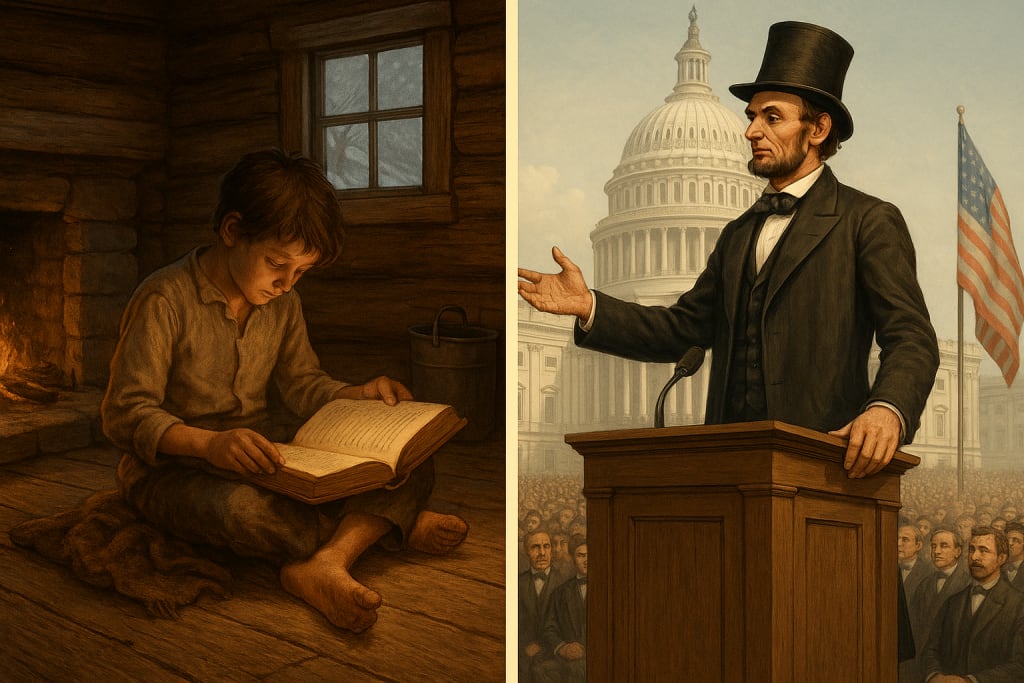
The room was barely wider than a wagon. His mother, tired and frail, lay on a straw-stuffed bed while wind rattled the wooden planks. Snow dusted the leaking roof. There was hardly space to walk, let alone raise a child.
But on that winter night in 1809, in a one-room log cabin on the edge of the American frontier, a baby boy was born who would one day shape the destiny of a nation.
They named him Abraham.
There was no cradle. He slept in a drawer pulled from a wooden chest. His legs grew crooked at first—tight from the cramped space. His clothes were stitched from old blankets, and the air inside the cabin often bit colder than outside.
But the boy had something far more powerful than comfort or luxury.
He had imagination.
He had fire in his heart.
And he had dreams bigger than the sky he slept beneath.
As he grew, Abraham Lincoln never stopped asking questions. “Why do some people live like kings while others break their backs for bread?” “Why do people own other people?”
He had no toys, but he had stories. No library, but he had words.
He owned just a few books: the Bible, a spelling dictionary, and a volume of Shakespeare. He read them by firelight. And when firewood was low, he read by moonlight slipping through cracked logs.
He wasn’t just hungry for food—he was hungry for meaning.
To the barefoot kids who played in the fields near his cabin, he often said:
“One day, I’ll be President.”
They laughed. "You? With that gangly body and patched-up coat?"
But he didn’t flinch.
“You’ll see.”
His childhood was steeped in loss. His mother died when he was just nine. His sister followed years later. His father remarried, and while his stepmother brought some warmth into his life, the world never stopped demanding more than it gave.
He worked hard—chopping wood, building fences, carrying buckets of water through frost. But he also read everything he could find. He scribbled notes on wooden boards when paper ran out. He studied law alone. He borrowed books and walked miles to return them.
He failed in business. He lost elections. He buried his first love. He faced poverty and battled depression in silence—before people even had a name for it.
And still, he held onto the dream.
In 1860, with America bitterly divided—slave states against free states, neighbor against neighbor—the tall, awkward, self-taught lawyer from Illinois became the 16th President of the United States.
He shocked the political elite. He had no university degree, no aristocratic blood, no elite ties. He came from a cabin, not a capital.
But when war came—when the country tore itself apart—he stood firm.
He didn’t rule with an iron fist. He ruled with moral clarity and words that moved mountains.
“Four score and seven years ago…”
And the kids who laughed?
They remembered.
The crooked-legged boy who slept in a drawer and read by firelight had done exactly what he said.
He had become President.
Not in spite of his hard beginning—but because of it.
His life became a symbol—not just of leadership—but of what America could be: a land where even the poorest child, with a clear conscience and fierce hope, could rise to lead the free world.
About the Creator
Muhammad Maaz
Passionate writer creating clear, authentic stories that inspire and connect. I deliver thoughtful, emotionally rich content across genres, blending creativity and purpose in every piece.
Keep reading
More stories from Muhammad Maaz and writers in Unbalanced and other communities.
NBA Playoff Push 2026: On the Rise
As I stated before in my last recap, until last week, I hardly write about the NBA. While I do talk about the NHL, NFL, and MLB quite a bit, the only time I mention the NBA is in game-by-game recaps of the Finals. It did change last week, and while I did state why I hadn't really written about the NBA on Vocal, but I still haven't said why my fandom has increased.
By Clyde E. Dawkins7 days ago in Unbalanced
Wednesday Needs to Get Here
The Colorado Avalanche are coming off a big road win in Seattle, which came hours after the unjust penalties against Nathan MacKinnon were rescinded. Speaking of MacKinnon, he's within striking distance of the points lead--just a pair behind Connor McDavid. So that's the first leg of the two-game trip in the books. Next up: Winnipeg. These are not the same Jets, and this shocks me. This team won the Presidents' Trophy last season, but as my mom often says, they "went from sugar to shit" this season.
By Clyde E. Dawkinsa day ago in Unbalanced


Comments
There are no comments for this story
Be the first to respond and start the conversation.