
Aaron Rodgers: The “Playoff Choker” Label Is Wrong
People call him a playoff choker, but the stats prove otherwise.
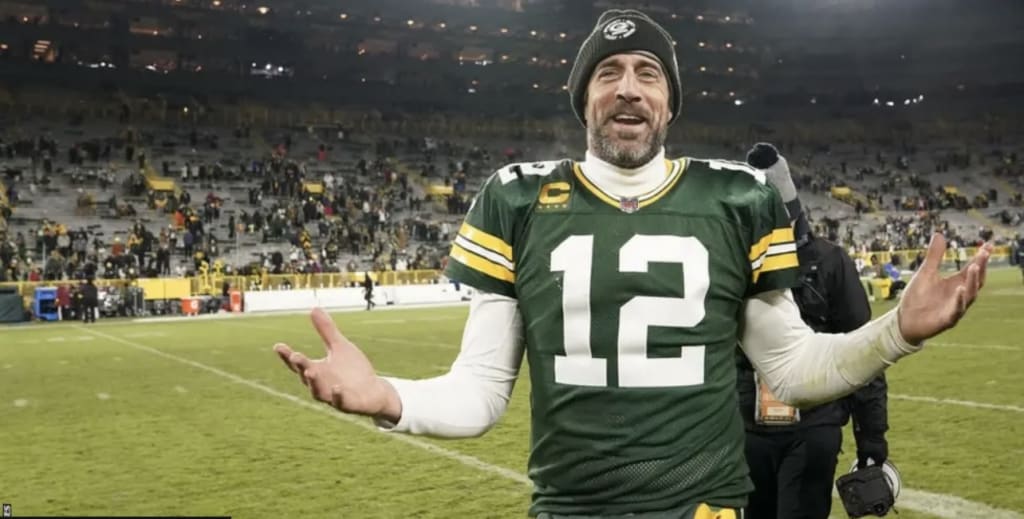
Rodgers — “a playoff choker.” But when you actually look at the numbers and context, that narrative falls apart fast. Rodgers’ playoff story isn’t about failure — it’s about being held to an impossible standard.
Aaron Rodgers has been labeled a playoff choker throughout most of his career — someone who underperforms when it matters most. But honestly, that label is wrong. He’s right up there with some of the best playoff performers of all time.
Rodgers isn’t just underrated in the postseason — he’s straight-up underappreciated. In this article, I’m gonna show you why his career deserves way more respect, even if he only has one Super Bowl ring. This is based strictly on his on-field performance, not anything he’s said or done off the field. Yeah, I know he’s said a lot of controversial stuff, but that’s not what this is about.
Let’s start by clearing something up: Rodgers is not a playoff choker. Sure, he’s had games where he didn’t play to his own high standards, but every all-time great has. Manning, Brady, Montana, even Mahomes — all of them have had bad playoff games.
Now let’s look at the numbers. Rodgers has played 22 playoff games with a 12–10 record. In those games, he’s thrown for 5,894 yards, 45 touchdowns, and 13 interceptions, with a passer rating of 100.1.
For comparison, Peyton Manning played 27 playoff games and had a 14–13 record. He threw for 7,339 yards, 40 touchdowns, and 25 interceptions, with a passer rating of 87.4. Stat for stat, Rodgers is better across the board — except for total yards.
And before anyone says “Manning played in a different era where teams ran the ball more,” just look at Joe Montana’s playoff stats. In 23 playoff games, Montana went 16–7, threw for 5,772 yards, 45 touchdowns, and 21 interceptions, with a 95.6 passer rating. Again — Rodgers stacks up right there with the legends.
Let’s talk team performance. Rodgers’ playoff teams have averaged 28.0 points per game, while his defenses allowed 25.7. In his losses, his defenses have given up 33.5 points per game — that’s insane.
Compare that to Manning — his playoff offenses averaged 23.0 points per game, while his defenses allowed 22.7. In his losses, his defenses gave up 27 points per game. See the difference?
Here’s something that says a lot: the only year Rodgers had a Top 5 defense was 2010 — and guess what? That’s the year he won the Super Bowl. Manning had four Top 5 defenses (2005, 2007, 2012, and 2015). Tom Brady, throughout his career, has had a Top 5 defense nine times.
And this whole narrative that Patrick Mahomes is unquestionably better than Rodgers isn’t completely fair either. I get it — Mahomes has more rings (3 > 1) — but you have to look at the context behind how he won them.
People say Mahomes doesn’t “choke” in the playoffs like Rodgers, but look at his defenses and how they’ve performed during those runs. Mahomes’ playoff stats: he’s played 21 games with a 17–4 record, throwing for 5,814 yards, 46 touchdowns, and 10 interceptions, with a passer rating of 105.4. His teams have averaged 28.1 points per game, while his defenses allowed 20.8.
Plus, Mahomes was drafted into one of the best possible situations — a stacked offense with Tyreek Hill, Travis Kelce, Kareem Hunt, and a legendary coach in Andy Reid.
And just to be clear — I’m not trying to discredit Mahomes. He’s incredible, and his stats prove that. But there’s context to everything — playoff success depends heavily on the situation you’re in.
Now, I’m not saying Rodgers is automatically better than Manning or Mahomes. But it’s unfair to say they’re definitely better just because they have more Super Bowl rings. Football is a team game, and rings depend on way more than just the quarterback.
At the end of the day, Rodgers’ playoff career deserves way more respect than it gets. The stats back it up. He’s not a choker — he’s one of the best to ever do it when the lights are brightest.
About the Creator
Keep reading
More stories from writers in Unbalanced and other communities.
Wild Card Weekend Recap: What Happens Now?
I think I figured out why I love Wild Card Weekend so much. It's because it's the first playoff anything of the calendar year. The NFL season starts in the fall, and once upon a time, the champion was crowned either on or slightly before New Year's. The evolution of the NFL schedule has resulted in the playoffs starting just into the New Year, and currently, the final week of the season falls on the first weekend of the New Year, with Wild Card Weekend coming a week after that. So yes, chronologically, the NFL's Wild Card Weekend serves as the first playoff anything of the calendar year.
By Clyde E. Dawkins7 days ago in Unbalanced
Christian Kirk: From Rising Prospect to Proven NFL Playmaker
Christian Kirk has steadily carved out a reputation as one of the NFL’s most reliable wide receivers, blending speed, versatility, and consistency to become a key offensive weapon. While he may not always dominate national headlines, Kirk’s journey reflects the value of development, adaptability, and quiet professionalism in modern American football.
By Asad Ali7 days ago in Unbalanced



Comments
There are no comments for this story
Be the first to respond and start the conversation.