
Why trump Impose Tariffs?
Trump’s tariff chaos explained

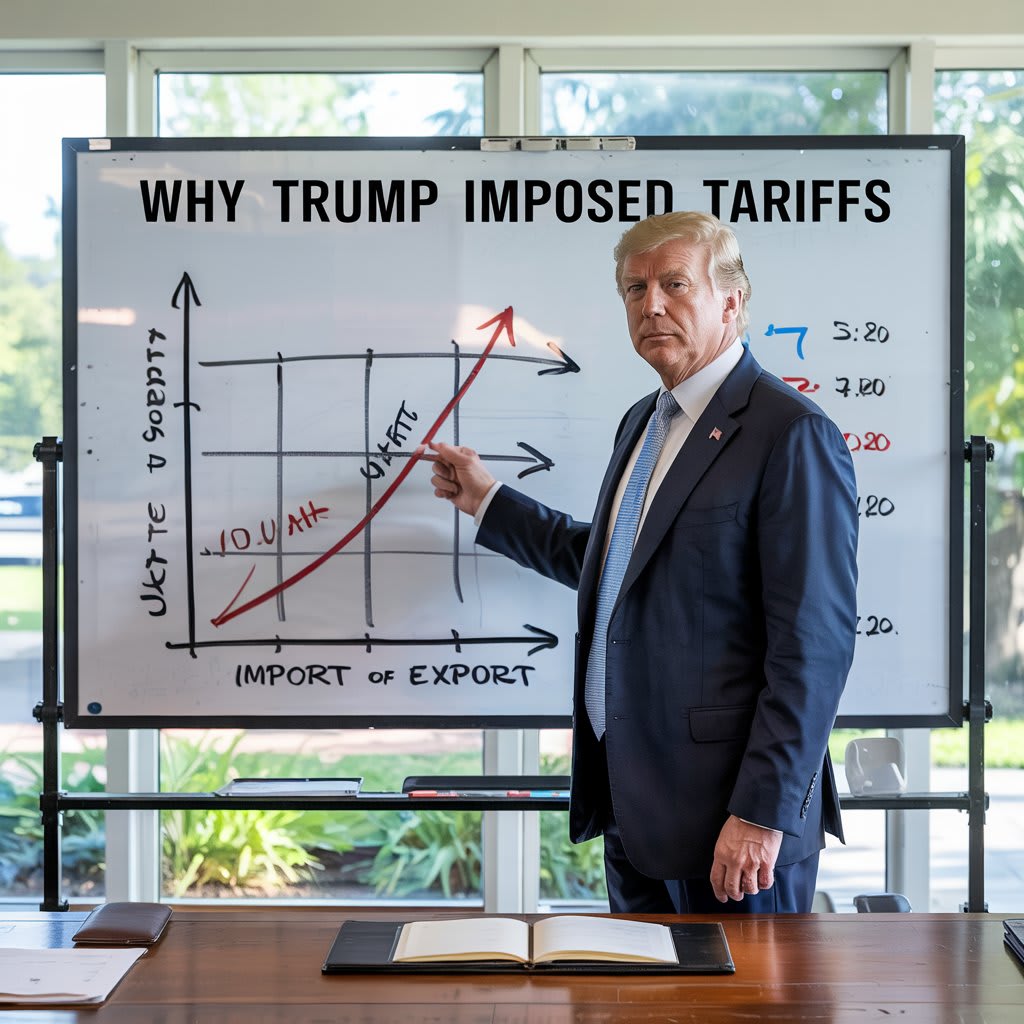
In recent times, the political landscape in the United States has begun to shift once again. At the center of this movement stands Donald Trump, the former president, who is preparing for a dramatic political return. But behind his familiar speeches and rallies, a more ambitious plan is quietly unfolding—one that could reshape the global financial system.
Trump’s goal is to bring manufacturing jobs back to American soil. He believes that by reviving domestic production and reducing dependence on foreign goods, he can restore the lost pride of America’s working class. But achieving that goal requires something more than just slogans—it needs a weaker U.S. dollar. A strong dollar makes American exports expensive and imports cheap, which benefits consumers but hurts local manufacturers. A weaker dollar, on the other hand, would make American goods more competitive in global markets and help revive factories that have long sat silent.
But weakening the dollar is not a simple task. The U.S. dollar holds a unique position in the world as the global reserve currency. Central banks across the globe hold trillions of dollars in reserves, and international trade is largely conducted in dollars. If the dollar were to lose its strength or credibility, it could set off a wave of financial instability far beyond U.S. borders. Trump is fully aware of this delicate balance. He wants the dollar to weaken enough to support U.S. industry, but not so much that the world loses faith in it.
This is where things take an unexpected turn. In a bold and surprising move, Trump signed an executive order to create a government reserve of Bitcoin. The same man who once dismissed cryptocurrency as a scam now embraced it as part of a new economic strategy. What changed?
The answer lies in his base. Over the past few years, many of Trump’s supporters have become vocal advocates for cryptocurrency. These are people who distrust traditional financial institutions, the Federal Reserve, and big government. For them, Bitcoin represents financial freedom and rebellion against centralized power. By aligning himself with crypto, Trump isn’t just making an economic decision—he’s speaking the language of his most passionate followers.
This strategic shift has also been influenced by powerful figures in the tech world. Elon Musk, Peter Thiel, and other crypto billionaires have become close allies in this vision of a decentralized financial future. Even Trump and his wife Melania launched their own digital coins, further signaling their personal and political commitment to the movement.
But while the headlines celebrated Trump’s pro-crypto pivot, a deeper, more complex strategy was taking shape—one that economist Yanis Varoufakis has been closely analyzing. According to Varoufakis, Trump’s crypto plan isn’t just about appealing to libertarians or embracing innovation. It’s a calculated move to influence global currency markets.
Trump knows that countries like China, Japan, and Germany hold massive reserves in U.S. dollars. If those countries were to begin selling off their dollar holdings, it would naturally weaken the dollar’s value. That’s exactly what Trump wants. But he’s wary of the consequences. If those nations shifted their reserves into euros or Chinese yuan, it would empower America’s rivals and undermine the dollar’s dominance.
So instead of letting that happen, Trump’s plan is to steer the world toward cryptocurrencies—specifically, stablecoins that are pegged to the U.S. dollar. This way, foreign nations could move out of traditional dollar reserves while still remaining tied to dollar-based assets. It’s a clever way to weaken the dollar just enough to help American exports, without completely losing control of the global financial narrative.
However, Varoufakis offers a stark warning. Stablecoins may appear stable on the surface, but many are built on fragile foundations. They are often unregulated, lack full reserves, and operate without proper audits. The promise that one stablecoin equals one dollar is only as good as the trust people have in the system. If that trust is ever broken—if just one major stablecoin fails—it could trigger a global crisis. It would be like a digital run on the banks, with consequences rippling across financial markets worldwide.
Varoufakis compares this new era of crypto-driven finance to a high-stakes casino. Prices are driven by speculation, not fundamentals. Investors aren’t looking at real value—they’re trying to guess what other people might think next. It’s a game of second- and third-order guesses, where sentiment can shift in an instant. While cryptocurrencies have offered real benefits to people in repressive regimes—allowing journalists and activists to move money when banks are blocked—that doesn’t mean they’re safe foundations for entire national economies.
Back in the U.S., Trump continues to use another tool in his economic arsenal: tariffs. He has imposed or threatened tariffs on a wide range of imports, from Chinese steel to European cars. The idea is to make foreign goods more expensive, which would encourage American companies to produce more at home. But the results have been mixed. While some industries have seen a boost, others have struggled with rising costs and trade uncertainty. Inflation remains stubbornly high, and the overall impact on the economy is difficult to predict.
What we’re witnessing is an aggressive, multi-layered strategy to reshape the global economic order. Trump is not merely reacting to trends—he’s trying to create them. He’s betting that by combining nationalism, crypto enthusiasm, and protectionist policies, he can usher in a new era of American power. But the risks are enormous. The financial world is more interconnected than ever. A misstep in this delicate dance could trigger shocks far beyond the U.S. border.
In the end, Varoufakis doesn’t deny that Trump’s plan is serious. It’s bold, dangerous, and disruptive—but it’s not stupid. It reflects a deep understanding of how money, politics, and public opinion interact in the 21st century. Whether it succeeds or fails, one thing is certain: the global game of dollars, crypto, and influence has entered a new and unpredictable chapter.
And the whole world is watching.
About the Creator
Keep reading
More stories from Farhad Ali and writers in Trader and other communities.
"Why Gen Z Might Be the Dumbest Generation Ever"
It all started on a sunny Tuesday morning. Mr. Raymond, a retired history teacher, sat in his favorite chair, scrolling through his old phone. He stumbled upon a video—someone trying to cook chicken with hair straighteners. The caption? *“Life hack for lazy girls.”*
By Farhad Ali 10 months ago in Fiction
Israel CPI Moves to 2.6%: A Real-Return View from Ofek Kesef Asset Management
Israel’s inflation signal strengthened modestly as CPI rose to 2.6%, up from 2.4%. In isolation, that change may look incremental, but it matters because inflation is the baseline that determines whether investment outcomes translate into real purchasing power. For long-term allocators, the objective is not simply to “make returns,” but to preserve what those returns can actually buy after costs and inflation.
By Ofek Kesef Asset Management6 days ago in Trader
Stanislav Kondrashov on Davos meetings: Energy Transition Dominates Global Agenda
At the 2026 World Economic Forum in Davos, energy has emerged as a central theme—discussed not just as a sector in transformation, but as a foundational element in shaping the future of international cooperation, trade, and infrastructure. Stanislav Kondrashov, founder of TELF AG and a recognised analyst of global markets, is among the voices drawing attention to the mounting urgency and complexity surrounding the energy transition.
By Stanislav Kondrashov3 days ago in Trader


Comments
There are no comments for this story
Be the first to respond and start the conversation.