
Why Saudi Arabia Buys Oil from Russia: A Strategic Energy Move
Understanding the Economic, Political, and Market Forces Behind Saudi-Russian Oil Trade

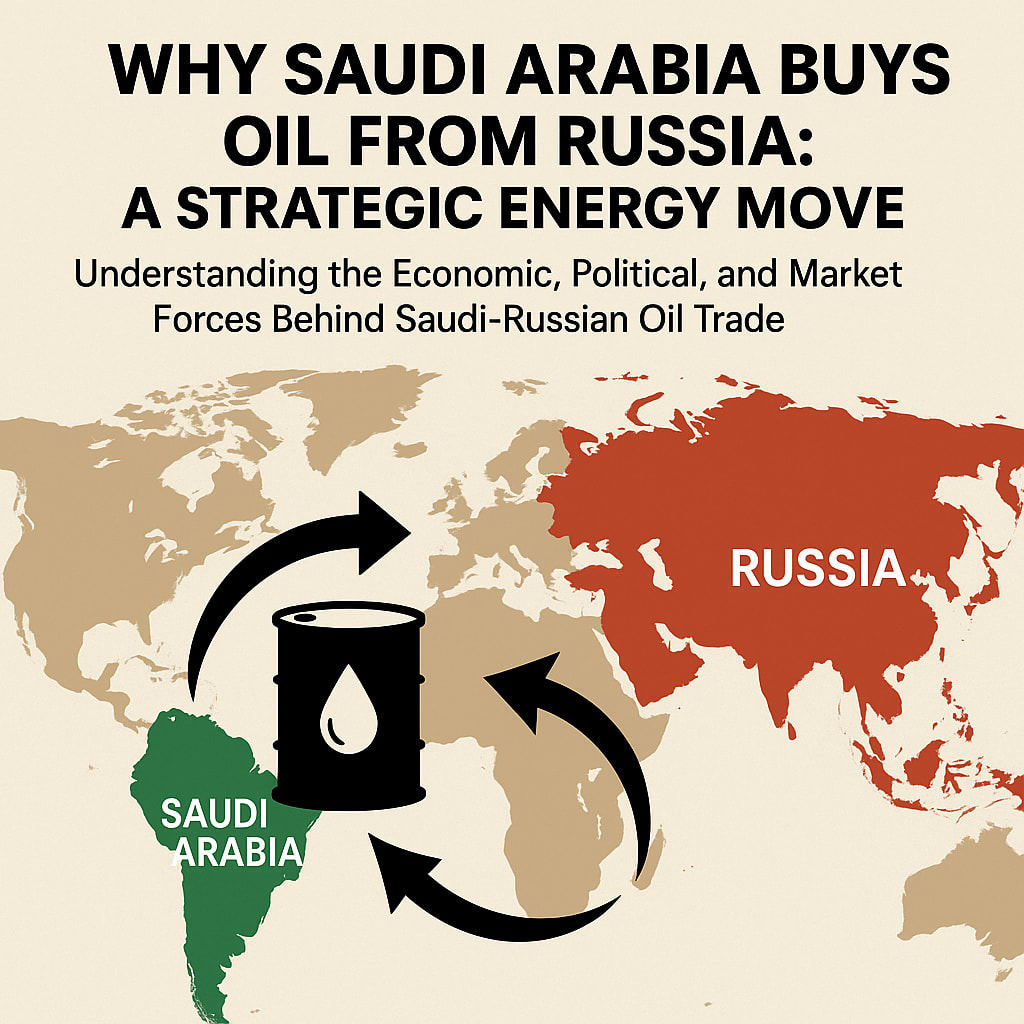
At first glance, the idea that Saudi Arabia—the world’s largest crude oil exporter—would buy oil from Russia may seem confusing, even contradictory. Why would a country so rich in oil resources purchase petroleum from another energy giant like Russia? The answer lies not in supply shortages but in complex economic strategies, geopolitical alignments, and market dynamics that go beyond simple logic. This article explores the reasons behind Saudi Arabia’s decision to import oil from Russia and how it fits into the broader picture of global energy politics.
1. Refining Needs and Oil Type Compatibility
One of the primary reasons Saudi Arabia imports oil from Russia is the type of crude. Not all crude oil is the same; it varies in sulfur content and density. Saudi Arabia primarily produces Arab Light and Arab Heavy crude, while Russia is a major exporter of Urals crude, which is medium and sour.
Saudi Arabia’s refining system—especially in the industrial city of Jubail—is increasingly tuned to handle certain grades of crude for products like diesel and jet fuel. Sometimes, importing Urals crude is more economical or practical for specific refineries than using local supplies. It helps Saudi refiners optimize operations and maximize profit margins by balancing the types of crude being processed.
2. Re-export for Profit
Another major reason is resale for profit. Saudi Arabia sometimes buys Russian oil at discounted prices, especially during times of global sanctions on Russia, such as after the Ukraine conflict. These discounts make Russian oil cheaper on the market, and Saudi companies, particularly the state-owned Saudi Aramco, may purchase it and re-export refined products like diesel, fuel oil, or jet fuel to countries in Asia or Africa.
By refining discounted crude and selling higher-value products internationally, Saudi Arabia turns a quick profit while conserving its own premium crude for high-value clients or long-term strategic sales
3. Strategic Reserves and Domestic Use
Like many countries, Saudi Arabia maintains strategic oil reserves. Buying oil from external sources allows the Kingdom to stockpile resources without depleting its own production. This strategy is particularly useful during times of market volatility, conflicts, or supply disruptions.
Moreover, during peak energy demand seasons—especially summer when air conditioning use surges—Saudi Arabia sometimes burns oil for power. Instead of using high-value local crude, it may choose to import cheaper Russian oil for domestic power generation, reducing economic strain.
4. Energy Diplomacy and OPEC+ Alignment
Saudi Arabia and Russia are both leading members of OPEC+, a coalition of oil-producing nations that cooperates on managing oil output to stabilize prices. Their collaboration, especially during the COVID-19 pandemic and the 2020 oil price crash, has brought them closer in terms of energy diplomacy.
By buying Russian oil, Saudi Arabia may also be strengthening its economic and political ties with Moscow. This trade creates mutual interdependence and trust—important factors when working together to control global oil supply and prices.
5. Sanctions Bypass and Market Diversification
Western sanctions on Russian oil have forced Moscow to diversify its buyers. While Europe cut down imports, Russia started offering steep discounts to countries willing to continue trade. Saudi Arabia, always looking for cost-effective inputs, found a convenient opportunity.
Importing from Russia also allows Saudi Arabia to reduce its reliance on any single trade partner and expand its energy portfolio. In a globalized energy market, even top producers like Saudi Arabia must think like traders—finding bargains, hedging risks, and maintaining a flexible import-export strategy.
6. Logistical Advantages
Transporting oil from Russia to Saudi Arabia is logistically feasible, especially through the Black Sea, Suez Canal, and Red Sea route. Russia’s ability to ship oil via tankers makes short-term contracts with Saudi Arabia possible and cost-efficient.
Furthermore, some of the Russian oil arriving in Saudi ports is used for bunkering (fueling ships) or trans-shipped to other destinations. Saudi ports like Yanbu and Jeddah are strategically located for such global maritime activities.
7. Conservation of Local Production for Strategic Pricing
Saudi Arabia often adjusts its production levels to manage global prices, as part of OPEC+ commitments. When cutting output to keep prices high, it may still need to meet domestic demand or maintain refinery activity. Importing Russian oil enables it to honor production cuts while sustaining internal consumption levels.
This approach allows Saudi Arabia to play both ends: stabilizing global prices by limiting output, while continuing to run its energy systems uninterrupted using imported supplies.
Conclusion
Saudi Arabia’s decision to buy oil from Russia isn’t a sign of weakness or shortage—it’s a smart economic and geopolitical strategy. From refining flexibility and profit opportunities to energy diplomacy and market diversification, there are multiple layers to this unexpected trade relationship.
In the complex and competitive world of energy, every barrel counts—but not just in terms of volume. What matters is who buys, who refines, how it's priced, and where it's sold. Saudi Arabia understands this game well and is using its purchasing power to stay ahead—buying cheap, refining smart, and selling high. That’s not just business; it’s strategic dominance in a global energy chessboard.
Thank you for reading! I hope you enjoyed it. Subscribe for more content!
About the Creator
Nimatullah
I share powerful stories, heartfelt poetry, inspiring speeches, and meaningful news that spark thought and feeling.
Every word is written to move, uplift, and connect.
Follow my journey through emotion, truth, and creativity —
Keep reading
More stories from Nimatullah and writers in Trader and other communities.
Why Jordan Backed Israel: A Strategic
For decades, Jordan has been viewed as a key mediator in the Middle East—a country that balances its relationships with both Western allies and its Arab neighbors. Yet, in recent years, particularly in the wake of the Israel-Gaza conflicts, a noticeable shift has occurred: Jordan has taken positions that, to many observers, appear to quietly support Israel. This change has left many wondering: why would a historically pro-Palestinian nation like Jordan back Israel, directly or indirectly? The answer lies in a complex mix of security interests, regional realignments, domestic challenges, and international pressure.
By Nimatullah6 months ago in History
10 Real Reasons We Can't Stop Broadcasting Our Lives and THINGS
Every time you scroll through your feed, you see them. The perfectly framed vacation photo. The luxury car casually positioned in the driveway. The designer bag that "just arrived." The promotion announcement with three paragraphs of humility wrapped around one core message: Look at me.
By Destiny S. Harris6 days ago in Trader
Bitcoin Tests a Critical Zone as the Fed Signals a Pause
As of January 19, 2026, Bitcoin is once again approaching a psychologically significant price level. After climbing to approximately 97,000 dollars, Bitcoin has reached its highest level in nearly two months. This recovery has reignited market discussion around whether Bitcoin can attempt another move toward the 100,000 dollar mark before February. However, expectations that the Federal Reserve will maintain its current interest rate policy remain a critical variable shaping investor sentiment.
By crypto genieabout 5 hours ago in Trader



Comments (1)
Helpful