
What Replaces the Dollar If It Falls?
Exploring the possible future of global money in a post-dollar world

What Replaces the Dollar If It Falls?
For nearly a century, the US dollar has been the world’s most powerful currency. It dominates global trade, oil markets, foreign reserves, and international finance. But as trust in the dollar is questioned by geopolitics, debt, and global power shifts, a serious debate has emerged: if the dollar ever loses its central role, what could replace it?
The truth is simple but uncomfortable—there is no single, ready-made replacement waiting in the shadows. Instead, the world may move toward a system where power is shared among several alternatives.
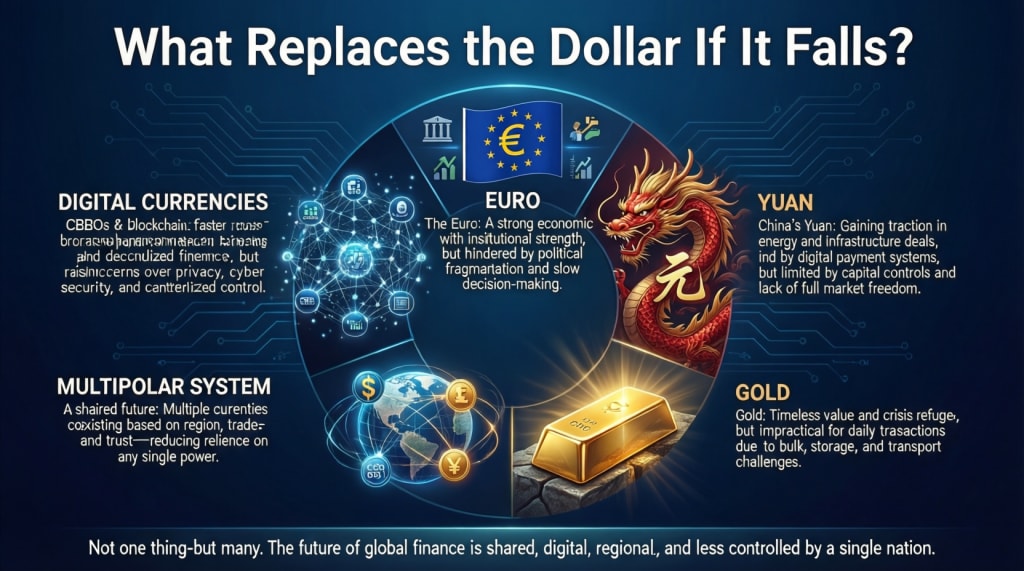
One possible contender is the euro. The European Union represents one of the largest economic blocs in the world, and the euro is already widely used in international trade and reserves. It benefits from strong institutions and transparent markets. However, the euro also faces internal challenges. Political divisions among EU members, debt problems in some countries, and slow decision-making reduce confidence in the euro becoming the sole global currency.
Another rising option is China’s yuan. China is actively promoting its currency in global trade, especially in energy deals and infrastructure projects. Some countries now settle trade with China directly in yuan, avoiding the dollar entirely. China has also developed its own payment systems to reduce reliance on US-controlled financial networks. Still, the yuan has major limitations. It is tightly controlled by the Chinese government, and capital flows are restricted. Many investors hesitate to trust a currency that lacks full transparency and freedom.
Gold is often mentioned as a safe alternative. For thousands of years, gold has held value across civilizations. During times of crisis, central banks and investors rush to it. Some countries are increasing their gold reserves as insurance against dollar risk. However, gold is not practical for modern global trade. It is difficult to transport, store, and use for daily transactions. Gold may support currencies—but it cannot replace one on its own.
Digital currencies are another emerging possibility. Central bank digital currencies (CBDCs) are being tested by many countries. These government-backed digital currencies could make cross-border payments faster and cheaper. Meanwhile, blockchain technology allows financial transfers without traditional banking systems. While digital money is promising, it raises concerns about privacy, cyber security, and control. No digital currency yet has the global trust needed to replace the dollar.
Some experts believe the future lies in a multipolar currency system. Instead of one dominant currency, the world may rely on several major currencies at the same time—the dollar, euro, yuan, and others—depending on region and trade relationships. This system would reduce dependence on any single country and spread financial risk more evenly.
Regional trade blocs may also create their own financial systems. Asia, the Middle East, Africa, and Latin America are exploring local-currency trade and regional payment networks. These systems do not aim to destroy the dollar, but to reduce vulnerability to external pressure.
International institutions could also play a role. The International Monetary Fund’s Special Drawing Rights (SDRs) are sometimes suggested as a neutral global reserve asset. SDRs are based on a basket of major currencies, including the dollar, euro, and yuan. While SDRs are currently limited in use, they show how shared monetary tools might evolve.
For ordinary people, these changes matter more than they realize. Currency shifts affect prices, savings, employment, and economic stability. A fragmented currency system could reduce global shocks—but it could also increase complexity and uncertainty.
History teaches us that reserve currencies decline slowly, not suddenly. The British pound remained influential long after Britain lost global dominance. The same is likely true for the dollar. Even if its role shrinks, it will remain important for many years.
So what replaces the dollar if it falls? The honest answer is: not one thing, but many. The future of global finance is likely to be shared, digital, regional, and less controlled by a single power.
The age of one currency ruling the world may be ending—but the next system is still being built.
About the Creator
Wings of Time
I'm Wings of Time—a storyteller from Swat, Pakistan. I write immersive, researched tales of war, aviation, and history that bring the past roaring back to life
Keep reading
More stories from Wings of Time and writers in Trader and other communities.
Is the Dollar Entering Its Final Era?
Is the Dollar Entering Its Final Era? For decades, the US dollar has been the backbone of the global financial system. It has been the main currency for international trade, oil sales, debt, and foreign reserves. When countries traded with each other, they usually settled payments in dollars. When crises happened, investors rushed toward the dollar as a safe haven. But today, a growing number of experts and governments are asking an uncomfortable question: are these the last dominant days of the dollar?
By Wings of Time 3 days ago in Trader
Mezcal Market: Trends, Growth, and Future Outlook
The global Mezcal market is experiencing strong growth as consumers increasingly seek premium, artisanal spirits with unique flavor profiles and cultural authenticity. Fueled by rising disposable incomes, expanding cocktail culture, and a growing appreciation for craft beverages, mezcal is transitioning from a niche traditional spirit to a globally recognized product. Projections show significant market expansion over the next decade across key regions, driven by both established and emerging consumer bases.
By James Smithabout 18 hours ago in Trader
How AI is Reshaping the South Korea Apparel Market Industry Size 2026-2034
South Korea Apparel Market Size Overview South Korea apparel market size reached USD 34.7 Billion in 2025. Looking forward, IMARC Group expects the market to reach USD 44.2 Billion by 2034, exhibiting a growth rate (CAGR) of 2.75% during 2026-2034. The rising consumer inclination towards trend-setting and stylish clothing items, owing to the evolving fashion industry across the country, along with the growing influence of Korean dramas, is primarily catalyzing the market growth.
By Kim Soo hyun7 days ago in Trader



Comments
There are no comments for this story
Be the first to respond and start the conversation.