
What is the difference between The problem of unfinished buildings in China and the subprime crisis in the United States?
The rotten poop
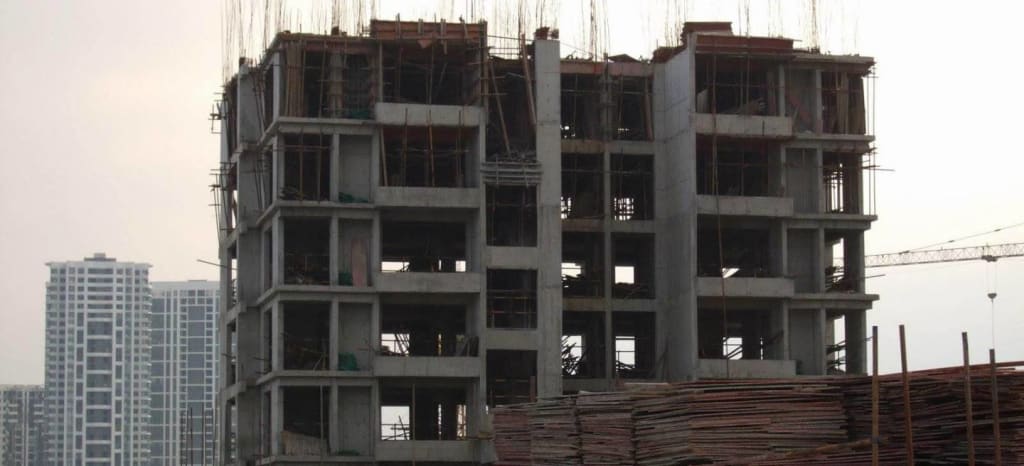
Essentially is the debt crisis, that is, the main body of debt can not fulfill the contract caused by the chain of debt problems.
However, during the subprime mortgage crisis, a large number of low-income groups who could not afford the mortgage rushed to buy a house with high leverage, gambling on the infinite rise of real estate prices, which eventually led to the risk of debt transmission chain. The main body of irresponsible lending is the real estate company.
Therefore, it is not the Chinese homebuyers who are the faultless ones who are the Chinese real estate developers who are the response to the US subprime mortgage crisis.
Before the SUBPRIME mortgage crisis in the United States, it was ordinary house buyers who assumed the risk that house prices could not continue to rise indefinitely and borrowed freely. They were not innocent. The best line in the film Margin Call is the joke at the end: now it is said that financial institutions are to blame for Wall Street's greed and shamelessly, why did they not say so when they bought big houses and sports cars that they are not qualified to live in? Now financial institutions are to blame for everything that goes wrong. The most greedy and shameless are ordinary people, F* CK ordinary people
In the end, everyone should pay the price for his greed, not who is miserable and who is weak.
It is Chinese developers, not Chinese home buyers, who are responding to the disorderly purchase of houses in the United States. They were the ones who took risks they couldn't afford to bet that housing prices would go up forever and screwed everybody. What forces real estate to continue at higher land prices is not an open question.
Borrow is not only the bank loan is borrowed, the credit on finance comes in is indebted. It is the money that land pledge gives bank loan not only is indebted, ask the person that buy a house to receive house money in advance also is indebted on finance, let construction party material square pad endowment, also be indebted. They are the same in a financial sense.
So both the subprime mortgage crisis and China's crisis of uncompleted housing are essentially about a group of people who are desperately in debt, with a debt burden that far exceeds their net worth, gambling that housing prices will rise forever. If we calculate the actual advance payment, various commercial bills, various off-balance sheet financial management, various advance payment and default payouts of Chinese real estate developers, we can calculate the leverage ratio in a real sense, which is no different from the American subprime mortgage buyers who bought the house price with no down payment. Are betting almost infinitely that housing prices will rise beyond the reach of everyone's income. In the United States, they're called house buyers. In China, they're called developers.
The difference is that in the United States, individuals who flip real estate lose everything they own; The developers are limited liability companies, whose bosses still let the companies pay dividends to their private accounts when the real estate is no longer visible, and give priority to the repayment of the "wealth management" bought by the bosses and executives. In other words, it is draining individual bosses from companies that are effectively insolvent.
The bosses of property developers prospered when they bet against soaring house prices. When the bet goes wrong, the homebuyers and bank depositors bear all the costs and they can still be super-rich.
This asymmetry of responsibility is a blatant injustice of great proportions. Then there is the transmission to the financial system, which is similar.
First of all, the impact is on the banking system. In the US subprime crisis, the role of investment banks was actually creating the securitization of subprime loans and creating a series of derivative products for bottom selling. A short put is a short put. Finally, commercial banks bought the subprime loans, including their own holdings and various financial products to the investment guests. With so many subprime loans still outstanding, investment banks that were SHORT PUT went down with them. Both commercial banks and investment banks were net long subprime mortgages.
Derivatives are not used to manage risk, they are used to amplify leverage and, of course, risk.
In the end, the Fed printed money and bought up almost all of the MBS, so the central bank became the lender of last resort to everybody. It kept the price of MBS from going down so much that it kept financial institutions from going bust. That would be a debt risk shared by all dollar holders in the world.
Mr Taleb's scathing comment remains: banks have lost more money on the subprime crisis than they have made in the entire history of banking.
In other words, the commercial bank business model is fundamentally untenable.
In my opinion, this is not the end of the story. The post-2008 QE rescue was a tiger. Two attempts to normalise monetary policy since QE have failed. The latest attempt failed spectacularly.
Helicopter drops are not without inflation risks, and the Fed can manage inflation as well as printing money as long as its forecasts do not deviate too far from the world's peaceful and productive growth spurts.
But the world is not "Ricardian". Humans have two kidneys and two lungs, not just enough for them, and it is only a matter of time before any maximally efficient extreme tugging hits a black swan.
In the end, the "out of sample" events of Russia's invasion of Ukraine and China's supply chain shutdown due to the pandemic hit QE. Inflation is out of control, with the latest CPI figure at a staggering 9.1%. The black swan is always on the way, though it will arrive late, and when it comes, it will definitely refresh you.
It's not new, it's not new, it's not unprecedented it's not a black swan and the world will hit back as hard as you can when you try to get away with appeasement. It is not for nothing that the hour has not come. The QE drug caused by the subprime mortgage crisis could not be stopped and hit the big truck of runaway inflation. The United States had to pay the bill for the subprime mortgage crisis. After more than a decade, it not only had to repay the principal, but also pay the interest.
China's impact on the financial system... What needs to be said in detail is not suitable for public discussion. Let me just say a bit of financial wisdom: when a listed company's price-to-book ratio is below 1, it means that the capital markets think that the so-called balance sheet is not worth that much, that it is either fake or rubbish. We might as well take a look at the price-to-book ratio of domestic commercial banks. It doesn't matter what you say. When it comes to money, we're all honest. People with a voice in the capital market feel that the assets reported by China's banks are much more than they are worth. Therefore, not everyone woke up to the financial systemic risk caused by the problem of unfinished buildings. In fact, gray rhinos have been standing there for a long time.
About the Creator
Keep reading
More stories from writers in Trader and other communities.



Comments
There are no comments for this story
Be the first to respond and start the conversation.