
Water Soluble Polymer Market Size and Forecast, 2026–2034
From Clean Water to Clean Labels: Why Water-Soluble Polymers Are Becoming a Core Material of the Modern Economy

Introduction: A Market Dissolving Barriers Across Industries
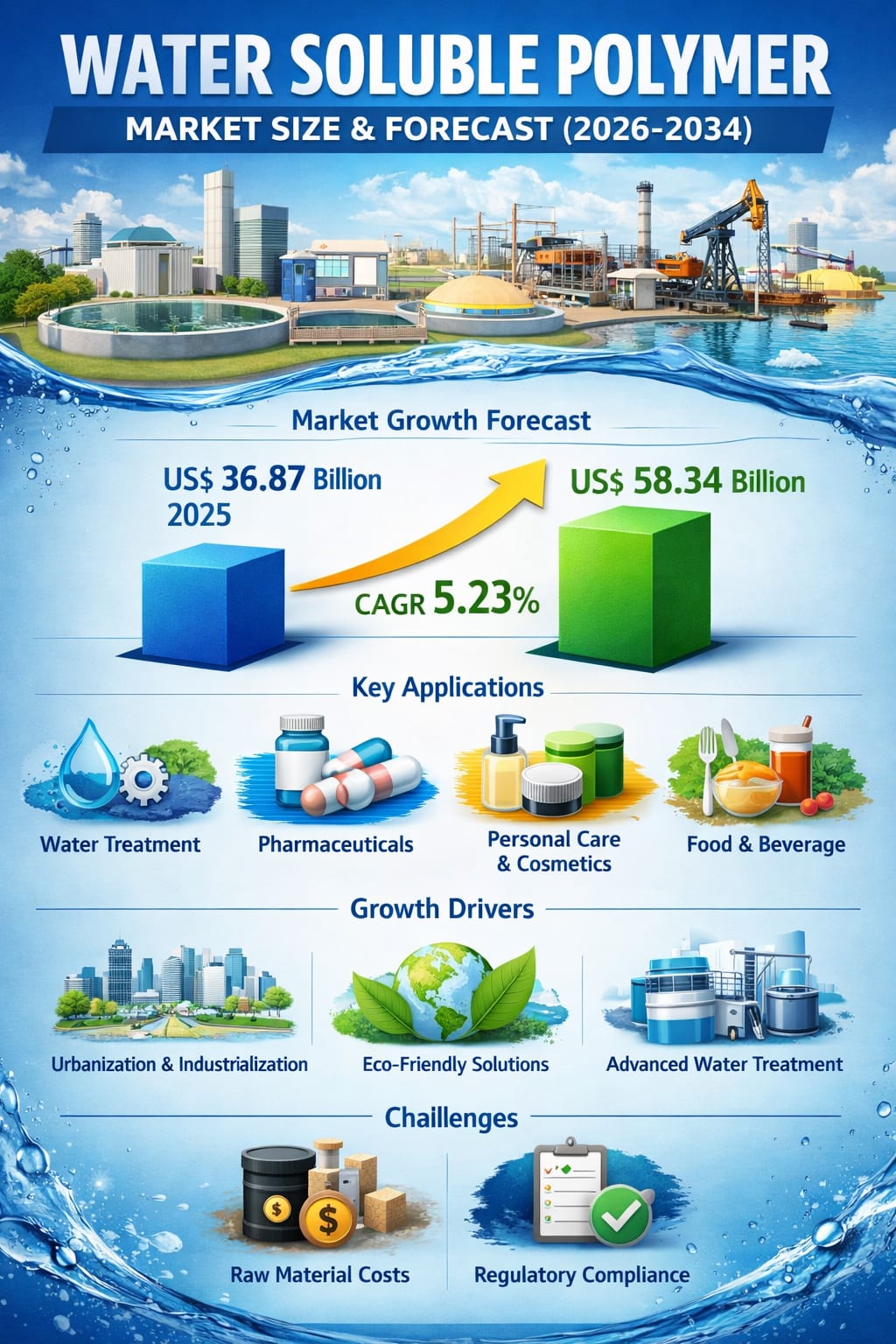
The global water-soluble polymer industry is entering a decisive growth phase, driven by the world’s rising demand for clean water, efficient industrial processes, and sustainable materials. According to industry estimates, the market is set to expand from US$ 36.87 billion in 2025 to US$ 58.34 billion by 2034, registering a compound annual growth rate (CAGR) of 5.23% between 2026 and 2034.
This growth is not limited to a single sector. Water-soluble polymers are now deeply embedded in water and wastewater treatment, pharmaceuticals, personal care, food processing, oil & gas, paper, textiles, and agriculture. Their ability to dissolve, disperse, or swell in water while delivering specific functional properties—such as thickening, binding, stabilizing, or flocculating—makes them indispensable in modern manufacturing and environmental management.
As governments tighten environmental regulations, consumers demand cleaner labels, and industries search for more efficient and sustainable solutions, water-soluble polymers are steadily shifting from being “supporting materials” to strategic enablers of performance, compliance, and sustainability.
Understanding Water-Soluble Polymers: More Than Just Chemistry
Water-soluble polymers are a broad class of materials that can be synthetic, semi-synthetic, or naturally derived. Once in contact with water, they either dissolve completely, disperse uniformly, or swell to perform a specific function. Their core value lies in modifying viscosity, controlling flow behavior, stabilizing mixtures, and improving process efficiency.
These polymers are widely used in water treatment and wastewater management, where they help separate solids from liquids and improve filtration efficiency. In pharmaceuticals, they serve as binders, coating agents, and controlled-release materials. In food and personal care, they enhance texture, stability, and shelf life. In oil & gas, paper, textiles, and agriculture, they improve process performance, reduce waste, and increase output quality.
Globally, their adoption has accelerated due to urbanization, industrial expansion, stricter environmental norms, and the growing focus on sustainable and high-performance materials. The shift toward biodegradable and eco-friendly formulations has further strengthened their strategic importance.
Key Growth Drivers Shaping the Market
1. Expanding Demand from Water and Wastewater Treatment
One of the strongest growth engines for the water-soluble polymer market is the rising global demand for efficient water and wastewater treatment. Rapid urbanization, population growth, and industrialization are placing enormous pressure on water resources, making advanced treatment solutions a necessity rather than a choice.
Water-soluble polymers are widely used as flocculants, coagulants, and dispersants, helping treatment plants achieve better solid-liquid separation, improved filtration, and higher operational efficiency. Municipal and industrial facilities increasingly rely on these materials to meet stricter environmental standards and reduce operating costs.
Governments and private players across the world are investing heavily in water infrastructure upgrades, which directly supports long-term demand. For instance, in February 2024, DuPont introduced a new line of advanced water filtration membranes aimed at delivering superior purification performance, highlighting how innovation in water technologies continues to create new opportunities for polymer-based solutions.
2. Rising Adoption in Pharmaceuticals, Personal Care, and Food
Beyond water treatment, water-soluble polymers are gaining rapid traction in healthcare, personal care, and food processing due to their non-toxic nature, functional versatility, and formulation benefits.
In pharmaceuticals, they are used as binders, coating agents, stabilizers, and controlled-release carriers, supporting the development of safer and more effective drug delivery systems. In personal care products such as shampoos, lotions, and cosmetics, they help improve texture, viscosity, stability, and user experience. In the food industry, they act as thickeners, emulsifiers, and stabilizers, enhancing consistency, shelf life, and visual appeal.
As consumers increasingly demand high-quality, convenient, and functional products, manufacturers are turning to water-soluble polymers to meet both performance and regulatory expectations. In January 2025, Engeotech Aqua Engineers launched a new sustainable water treatment technology aimed at addressing global water scarcity and contamination, reinforcing the broader industry push toward efficient and responsible solutions.
3. The Shift Toward Sustainable and Bio-Based Polymer Solutions
Sustainability is no longer a niche concern—it is now a core strategic priority across industries. This has significantly influenced the evolution of the water-soluble polymer market. Companies are investing in biodegradable, non-toxic, and bio-based alternatives to reduce environmental impact and comply with stricter regulations.
Natural polymers such as cellulose, polysaccharides, gelatin, guar gum, and xanthan gum are gaining attention as industries seek greener material portfolios. At the same time, major manufacturers are accelerating R&D efforts to develop high-performance polymers that combine functionality with environmental responsibility.
A notable example came in April 2025, when EF Polymer, a startup focused on organic super-absorbent polymers, raised JPY 1 billion (around USD 6.6 million) in Series B funding to expand solutions aimed at addressing global water challenges and supporting agriculture. This reflects how sustainability-driven innovation is becoming a central investment theme in the sector.
Challenges Facing the Water-Soluble Polymer Industry
1. Raw Material Price Volatility and Supply Constraints
Despite strong demand, the industry faces ongoing challenges related to raw material price fluctuations. Many synthetic water-soluble polymers are derived from petrochemical feedstocks, making their production costs sensitive to crude oil price movements. This volatility can impact profit margins, pricing strategies, and long-term planning for manufacturers.
In addition, the limited availability and higher cost of certain bio-based raw materials can restrict large-scale production and slow down the transition toward greener alternatives, especially in price-sensitive markets.
2. Environmental and Regulatory Compliance Pressure
While sustainability is driving growth, it is also creating regulatory pressure. Some synthetic polymers face scrutiny due to concerns over environmental persistence and ecological impact. Regulations related to chemical safety, disposal, and biodegradability are becoming stricter across major markets.
Compliance with these evolving standards increases R&D costs, testing requirements, and certification expenses, forcing companies to continuously adapt their formulations and production processes. For smaller players, this can be a significant barrier to entry or expansion.
Key Market Segments in Focus
Global Water-Soluble Polyacrylamide Market
Polyacrylamide remains one of the most important water-soluble polymers globally, primarily due to its extensive use as a flocculant and coagulant in water and wastewater treatment. It improves sludge dewatering efficiency and enhances overall separation processes.
Beyond water treatment, polyacrylamide is also used in oil & gas, mining, and agriculture, thanks to its high efficiency at low dosages. Although environmental concerns exist, ongoing formulation improvements and the development of specialty grades continue to support its widespread adoption.
Gelatin Water-Soluble Polymer Market
Gelatin-based water-soluble polymers are benefiting from the rising demand for natural, biodegradable, and biocompatible materials. Their excellent film-forming, gelling, and stabilizing properties make them valuable in pharmaceuticals, food, nutraceuticals, cosmetics, and biomedical applications.
In pharmaceuticals, gelatin is widely used for capsule shells and drug delivery systems. In food, it improves texture in confectionery, dairy, and desserts. The growing preference for clean-label and naturally derived ingredients is further strengthening this segment’s growth outlook.
Global Water Treatment Soluble Polymer Market
The water treatment segment represents one of the fastest-growing application areas. Soluble polymers play a crucial role in clarification, filtration enhancement, and suspended solid removal, helping treatment plants meet stricter discharge norms while reducing chemical consumption and operating costs.
As water scarcity and environmental concerns intensify, industries such as power generation, mining, and manufacturing are increasingly adopting advanced treatment technologies, further boosting demand for high-performance soluble polymers.
Food Water-Soluble Polymer Market
In the food industry, water-soluble polymers are widely used to improve texture, stability, and shelf life of processed foods. With consumers demanding more convenient, high-quality, and visually appealing products, food manufacturers rely on these polymers to maintain consistency and product performance.
The growing trend toward plant-based and clean-label ingredients is also influencing material choices, creating new opportunities for both natural and modified water-soluble polymers in food formulations.
Paper and Paperboard Applications
In the pulp and paper industry, water-soluble polymers are used as retention aids, drainage agents, strength enhancers, and coating materials. They help improve fiber bonding, reduce raw material losses, and optimize paper formation.
While digitalization has reduced demand in some paper segments, growth in packaging and specialty papers, along with rising recycling rates, continues to support steady demand for polymer-based processing aids.
Regional Market Perspectives
United States
The U.S. water-soluble polymers market is driven by strong demand from water treatment, pharmaceuticals, personal care, food processing, oil & gas, and agriculture. The country’s advanced manufacturing base and focus on innovation support the adoption of high-performance and sustainable polymer solutions.
In December 2023, IFF and Kemira announced progress in their collaboration to develop environmentally friendly polymers using advanced enzymatic technologies, signaling continued momentum toward greener commercial-scale solutions.
Germany
Germany’s market is characterized by strong industrial demand, technical precision, and strict environmental standards. Water-soluble polymers are widely used in water treatment, pulp & paper, construction chemicals, and specialty manufacturing. The country’s emphasis on sustainability and high-quality production ensures steady demand for advanced polymer formulations.
India
India represents one of the fastest-growing markets, driven by urbanization, infrastructure development, and rising demand for clean water and sanitation. Water-soluble polymers are increasingly used in water treatment, agriculture, textiles, paper, pharmaceuticals, and food processing.
In October 2024, Arrow Greentech’s Watersol brand showcased advanced water-soluble film technology designed as an eco-friendly alternative to plastic packaging, highlighting how innovation and sustainability are shaping the Indian market’s future.
Saudi Arabia
In Saudi Arabia, demand is largely fueled by water scarcity and industrial expansion. Water-soluble polymers play a critical role in desalination, wastewater treatment, water reuse, and oil & gas applications. The country’s focus on industrial modernization and water sustainability continues to support long-term growth.
In February 2024, VA TECH WABAG signed a USD 33.5 million agreement related to an industrial wastewater treatment project at the Ras Tanura Refinery Complex, underscoring the scale of investment flowing into water infrastructure and treatment technologies.
Competitive Landscape
The global market features a mix of large multinational chemical companies and specialized players, including:
Arkema, Ashland Inc, BASF SE, DuPont de Nemours, Kemira Oyj, Kuraray Co. Ltd, Merck KGaA, Mitsubishi Chemical Group Corporation, Nouryon, and Sumitomo Seika Chemicals Co. Ltd.
These companies compete through product innovation, sustainability-focused R&D, strategic partnerships, and geographic expansion, while also adapting to evolving regulatory and customer requirements.
Final Thoughts: A Market Built on Function, Efficiency, and Sustainability
The water-soluble polymer market is no longer just about chemistry—it is about enabling cleaner water, safer products, more efficient industries, and a more sustainable material future. With the market projected to grow from US$ 36.87 billion in 2025 to US$ 58.34 billion by 2034, its role in the global industrial ecosystem will only become more critical.
As environmental pressures increase and performance expectations rise, water-soluble polymers will continue to evolve from functional additives into strategic materials at the heart of modern manufacturing, infrastructure, and sustainability efforts. For industries and investors alike, this is a market not just dissolving in water—but solidifying its importance in the global economy.
About the Creator
Sakshi Sharma
Content Writer with 7+ years of experience crafting SEO-driven blogs, web copy & research reports. Skilled in creating engaging, audience-focused content across diverse industries.
Keep reading
More stories from Sakshi Sharma and writers in Trader and other communities.
Europe Next Generation Sequencing Market Size & Forecast 2026–2034
Europe Next Generation Sequencing Market Overview The Europe Next Generation Sequencing (NGS) Market is undergoing a transformative phase, driven by rapid advancements in genomics, expanding clinical applications, and strong institutional support for precision medicine. According to Renub Research, the European NGS market is expected to grow from US$ 2.43 billion in 2025 to US$ 13.94 billion by 2034, registering an impressive CAGR of 21.42% during the forecast period 2026–2034.
By Sakshi Sharmaabout 21 hours ago in Trader
Franklin Mutual Financial Services Fund: In-Depth Analysis for Strategic Investors
The Franklin Mutual Financial Services Fund is a specialized mutual fund designed for investors seeking targeted exposure to the financial services industry. By focusing on companies that operate at the core of global finance, this fund aims to deliver long-term capital appreciation through a disciplined, value-driven investment approach. Financial services remain one of the most influential sectors in the global economy, making this fund an important consideration for portfolio diversification.
By Hammad Nawaz2 days ago in Trader


Comments
There are no comments for this story
Be the first to respond and start the conversation.