
Unmasking Game Stop's True Worth
A Realistic Valuation Beyond the Hype


GameStop Corp. (GME) has become a poster child for the rise of meme stocks, driven by retail investors and social media hype. While the company has garnered significant attention, it’s important to differentiate between the hype and its actual financial fundamentals. The reality is that GameStop’s stock is overvalued relative to its underlying financials, with cash reserves and negative cash flow suggesting a true intrinsic value around $12 per share. This article delves into GameStop’s financial situation, focusing on its cash burn, cash reserves, and the speculative nature of its stock price—highlighting why a valuation above $12 may be risky for value investors.
The Core Issue
One of the most concerning aspects of GameStop’s financial health is its ongoing cash burn. The company is burning through $115 million per quarter, or $460 million annually, due to operational expenses exceeding revenues. Such negative free cash flow creates a financial gap that GameStop must address either by cutting expenses or significantly boosting revenue.
Despite recent capital raises, GameStop’s survival hinges on its ability to stop the cash bleed. Without changes, the company risks depleting its cash reserves in a few years, which underscores the urgency of addressing its financial inefficiencies.
A Silver Lining
On a positive note, GameStop holds substantial cash reserves. As of its most recent quarterly report, the company had $1.05 billion in net cash and marketable securities. This includes $999.9 million in cash and $83 million in marketable securities, offset by $25.7 million in long-term debt. This position was bolstered further in May 2023 when GameStop raised $933.7 million by selling 45 million new shares.
With this influx of capital, GameStop’s net cash position sits around $2 billion, providing short-term financial security. Moreover, the company filed for another share offering in June, potentially raising an additional $1.72 billion to $2.62 billion. In the best-case scenario, GameStop could end up with $4 billion to $5 billion in net cash.
Estimating GameStop’s Cash Value Per Share
Let’s break down the numbers. Assuming the additional 75 million shares are sold, GameStop’s outstanding shares would rise to roughly 426 million. If the company holds $4 billion to $5 billion in net cash, the cash value per share would fall between $10.80 and $12.
At this stage, the company's operations contribute little to its valuation, as the core business is still burning cash. Assuming GameStop’s business could be sold for a half-billion dollars, the net value of the stock would be around $12 per share. Any price above that assumes that management can successfully invest its cash reserves and turn the business around, introducing significant risk for investors.
The Market’s Current Valuation
As of mid-June, GameStop’s stock is trading around $23 per share, translating to a market cap of approximately $10 billion. This implies the market is valuing the business at $4.68 billion beyond its cash reserves, based on speculative bets that GameStop can generate a significant return on its cash holdings. A market cap of $10 billion suggests investors believe the company will achieve a 92% return on its cash pile.
For value investors, such an assumption is hard to justify. Expecting a near-100% return from a cash-burning business requires extraordinary management performance, market timing, and a fair amount of luck. Without a margin of safety—a cornerstone of value investing—this speculative gamble becomes difficult to defend.
Investor Takeaways
It’s clear that GameStop’s stock price reflects optimism rather than solid fundamentals. The company’s operations remain unprofitable, and the turnaround plan is uncertain. Here’s why investors should exercise caution:
Lack of Margin of Safety
GameStop’s stock price leaves no margin for error. Any investment above $12 per share is a speculative bet that management will stop the cash burn and effectively utilize the company’s cash reserves. But there’s no guarantee this will happen.
Reliance on Management
The current stock price assumes GameStop’s leadership can successfully pivot the company and reverse its financial trajectory. Although the recent capital raise buys time, it remains to be seen whether management can deploy the funds wisely to generate profits.
Risks of Continued Cash Burn
Even with significant cash reserves, GameStop cannot sustain its current rate of cash burn indefinitely. If the turnaround takes too long, the company could face further share dilution or additional debt, leaving less value for shareholders.
A Glimmer of Hope
There are, however, speculative scenarios where GameStop could succeed. For instance:
- Management could find a profitable acquisition or growth investment.
- The company might pivot its business model to better align with the evolving gaming and entertainment sectors.
- GameStop could raise additional funds by issuing more shares at higher prices, further strengthening its cash reserves.
While these possibilities exist, they are speculative and uncertain. For value investors, the current risk-reward ratio does not offer a favorable investment opportunity.
Overvalued but with Speculative Potential
GameStop’s stock is likely overvalued at current levels. Based on its cash reserves and the ongoing cash burn, a realistic valuation places the stock around $12 per share. Any price above that reflects speculative optimism rather than a grounded analysis of the company’s fundamentals.
For value investors, GameStop presents considerable risks. Without a margin of safety, investing at current prices is essentially betting on management’s ability to execute a successful turnaround. Although the company’s cash position offers some security, it’s far from a guarantee.
In summary, GameStop remains a speculative play, and investors should proceed with caution. Until there’s tangible evidence that the company can reverse its cash flow issues and achieve sustainable profitability, the stock is likely to remain overinflated by optimism rather than financial realities.
About the Creator
Donna Lee Hellmann
Just a Gen Xer living in a Gen Z world. I'm a seasoned writer struggling to adapt to technology that changes every 6 months, and fighting to keep my career.
Keep reading
More stories from Donna Lee Hellmann and writers in Trader and other communities.
Gold Prices Rise
In 2024, U.S.-China trade relations remain tense, driven by tariffs on billions of dollars of goods, technological restrictions, and national security concerns. The U.S. continues to limit China's access to advanced technologies like semiconductors, aiming to protect intellectual property and reduce reliance on Chinese supply chains.
By Donna Lee Hellmann about a year ago in Trader
Mezcal Market: Trends, Growth, and Future Outlook
The global Mezcal market is experiencing strong growth as consumers increasingly seek premium, artisanal spirits with unique flavor profiles and cultural authenticity. Fueled by rising disposable incomes, expanding cocktail culture, and a growing appreciation for craft beverages, mezcal is transitioning from a niche traditional spirit to a globally recognized product. Projections show significant market expansion over the next decade across key regions, driven by both established and emerging consumer bases.
By James Smith2 days ago in Trader
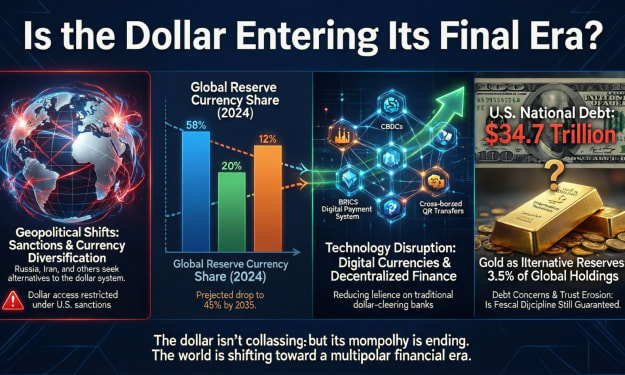
Is the Dollar Entering Its Final Era?
Is the Dollar Entering Its Final Era? For decades, the US dollar has been the backbone of the global financial system. It has been the main currency for international trade, oil sales, debt, and foreign reserves. When countries traded with each other, they usually settled payments in dollars. When crises happened, investors rushed toward the dollar as a safe haven. But today, a growing number of experts and governments are asking an uncomfortable question: are these the last dominant days of the dollar?
By Wings of Time 4 days ago in Trader



Comments
There are no comments for this story
Be the first to respond and start the conversation.