
United States Smart Pills Market Size and Forecast 2025–2033
How Ingestible Sensors, Capsule Endoscopy, and Digital Pills Are Transforming Diagnostics and Patient Monitoring in America

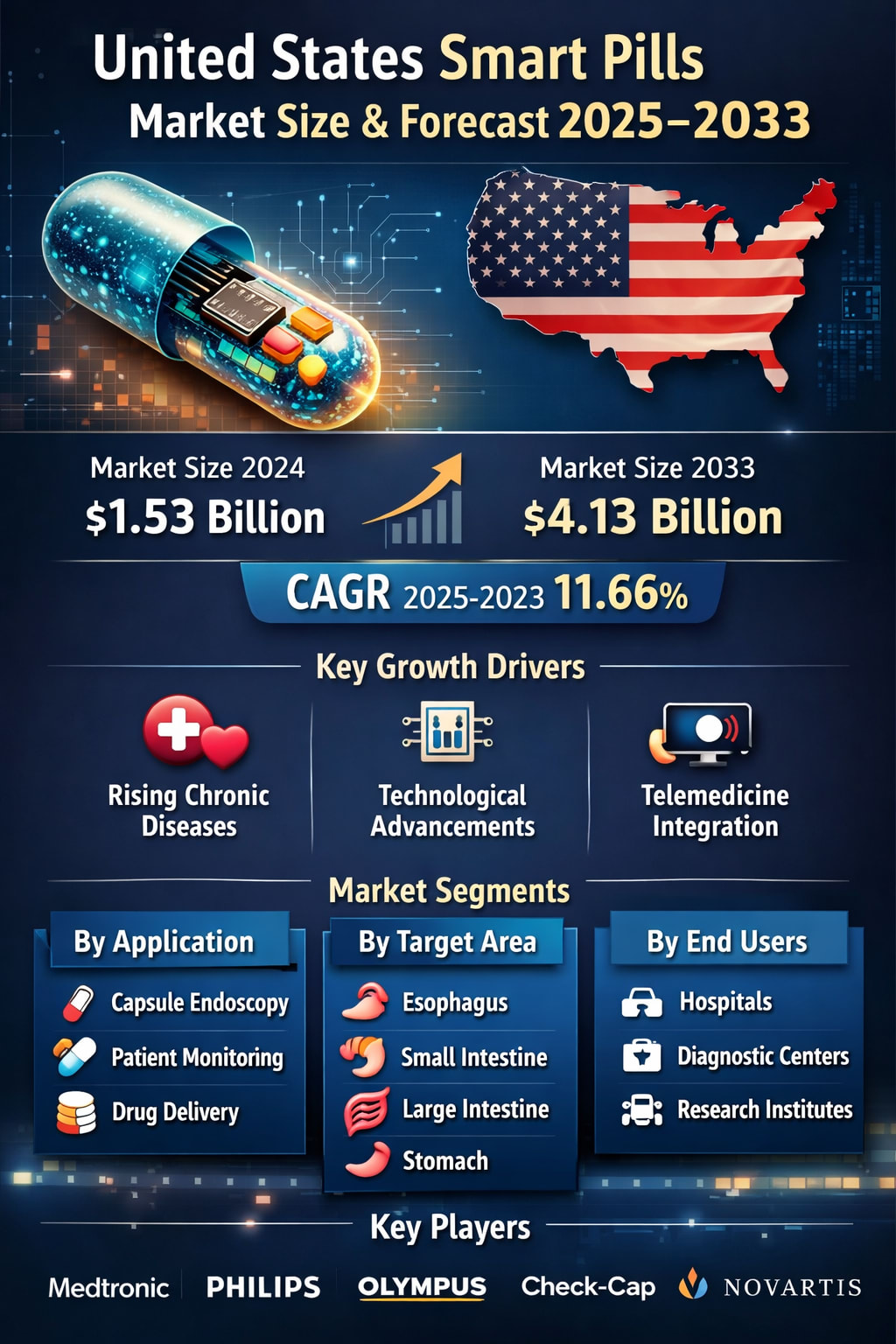
United States Smart Pills Market: A New Era of Ingestible Technology
The United States Smart Pills Market is entering a phase of rapid transformation, driven by the convergence of healthcare, digital technology, and advanced medical devices. According to industry estimates, the market is expected to reach US$ 4.13 billion by 2033, growing from US$ 1.53 billion in 2024, at a robust CAGR of 11.66% from 2025 to 2033. This impressive growth reflects a broader shift in modern healthcare toward minimally invasive diagnostics, real-time patient monitoring, and data-driven treatment strategies.
Smart pills—also known as digital pills or ingestible sensors—represent one of the most fascinating innovations in contemporary medicine. These tiny, swallowable devices are embedded with microchips, sensors, cameras, or transmitters that can collect and transmit data from inside the human body. Once ingested, they interact with biological fluids and organs, sending critical information to external receivers or cloud-based platforms. Physicians can then analyze this data to monitor disease progression, evaluate medication adherence, or detect abnormalities within the gastrointestinal (GI) tract.
In a healthcare system increasingly focused on precision medicine and patient-centered care, smart pills offer a powerful combination of convenience, accuracy, and real-time insight. Their applications range from capsule endoscopy and patient monitoring to advanced drug delivery systems, making them a cornerstone of next-generation medical diagnostics in the United States.
Market Overview: Why Smart Pills Matter
Smart pills are reshaping how clinicians diagnose, monitor, and manage a wide range of medical conditions. Traditional diagnostic methods—especially invasive procedures like conventional endoscopy—can be uncomfortable, expensive, and resource-intensive. Smart pills, by contrast, offer a non-invasive, patient-friendly alternative that significantly improves comfort while maintaining high diagnostic accuracy.
A typical smart pill may contain a miniature camera, pH sensors, temperature sensors, or even drug-release mechanisms. As it travels through the digestive system, it captures images or records physiological data, which is then transmitted wirelessly to an external device worn by the patient. This information helps doctors identify issues such as internal bleeding, tumors, inflammation, or motility disorders—often without the need for sedation or hospital admission.
Beyond diagnostics, smart pills are also gaining traction in medication adherence monitoring and clinical research. In clinical trials, for example, digital pills can confirm whether patients are taking their medications as prescribed, improving data accuracy and trial outcomes. In chronic disease management, they enable continuous monitoring, allowing for earlier interventions and more personalized treatment plans.
The United States, with its advanced healthcare infrastructure, strong R&D ecosystem, and high adoption of digital health technologies, is uniquely positioned to lead the global smart pills market.
Key Growth Drivers of the U.S. Smart Pills Market
1. Rising Prevalence of Chronic Diseases
One of the most significant drivers of the smart pills market in the United States is the growing burden of chronic diseases. Conditions such as diabetes, kidney disease, cancer, and gastrointestinal disorders are becoming increasingly common, particularly as the population ages.
For instance, millions of Americans suffer from kidney disease, and tens of thousands remain on transplant waiting lists each year. Similarly, gastrointestinal disorders and cancers require frequent monitoring and early detection to improve patient outcomes. These conditions create a strong demand for non-invasive, accurate, and repeatable diagnostic tools—a need that smart pills are uniquely positioned to fulfill.
Smart pills enable early detection, continuous monitoring, and real-time data collection, helping clinicians make faster and more informed decisions. As chronic diseases continue to strain the U.S. healthcare system, technologies that improve efficiency and patient comfort are likely to see accelerated adoption.
2. Technological Advancements in Digital Health
Rapid advancements in wireless communication, sensor miniaturization, battery efficiency, and microelectronics have dramatically improved the capabilities of smart pills. Today’s devices are smaller, more reliable, and more data-rich than ever before.
A notable example is the progress made by U.S.-based companies in digital pill systems designed to track medication adherence. In recent years, milestones such as tens of thousands of successful ingestions of digital pills in real-world settings have demonstrated both the safety and practicality of these technologies.
In capsule endoscopy, improvements in image resolution, battery life, and data transmission have made smart pills an increasingly preferred option for small bowel and gastrointestinal imaging. As technology continues to evolve, future smart pills are expected to offer AI-assisted diagnostics, enhanced imaging, and multi-parameter monitoring, further expanding their clinical value.
3. Integration with Telemedicine and Remote Care
The integration of smart pills with telemedicine and remote patient monitoring is another powerful growth catalyst. The COVID-19 pandemic accelerated the adoption of virtual healthcare, and patients and providers alike have become more comfortable with remote diagnostics and digital health solutions.
Smart pills fit perfectly into this ecosystem. By transmitting real-time data to healthcare providers, they enable continuous monitoring without requiring frequent in-person visits. This is particularly valuable for patients in rural or underserved areas, as well as for those with mobility limitations or chronic conditions requiring long-term observation.
As the U.S. healthcare system continues to shift toward value-based care and patient-centric models, technologies that support remote monitoring, early intervention, and personalized treatment—like smart pills—are expected to see sustained demand.
Challenges Facing the United States Smart Pills Market
1. High Cost of Technology
Despite their many advantages, smart pills remain expensive to develop, manufacture, and deploy. The integration of advanced sensors, wireless modules, micro-cameras, and biocompatible materials significantly increases production costs. These expenses are often passed on to healthcare providers and patients, limiting accessibility—especially for those without comprehensive insurance coverage.
Additionally, hospitals and diagnostic centers may face high initial investment costs for supporting infrastructure, staff training, and data management systems. Unless costs decline over time through technological maturation and economies of scale, pricing could remain a barrier to widespread adoption.
2. Regulatory and Approval Hurdles
Regulatory approval is another major challenge in the U.S. smart pills market. The U.S. Food and Drug Administration (FDA) maintains strict standards for safety, efficacy, and data security, which is essential for patient protection but can also slow down product launches.
Smart pills occupy a unique space between medical devices, digital health tools, and pharmaceuticals, which can complicate regulatory pathways. Developers must conduct extensive clinical trials, validate data accuracy, and demonstrate long-term safety. Any delays in approval can postpone commercialization and increase development costs, potentially discouraging smaller innovators from entering the market.
Recent Developments in the U.S. Smart Pills Industry
The U.S. smart pills market has witnessed several important regulatory and technological milestones in recent years:
January 2025: The FDA approved CapsoVision, Inc.’s CapsoCam Plus for use in pediatric patients aged two years and above. This marked a significant step forward in making capsule endoscopy more accessible to children, offering a comfortable and non-invasive diagnostic alternative to traditional endoscopy.
January 2024: The FDA approved expanded indications for AnX Robotics’ NaviCam Small Bowel Video Capsule Endoscopy for both adults and children aged two and above. The approval of its AI-assisted reading tool, ProScan, further highlighted the growing role of artificial intelligence in smart pill diagnostics.
February 2022: The FDA approved Check-Cap Ltd.’s modified Investigational Device Exemption (IDE) application, allowing the company to begin pivotal clinical studies in the United States—an important step toward bringing new colon imaging solutions to market.
These developments underscore the strong regulatory momentum and innovation pipeline shaping the future of smart pills in the U.S.
United States Smart Pills Market Segmentation
By Application
Capsule Endoscopy: The largest and most established segment, widely used for gastrointestinal imaging and diagnosis.
Patient Monitoring: Growing rapidly due to demand for medication adherence tracking and chronic disease management.
Drug Delivery: An emerging segment focused on targeted and controlled release of medications within the body.
By Target Area
Esophagus
Small Intestine
Large Intestine
Stomach
Among these, the small intestine segment holds a particularly strong position due to the difficulty of examining this area using traditional endoscopic methods.
By End Users
Diagnostic Centers
Hospitals
Research Institutes
Others
Hospitals and diagnostic centers currently dominate usage, while research institutes play a crucial role in clinical trials and technology development.
Competitive Landscape: Key Players in Focus
The U.S. smart pills market is highly competitive, with both global healthcare giants and specialized technology firms investing heavily in innovation. Key players include:
Check-Cap Ltd.
General Electric Company
Fujifilm
Koninklijke Philips N.V.
Medtronic plc.
Olympus Corporation
Novartis AG
Otsuka Holdings Co., Ltd.
These companies are evaluated across four main dimensions: company overview, key leadership, recent developments and strategies, and sales performance. Strategic partnerships, AI integration, and expansion of clinical applications remain central to their growth strategies.
Market Outlook: What Lies Ahead?
Looking ahead to 2033, the U.S. smart pills market is poised for sustained double-digit growth, driven by technological innovation, rising chronic disease prevalence, and the continued expansion of digital healthcare. The increasing use of artificial intelligence, cloud-based data platforms, and personalized medicine approaches will further enhance the value proposition of smart pills.
As costs gradually decrease and regulatory pathways become more streamlined, smart pills are likely to move from being a niche diagnostic tool to a mainstream component of modern healthcare. Their role in early detection, remote monitoring, and precision treatment could fundamentally change how patients and providers interact with medical technology.
Final Thoughts
The United States Smart Pills Market stands at the intersection of medicine, technology, and data science. With the market projected to grow from US$ 1.53 billion in 2024 to US$ 4.13 billion by 2033, the momentum behind this sector is undeniable. While challenges such as high costs and regulatory complexities remain, the long-term benefits—improved patient comfort, better diagnostic accuracy, and more efficient healthcare delivery—make smart pills one of the most promising innovations in modern medicine.
As the U.S. healthcare system continues its shift toward digital, personalized, and minimally invasive solutions, smart pills are not just a futuristic concept—they are rapidly becoming a core tool in the next generation of healthcare.
About the Creator
Sakshi Sharma
Content Writer with 7+ years of experience crafting SEO-driven blogs, web copy & research reports. Skilled in creating engaging, audience-focused content across diverse industries.
Keep reading
More stories from Sakshi Sharma and writers in Trader and other communities.
United States Epilepsy Drugs Market Size and Forecast 2025–2033 | Renub Research
United States Epilepsy Drugs Market Overview The United States Epilepsy Drugs Market is poised for steady and sustained growth over the forecast period, reflecting both rising disease awareness and continuous innovation in neurological therapeutics. According to Renub Research, the market is expected to reach US$ 3.45 billion by 2033, up from US$ 2.36 billion in 2024, registering a compound annual growth rate (CAGR) of 4.31% from 2025 to 2033.
By Sakshi Sharmaa day ago in Trader
Understanding Stock Options: A Beginner’s Guide to Options Trading
Introduction Stock options are a powerful financial tool used by traders and investors to manage risk, speculate on price movements, and enhance portfolio returns. While options can seem complex for beginners, understanding the basics opens opportunities for more advanced strategies in trading.
By Hammad Nawaz5 days ago in Trader




Comments
There are no comments for this story
Be the first to respond and start the conversation.