
United States Procurement Software Market Size and Forecast 2026–2034
How Cloud, AI, and Compliance-Driven Digital Transformation Are Reshaping Enterprise Purchasing in the U.S.

United States Procurement Software Market Overview
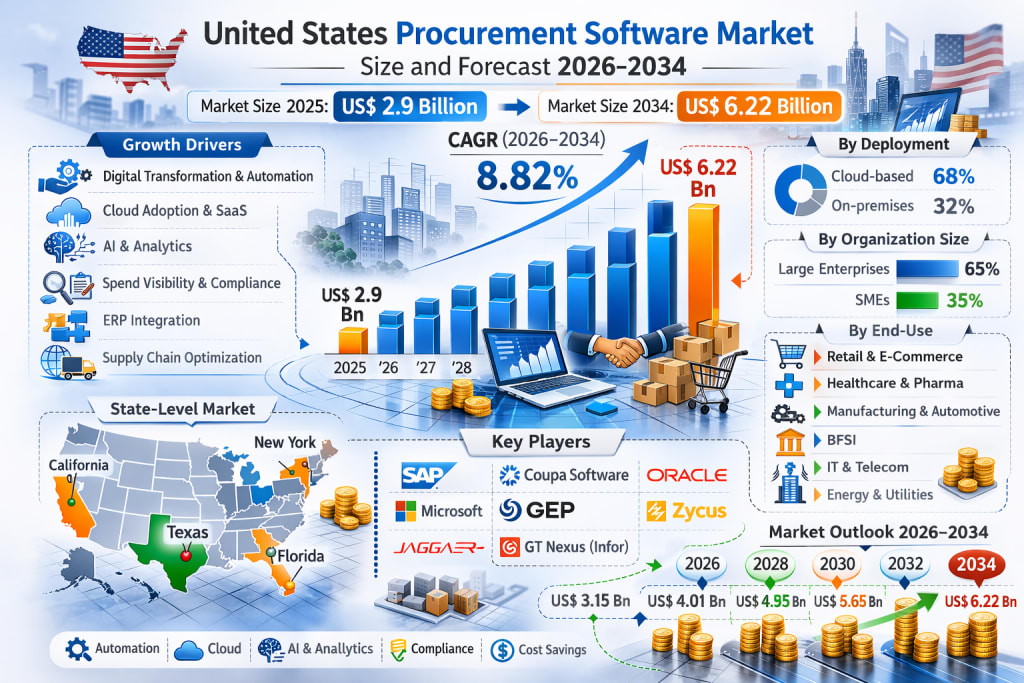
The United States Procurement Software Market is entering a decisive growth phase as enterprises accelerate their shift toward digital, data-driven purchasing operations. The market is expected to reach US$ 6.22 billion by 2034, up from US$ 2.9 billion in 2025, expanding at a compound annual growth rate (CAGR) of 8.82% from 2026 to 2034. This strong upward trajectory reflects how procurement is no longer viewed as a purely administrative function, but as a strategic lever for cost optimization, risk management, compliance, and long-term value creation.
Procurement software refers to digital platforms that automate and manage the entire procurement lifecycle, including sourcing, supplier management, contract management, purchase orders, and invoice processing. These systems help organizations reduce manual work, improve visibility into spending, strengthen compliance, and ensure better financial control. Modern solutions are increasingly cloud-based and integrated with ERP and finance systems, enabling real-time data sharing and more accurate decision-making. Advanced platforms now incorporate artificial intelligence (AI), analytics, and automation to support smarter supplier selection, demand forecasting, risk mitigation, and strategic sourcing.
In the United States, several structural trends are converging to accelerate adoption. Enterprises face growing pressure to control costs, improve operational efficiency, and comply with increasingly complex regulatory requirements. At the same time, supply chain disruptions, remote and hybrid work models, and rising expectations for transparency are forcing procurement teams to modernize outdated, manual processes. Cloud computing and AI-powered analytics have emerged as critical enablers, allowing organizations to scale procurement operations, gain real-time insights, and respond more quickly to market changes.
Together, these factors position the U.S. as one of the most dynamic and influential procurement software markets globally, with strong demand coming from both the private and public sectors.
Why Procurement Software Is Becoming Mission-Critical
Traditionally, procurement was often seen as a back-office function focused on processing purchase orders and negotiating prices. Today, that perception has changed dramatically. In an environment marked by volatile supply chains, geopolitical uncertainty, inflationary pressures, and stricter compliance standards, procurement has become central to enterprise resilience and competitiveness.
Modern procurement software platforms provide organizations with a single, centralized view of suppliers, contracts, spend, and performance metrics. This visibility enables better governance, reduces maverick spending, and supports more strategic supplier relationships. By automating routine tasks such as invoice matching, approvals, and compliance checks, these systems free up procurement professionals to focus on higher-value activities like category management, supplier innovation, and risk management.
In the U.S. market, this strategic shift is especially visible in sectors such as healthcare, BFSI, manufacturing, IT & telecom, and government, where regulatory oversight, cost pressures, and operational complexity are particularly high.
Growth Drivers for the United States Procurement Software Market
Rising Digital Transformation and Automation Across Enterprises
Digital transformation is one of the most powerful forces driving the U.S. procurement software market. Organizations across industries are replacing fragmented, manual, and paper-based workflows with integrated, automated platforms that streamline the entire procure-to-pay (P2P) cycle.
Automation reduces human error, shortens cycle times, and improves process consistency. Tasks such as supplier onboarding, contract approvals, purchase requisitions, and invoice processing can now be handled through standardized digital workflows. This not only improves efficiency but also strengthens internal controls and audit readiness.
Advanced technologies such as AI, machine learning, robotic process automation (RPA), and predictive analytics are further enhancing procurement capabilities. These tools enable demand forecasting, intelligent supplier recommendations, automated invoice matching, and anomaly detection in spending patterns. As enterprises continue to integrate procurement systems with ERP, finance, and supply chain platforms, they gain a more unified and real-time view of operations.
For large U.S. enterprises operating across multiple regions and business units, centralized digital procurement platforms are becoming essential for enforcing consistent policies, improving governance, and achieving enterprise-wide spend visibility.
Increasing Demand for Spend Transparency and Compliance Management
Another major driver of market growth is the rising need for spend transparency, auditability, and regulatory compliance. U.S. organizations operate in an environment where regulatory scrutiny is intensifying, particularly in sectors such as healthcare, financial services, government, and energy.
Procurement software centralizes data related to suppliers, contracts, invoices, and purchase orders, making it easier to track who is buying what, from whom, and at what price. This visibility helps organizations identify cost-saving opportunities, eliminate off-contract or maverick spending, and negotiate better supplier terms.
From a compliance perspective, modern platforms provide built-in controls, approval workflows, and audit trails that reduce the risk of fraud and regulatory violations. Many systems also support supplier risk assessments and compliance checks, helping organizations monitor issues related to data security, financial stability, and regulatory adherence.
In addition, the growing importance of ESG (Environmental, Social, and Governance) reporting and ethical sourcing is pushing companies to track supplier sustainability performance and social compliance more closely. Procurement software simplifies this by integrating ESG metrics, certifications, and reporting tools into supplier management workflows.
Expansion of Cloud-Based Platforms and AI-Driven Capabilities
Cloud adoption has become a defining trend in the U.S. procurement software market. Cloud-based solutions offer several advantages over traditional on-premises systems, including lower upfront costs, faster deployment, automatic updates, and easier scalability. They also support remote and hybrid work environments by providing secure, anytime access to procurement systems.
The rise of Software-as-a-Service (SaaS) models has made advanced procurement capabilities accessible not only to large enterprises but also to small and medium-sized businesses. This democratization of technology is expanding the addressable market and accelerating overall adoption.
At the same time, vendors are increasingly embedding AI-driven features into their platforms. These include intelligent guided buying, automated supplier scoring, contract analytics, spend forecasting, and fraud detection. Such capabilities transform procurement from a reactive, transactional function into a proactive, strategic one.
In an era of frequent supply chain disruptions, cloud and AI tools also support greater resilience by enabling real-time supplier monitoring, faster scenario analysis, and more agile decision-making.
Challenges in the United States Procurement Software Market
Data Integration Complexity and Legacy System Limitations
Despite strong growth prospects, many U.S. organizations face significant challenges when modernizing procurement systems. One of the biggest hurdles is integrating new procurement platforms with existing legacy ERP, finance, and inventory systems. Older infrastructures often lack modern APIs or standardized data models, leading to integration delays, data inconsistencies, and higher IT costs.
Migrating historical data from spreadsheets or outdated systems can also be time-consuming and risky if not managed properly. Without seamless integration, organizations may fail to realize the full benefits of automation, visibility, and analytics.
Data security and privacy concerns add another layer of complexity, especially in highly regulated industries. These issues can slow down cloud adoption and require additional investments in governance and cybersecurity frameworks.
Supplier Risk, Compliance Issues, and Change Management Barriers
Technology alone does not guarantee success. Implementing procurement software often requires significant organizational change, including new processes, new roles, and new ways of working. Resistance from users, lack of training, and limited digital maturity can undermine adoption and reduce return on investment.
Managing supplier risk and compliance is also becoming more complex as supply chains grow more global and regulatory requirements more stringent. Maintaining accurate supplier data, enforcing consistent policies, and configuring systems correctly are ongoing challenges.
If not implemented thoughtfully, procurement software can create new bottlenecks instead of eliminating old ones. This makes change management, stakeholder alignment, and user training critical success factors in any digital procurement initiative.
State-Level Market Dynamics
California
California’s procurement software market is expanding rapidly, driven by its concentration of technology companies, public sector agencies, and heavily regulated industries such as healthcare and utilities. Government digital transformation initiatives are accelerating the adoption of e-procurement platforms to improve transparency, automate bidding, and enhance supplier diversity tracking. In the private sector, complex supply chains and sustainability reporting requirements are boosting demand for AI-driven spend analytics and cloud-based procurement suites.
Texas
Texas is seeing steady growth as organizations prioritize cost efficiency, vendor consolidation, and modernization of legacy systems. Energy, manufacturing, transportation, and construction sectors rely heavily on platforms that support complex sourcing and contract oversight. Public sector investments in digital procurement are also rising, driven by transparency and auditability initiatives.
New York
New York’s diverse economy—spanning finance, healthcare, education, and retail—creates strong demand for advanced procurement tools. Both public and private organizations are investing in cloud-based platforms that offer robust analytics, workflow automation, and ERP integration to improve compliance and operational efficiency.
Florida
Florida’s market is expanding as state and local governments upgrade outdated systems and private enterprises seek better visibility across high-volume, distributed operations. Industries such as tourism, construction, logistics, and healthcare are key adopters of cloud-based, automated procurement solutions.
Recent Developments in the Procurement Software Ecosystem
The procurement software landscape continues to evolve through acquisitions, product innovation, and strategic expansion:
May 2025: The Hackett Group acquired Spend Matters, strengthening its AI-driven procurement advisory and digital sourcing intelligence capabilities.
March 2025: Beroe acquired nnamu, enhancing its procurement intelligence platform with deeper market research and category insights.
December 2024: Ivalua launched an AI-powered Intake Management solution with a chat-based interface, designed to standardize procurement requests and improve compliance.
July 2024: GEP acquired OpusCapita, integrating e-invoicing and accounts payable automation into its AI-driven procurement and supply chain platform and expanding its presence in Europe.
These developments highlight the industry’s focus on AI, automation, and end-to-end digital procurement ecosystems.
Market Segmentation Snapshot
By Deployment:
Cloud-based
On-premises
By Organization Size:
Small and Medium-sized Enterprises
Large Enterprises
By End Use:
Retail & E-Commerce
Healthcare and Pharmaceutical
Manufacturing & Automotive
BFSI
IT & Telecom
Oil & Gas, Energy & Utilities
Others
By States:
California, Texas, New York, Florida, Illinois, Pennsylvania, Ohio, Georgia, New Jersey, Washington, North Carolina, Massachusetts, Virginia, Michigan, Maryland, Colorado, Tennessee, Indiana, Arizona, Minnesota, Wisconsin, Missouri, Connecticut, South Carolina, Oregon, Louisiana, Alabama, Kentucky, and the Rest of the United States.
Competitive Landscape
The U.S. procurement software market is highly competitive, with global technology providers and specialized vendors offering comprehensive suites and niche solutions. Key players include:
GT Nexus (Infor Inc.)
SAP SE
Zycus Inc.
Coupa Software Inc.
Microsoft Corporation
Oracle Corporation
Jaggaer Inc.
GEP Corporation
These companies compete on the basis of platform breadth, AI capabilities, integration strength, industry specialization, and global support networks.
Final Thoughts
The United States Procurement Software Market is on a clear growth path, supported by strong fundamentals such as digital transformation, cloud adoption, AI-driven automation, and rising compliance requirements. With the market projected to grow from US$ 2.9 billion in 2025 to US$ 6.22 billion by 2034 at a CAGR of 8.82%, procurement technology is becoming a strategic investment rather than a discretionary IT upgrade.
As organizations continue to navigate economic uncertainty, supply chain risk, and regulatory complexity, procurement software will play an increasingly central role in improving efficiency, transparency, and resilience. Vendors that can combine deep functionality, seamless integration, and intelligent automation will be best positioned to capture long-term growth in this evolving and highly strategic market.
About the Creator
Keep reading
More stories from shibansh kumar and writers in Trader and other communities.
Procurement Software Market Size and Forecast 2026–2034
Procurement Software Market Outlook The global procurement software market is entering a phase of accelerated transformation as organizations across industries seek to modernize purchasing operations, enhance transparency, and strengthen cost control. According to industry estimates, the Procurement Software Market is expected to reach US$ 20.93 billion by 2034, up from US$ 9.31 billion in 2025, growing at a compound annual growth rate (CAGR) of 9.42% from 2026 to 2034.
By shibansh kumarabout 23 hours ago in Trader
Contract Catering Market — Global Industry Overview, Trends, Forecast & Key Players Analysis
Market Overview Contract catering refers to the outsourcing of food service operations by organizations—including businesses, educational institutions, healthcare facilities, and events— to professional catering providers. These services typically encompass meal planning, food preparation, delivery, and on-site service management.
By James Smith4 days ago in Trader
Winterthorne
Winterthorne stood alone at the edge of the park. The beautiful snow that had surrounded him was all trampled now, from the feet of all of the children who had built him. He missed the sparkly clean snow blanket, but he was happy that so many children had come out to make him.
By Laura DePace6 days ago in Fiction




Comments
There are no comments for this story
Be the first to respond and start the conversation.