
Trump's tariff policy is implemented, "this is a 'slaughter day' for the market"
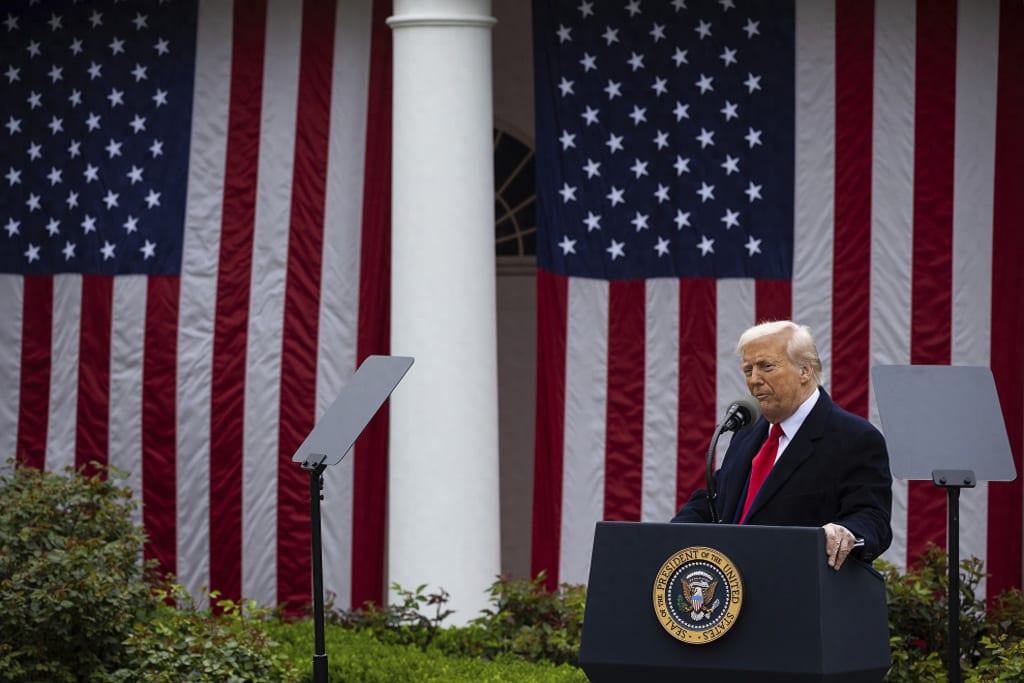
On April 2, local time, US President Trump signed two executive orders on so-called "reciprocal tariffs" at the White House, announcing that the United States would establish a 10% "minimum benchmark tariff" on its trading partners and impose higher tariffs on certain trading partners.
CNBC quoted analysts as saying that uncertainty surrounding the imminent U.S. tariffs has been dragging down global markets over the past month, but Trump's highly anticipated tariff announcement may not end the turmoil.
Ozan Ozkural, founding managing partner of investment and consulting firm Tanto Capital Partners, said on the 1st that although Trump called April 2 "Liberation Day", it might be better to describe it as "Slaughter Day" for the market.
Ozkulal said this was just a typical Trump deterrence tactic, as he tried to bring his opponents to the negotiating table and gain greater benefits for the United States.
He said Trump's approach makes it difficult to price any asset now.
“If you look at the commodity markets, it’s crazy, with talk of secondary sanctions on Venezuelan oil on one hand, and then potentially a Russia-Ukraine deal on the other, which could put Russian crude back on the market, which would completely change the supply and demand picture. And now sanctions on Russian oil could be coming again,” Ozkular said. “It’s very difficult to put a price on anything right now, so we’re assessing it sometimes on a daily, hourly basis.”
On March 30, Trump said in an interview that if Russia and Ukraine cannot reach a ceasefire agreement due to Russia, the United States may impose a 25% to 50% "secondary tariff" on buyers of Russian oil. Not long ago, Trump also announced that he would impose a 25% "secondary tariff" on countries that buy Venezuelan oil and natural gas.
On March 31, 2025, local time, in Washington, D.C., U.S. President Trump signed an executive order. IC photo
While Trump’s “America First” strategy has left global markets struggling with uncertainty, “due to the breadth of the U.S. and the quality of its companies,” Zoe Gillespie, a chartered wealth manager at RBC Brewin Dolphin, believes that “in the long run, it’s hard to look elsewhere and avoid the U.S..”
Zoe Gillespie, chief economist at CNBC’s “Squawk Box Europe,” said uncertainty could continue to have a “spooking effect” on markets even after the tariffs are announced.
“There’s probably going to be more uncertainty as this unfolds,” she said. “I think the risk is that we don’t get a lot of clarity for a longer period of time about what the impact on economic growth will be ... and that could delay any signals that the market has bottomed out.”
Gillespie believes that Trump may not announce all the details of the tariffs on the 2nd. Other unknown factors include whether trading partners such as the European Union will announce retaliatory tariffs, and the impact of tariffs on inflation and interest rates.
“It’s really difficult because you’re trying to prepare for something you don’t really know the details of… For various sectors, the question is whether global supply chains will be affected to some extent, or whether at this stage you should be looking at companies that are more focused on the domestic market and less reliant on global supply chains. The services sector is also another unknown factor.”
Arnaud Girod, head of economics and cross-asset strategy at Kepler Cheuvreux, said April 2 could mark the "peak of uncertainty" in the market.
"I hope there will be a sense of relief tonight and we'll see. For sure, analysts have shared a lot of data and they have simulated various scenarios. So I hope that tonight is the worst-case scenario, the peak of uncertainty, and then there will be negotiations, discussions, and hopefully the impact will be slightly less than the worst-case scenario... Hopefully this will help the U.S. market recover," said Giraud.
According to Reuters, Mark Spindel, chief investment officer of investment firm Potomac River Capital LLC, said, "I think the market is really holding its breath."
He expects the so-called fear index to climb to around 30, a level that typically indicates a high level of risk aversion.
“Ideally, we would just get an exact number for the tariff rate and then be able to calculate the downstream impact, but my concern is that we won’t get an exact number, or if we do, it might be questionable,” said Sonu Varghese, global macro strategist at financial advisory firm Carson Group.
About the Creator
78% of People Live Paycheck to Paycheck. Does This Include You?
A 2023 survey conducted by Payroll.org found that 78% of Americans live paycheck to paycheck, a 6% increase from the year before. According to reporting by Forbes, this means more than three-quarters of people struggle to save or invest after covering monthly expenses.
By Destiny S. Harris6 days ago in Trader
Kalyan Jewellers Share Price Update: What Investors Need to Know Today
The kalyan jewellers share price has been in the spotlight recently, attracting both new and experienced investors. Sudden changes in the stock market often create curiosity and questions about why the price moves so quickly. They will break down the factors affecting the kalyan jewellers share price, explain why experts are paying attention, and offer tips for making smart investment choices.
By hamza mirzaabout 14 hours ago in Trader



Comments
There are no comments for this story
Be the first to respond and start the conversation.