
"Trade Winds: Navigating the Latest Global Market Trends"
An inside look at the forces reshaping international trade in 2025 and beyond.
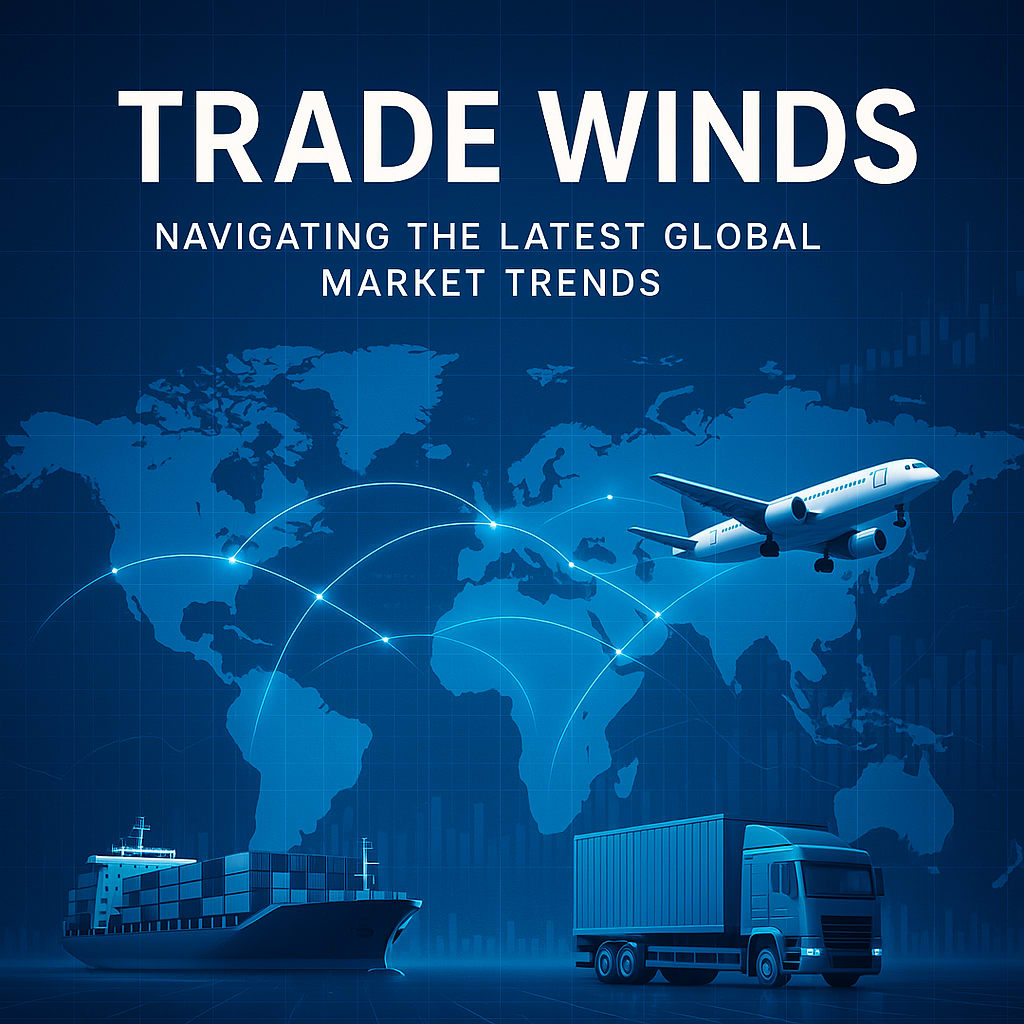
The port of NeoMarin never slept. Day and night, cranes dipped and rose like colossal dancers, lifting containers off ships that arrived in choreographed precision. The sea smelled of salt, steel, and electricity—a modern scent, born of automation and ambition.
Mira Sato, Trade Forecaster at Aether Logistics, leaned against the observation glass of the control tower, sipping synthetic coffee. Her eyes weren’t on the sea. They were fixed on her tablet, where the AI system VANTA had just flagged something... strange.
“A demand spike?” she muttered, frowning.
The screen pulsed with real-time data. Orders for lithium, gallium, and tellurium had increased tenfold—yet not from the usual industrial powerhouses. These were coming from tiny, scattered nations. The kind of places that typically dealt in tourism and fisheries, not high-demand tech metals.
"Something’s up," she said aloud, though the only one listening was Nox, her AI assistant.
“No media alerts. No tariff adjustments. No declared manufacturing expansions,” Nox replied in its neutral voice. “But trend convergence indicates a 72% likelihood of technological disruption.”
Mira’s pulse quickened.
Disruptions like this didn’t happen in a vacuum. In the past, these kinds of signals had preceded everything from quantum computing breakthroughs to biotech revolutions. But this one was too quiet. Too clean. It felt... hidden.
She dug deeper.
Layer after layer of shell companies. Each pointing nowhere. The orders were being routed through shadow entities, bounced off global trade hubs, and timed with exquisite precision. Someone was building something. Big. And they didn’t want the world to know—yet.
She opened a global logistics overlay and cross-referenced it with dark web chatter, patent leaks, and crypto flows. A shape emerged: a new kind of energy cell. The materials pointed to a battery—more compact, more powerful, and astonishingly eco-efficient. The kind of tech that could end fossil fuels overnight.
Mira’s breath caught.
She knew what this meant. Whoever controlled this technology wouldn’t just change the market. They would own the future.
She had two choices.
One: report it to the Global Trade Authority, the watchdogs who monitored emergent tech to prevent economic instability.
Or two: find the source herself.
She chose the second.
—
Forty-eight hours later, Mira boarded a freighter under an alias. Destination: Ilhava, a nearly forgotten island port once used for military refueling. Now it was a ghost town on paper—but the data pointed there. Quiet shipments had been rerouting there over the last six months.
As the freighter cut through fog, Mira stood on the deck, watching the outline of Ilhava rise like a mirage. The island shimmered with unnatural activity—cargo drones zipped across the sky, solar farms glowed faintly, and steel structures jutted from the cliffs like the bones of a buried titan.
She was met at the dock by a man in a simple black uniform, no insignia. He offered no name, just a nod.
“You’re early,” he said. “But you read the signs. That counts.”
He led her inland, past labs and warehouses cloaked in secrecy. Inside, engineers worked in silence, coding, testing, assembling. On one screen, Mira caught the schematic of the battery—its size barely larger than a coin, yet its output exceeded anything she’d seen in classified files.
“We call it the Helix Core,” said a woman in a lab coat, approaching. Her name was Dr. Selene Rowe, a name Mira recognized from a defunct MIT clean-energy think tank. “We’ve achieved energy storage density at levels that can power cities, vehicles, and devices indefinitely.”
Mira stared, stunned. “Why hide this? Why not go public?”
Dr. Rowe’s smile was sad. “Because the world isn’t ready. The corporations that control energy would bury this. We needed to build the infrastructure first—quietly. When we emerge, we won’t be asking for permission.”
“You’ve disrupted the global supply chain to protect the rollout.”
“We’ve started a new one. Cleaner, fairer, decentralized. You can join us—or stop us.”
Mira thought of VANTA, the balance of power, the old systems she spent her career trying to optimize. Systems that never changed. Systems that always benefited the same players.
She extended her hand.
“I’m in.”
—
Weeks later, back in NeoMarin, Mira watched the old trade routes shift. Silent as wind, the change was coming. The ports were still busy, but the game had changed.
The trade winds had turned.
And this time, she was riding the wave.
About the Creator
Keep reading
More stories from sodais javid and writers in Trader and other communities.
"Small Steps, Big Dreams: How Every Move Matters"
In the heart of a bustling city, where the sound of honking horns and rushing footsteps filled the air, there was a young woman named Clara who had a dream. Not just any dream, but one that would change her life forever. Clara dreamt of becoming an artist. Not just a painter, but a renowned one, with exhibitions in grand galleries and her work admired by people all over the world. But, there was one problem—Clara didn’t know where to start.
By sodais javid10 months ago in Motivation
Damian Mercer’s Investment Theory and Its Real-World Implementation
Abstract This research report examines the practical application of Damian Mercer’s investment theory, a framework that integrates behavioral finance, risk-adjusted valuation, and adaptive portfolio construction. While Mercer’s theory originated as an academic response to the limitations of classical efficient market assumptions, its true value lies in its applicability to real-world investment decision-making. This paper aims to bridge theory and practice by analyzing the core principles of Mercer’s approach and evaluating how these principles can be implemented across different market conditions, asset classes, and institutional contexts. Through conceptual analysis and illustrative case-based discussion, the report demonstrates that Mercer’s investment theory provides a structured yet flexible methodology for navigating uncertainty, improving long-term returns, and enhancing decision discipline. The findings suggest that, when applied rigorously, Mercer’s framework can serve as a robust guide for both individual and institutional investors.
By Damian Mercer4 days ago in Trader



Comments
There are no comments for this story
Be the first to respond and start the conversation.