
Thermal Camera Market Size and Forecast 2025–2033
Advancements in Infrared Technology and Rising Demand in Security, Industrial Monitoring, and Healthcare to Drive Global Thermal Camera Market Growth


Introduction
The global thermal camera market is experiencing steady expansion as industries increasingly rely on infrared imaging technology for safety, monitoring, and diagnostic applications. According to Renub Research, the thermal camera market was valued at USD 4.29 billion in 2024 and is projected to reach USD 4.61 billion in 2025 and USD 8.11 billion by 2033, growing at a compound annual growth rate (CAGR) of 7.32% from 2025 to 2033.
This growth is largely driven by continuous innovations in infrared sensor technology, rising demand for surveillance systems, and the growing use of thermal imaging in sectors such as industrial maintenance, healthcare, defense, and infrastructure monitoring. Thermal cameras have become essential tools for identifying temperature variations, enabling organizations to detect potential issues before they become costly or dangerous.
Understanding Thermal Camera Technology
A thermal camera is a specialized device that detects infrared radiation (heat energy) emitted by objects and converts it into a visual image known as a thermogram. Unlike traditional cameras that rely on visible light, thermal cameras capture heat signatures, allowing them to operate effectively even in complete darkness or through obstacles like smoke, fog, and dust.
The resulting thermographic images use color variations to represent temperature differences. Warmer areas often appear in shades of red, yellow, or white, while cooler areas appear in blue or purple tones. This visualization allows users to quickly identify temperature anomalies.
Thermal imaging technology plays a vital role across many industries. For example:
Security and surveillance systems use thermal cameras to detect intruders at night or in low-visibility environments.
Healthcare applications include identifying elevated body temperatures that may indicate illness.
Industrial inspections rely on thermal imaging to identify overheating machinery, faulty electrical connections, or insulation problems.
Firefighting operations utilize thermal cameras to locate individuals trapped in smoke-filled environments or identify hidden hotspots after a fire.
Because of their ability to provide real-time temperature insights, thermal cameras have become indispensable in modern monitoring systems.
Porter’s Five Forces Analysis of the Thermal Camera Market
Competitive Rivalry – High
The thermal camera industry is highly competitive and includes several established global manufacturers alongside emerging regional companies. Major players continuously invest in research and development to improve sensor resolution, detection range, and integration with artificial intelligence.
Companies compete aggressively on factors such as product performance, durability, price, and system integration capabilities. The rapid pace of technological innovation means that manufacturers must constantly upgrade their offerings to maintain market relevance.
Threat of New Entrants – Moderate
Entering the thermal camera market requires specialized expertise in infrared sensor design, precision optics, and advanced manufacturing processes. Additionally, companies operating in defense and aerospace segments must comply with strict regulatory requirements.
However, technological advancements and improved access to component suppliers have lowered entry barriers to some extent. New startups and niche manufacturers can enter the market by focusing on specialized applications such as automotive safety systems or consumer electronics.
Bargaining Power of Suppliers – Moderate to High
The production of thermal cameras depends heavily on specialized components such as infrared detectors, optical lenses, and microbolometers. Since only a limited number of suppliers manufacture these components, suppliers can exert considerable influence on pricing and availability.
However, large manufacturers often mitigate this risk by establishing long-term supply agreements or diversifying their supplier networks.
Bargaining Power of Buyers – High
Customers in the thermal camera market—including governments, industrial companies, and commercial organizations—have a wide range of suppliers to choose from. As a result, buyers often compare features, price points, and performance specifications before making purchasing decisions.
This competitive environment provides buyers with significant negotiating power, forcing manufacturers to maintain competitive pricing and deliver superior product performance.
Threat of Substitutes – Low to Moderate
While conventional surveillance cameras and night-vision technologies can serve similar purposes in some scenarios, they cannot match the capabilities of thermal cameras in environments with smoke, fog, or complete darkness. As a result, thermal imaging remains the preferred solution for many critical applications.
Key Growth Drivers of the Thermal Camera Market
Technological Advancements in Infrared Imaging
Rapid innovation in thermal sensor technology has significantly improved the performance of thermal cameras. Advances in sensor resolution, image processing algorithms, and device miniaturization have expanded the potential applications of thermal imaging.
Artificial intelligence and machine learning integration are also transforming thermal camera capabilities. AI-powered systems can automatically detect unusual temperature patterns, improving predictive maintenance and safety monitoring.
Recent product launches highlight the industry’s technological progress. In October 2024, HIKMICRO introduced advanced thermal devices equipped with a 1280-resolution thermal detector, significantly improving image clarity for hunting and outdoor applications.
Growing Demand for Security and Surveillance
Global security concerns have accelerated the adoption of thermal cameras in both public and private sectors. Governments and organizations rely on thermal imaging systems for border monitoring, perimeter security, and infrastructure protection.
Thermal cameras are particularly effective in surveillance applications because they can detect heat signatures regardless of lighting conditions. This capability allows security personnel to monitor large areas continuously, even at night or during poor weather conditions.
For instance, in May 2024, 3S System Technology launched advanced thermal IP cameras designed to improve security monitoring and threat detection.
Expanding Industrial Applications
Thermal cameras have become essential tools in industrial environments for predictive maintenance and equipment monitoring. By identifying temperature anomalies in machinery or electrical systems, companies can detect problems early and prevent costly failures.
Industries such as manufacturing, energy, and oil and gas rely heavily on thermal imaging for preventive inspections. These systems help organizations maintain operational efficiency while reducing downtime and safety risks.
In April 2024, Seek Thermal introduced the FirePRO 300, a high-resolution thermal camera designed specifically for firefighters and industrial safety professionals.
Challenges in the Thermal Camera Market
High Cost of Thermal Imaging Devices
One of the major barriers to wider adoption is the relatively high cost of advanced thermal cameras. High-resolution models equipped with sophisticated sensors and analytics software can be expensive, making them less accessible for small businesses and budget-conscious organizations.
Although prices have gradually decreased due to technological improvements and larger production volumes, cost remains a limiting factor in some markets.
Regulatory and Certification Requirements
Thermal cameras used in sensitive sectors such as healthcare, aviation, and defense must meet strict regulatory standards. Obtaining certifications for safety, accuracy, and operational reliability can be time-consuming and expensive.
Additionally, regulatory requirements vary across regions, which can complicate international market expansion for manufacturers.
Handheld Thermal Camera Market
Handheld thermal cameras are among the most widely used thermal imaging devices due to their portability and ease of use. Professionals in industries such as electrical engineering, construction, and facility management rely on handheld devices for quick inspections.
These compact cameras allow technicians to identify overheating components, insulation defects, or mechanical issues on-site. Continuous improvements in sensor technology have also made handheld devices more affordable and accessible.
In April 2024, PARD introduced the Sphinx 384 Thermal Handheld Camera and Rifle Scope, combining handheld inspection capabilities with advanced thermal imaging features.
Cooled RD Detector Thermal Camera Market
Cooled RD detector thermal cameras are designed for high-precision applications requiring superior sensitivity and long-range detection. These systems use cryogenic cooling technology to reduce sensor temperature, improving image quality and measurement accuracy.
Although these cameras are more expensive and require specialized maintenance, they are widely used in defense, aerospace, and scientific research where precision is critical.
As global defense spending continues to rise, demand for cooled detector thermal cameras is expected to increase steadily.
Security and Surveillance Thermal Camera Market
Thermal cameras play a crucial role in modern surveillance systems. Their ability to detect heat signatures allows security personnel to monitor environments even in complete darkness or challenging weather conditions.
Applications include border security, critical infrastructure monitoring, law enforcement operations, and residential safety systems. As global security threats evolve, the demand for advanced thermal surveillance technologies continues to grow.
Industrial Thermal Camera Market
The industrial sector is a major driver of thermal camera adoption. Companies use thermal imaging for equipment diagnostics, electrical inspections, and energy efficiency analysis.
Thermal cameras help identify overheating motors, faulty wiring, and insulation issues before they cause operational disruptions. As industries adopt Industry 4.0 technologies, thermal cameras are increasingly integrated with IoT platforms and predictive maintenance systems.
This integration allows real-time monitoring of equipment performance and improves operational reliability.
Commercial Thermal Camera Market
Commercial applications of thermal cameras include building inspections, HVAC diagnostics, and energy management. Property managers and construction professionals use thermal imaging to identify heat leaks, moisture intrusion, and electrical problems.
As organizations focus more on sustainability and energy efficiency, thermal cameras have become valuable tools for evaluating building performance and reducing energy consumption.
In September 2024, ACSL Inc. announced new thermal imaging solutions aimed at improving commercial inspection and facility management operations.
Regional Market Insights
United States
The United States represents one of the largest markets for thermal cameras due to strong demand in defense, industrial inspection, and security sectors. Technological innovation and increasing adoption of smart monitoring systems continue to drive growth in the country.
Germany
Germany’s thermal camera market benefits from its advanced manufacturing sector and strong emphasis on engineering excellence. Industries such as automotive production, energy management, and industrial automation increasingly rely on thermal imaging for monitoring and maintenance.
India
India’s thermal camera market is expanding rapidly as industries adopt advanced monitoring technologies. Growing manufacturing activities, infrastructure development, and government initiatives aimed at improving public safety are boosting demand for thermal cameras.
Programs such as Digital India are encouraging the development of indigenous imaging technologies, helping strengthen the domestic thermal camera ecosystem.
Saudi Arabia
Saudi Arabia is witnessing increased adoption of thermal cameras in oil and gas facilities, infrastructure projects, and security operations. The country’s Vision 2030 initiative emphasizes technological modernization, which is expected to drive further investment in thermal imaging solutions.
Recent Developments in the Thermal Camera Industry
Several technology companies are launching new thermal imaging solutions to expand their market presence.
In March 2025, Teledyne FLIR introduced radiometric versions of its Boson+ and Hadron 640R+ thermal camera modules, enabling pixel-level temperature measurement.
In January 2024, Hanwha Vision launched AI-enabled radiometric thermal cameras designed for industrial and infrastructure monitoring.
Additionally, Raythink’s PC5 series thermal cameras, released in December 2024, combine thermal and visible light imaging for enhanced perimeter security and forest fire detection.
These innovations demonstrate how thermal imaging technology is evolving rapidly to support advanced monitoring systems across industries.
Final Thoughts
The global thermal camera market is poised for significant growth over the next decade as industries increasingly adopt infrared imaging technology for safety, monitoring, and efficiency improvements. With the market expected to reach USD 8.11 billion by 2033, thermal cameras will play an increasingly important role in modern surveillance, industrial diagnostics, and healthcare monitoring.
Continuous technological innovation, combined with rising security concerns and the expansion of industrial automation, will further strengthen demand for thermal imaging solutions. Although challenges such as high costs and regulatory requirements remain, ongoing advancements in sensor technology and manufacturing processes are expected to make thermal cameras more accessible in the coming years.
As organizations across sectors recognize the value of temperature-based monitoring systems, thermal cameras are set to become an essential component of the global technology landscape.
About the Creator
Dark Chocolate Market Size and Forecast 2026–2034
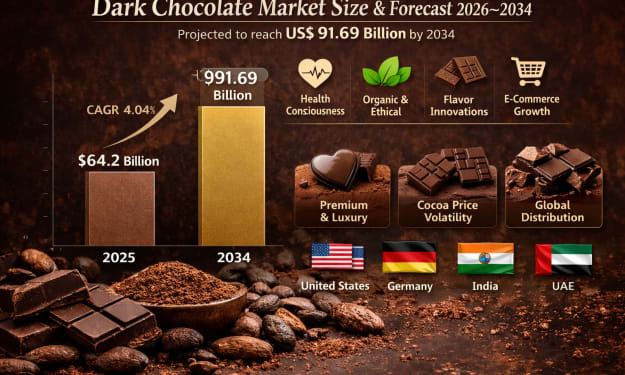
The global Dark Chocolate Market is entering a transformative decade. According to Renub Research, the market is projected to grow from US$ 64.2 billion in 2025 to US$ 91.69 billion by 2034, expanding at a CAGR of 4.04% between 2026 and 2034. This steady growth reflects a powerful shift in consumer behavior: indulgence is no longer just about taste—it is about wellness, sustainability, authenticity, and premium experiences.
By Sakshi Sharma6 days ago in Trader
Global Household Cleaners Market Size and Forecast 2026–2034
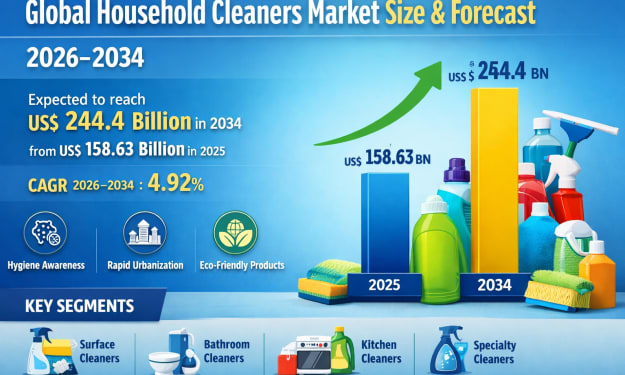
Introduction The global household cleaners market is witnessing steady expansion as hygiene awareness, urbanization, and environmental consciousness continue to influence consumer behavior worldwide. Household cleaning products have become an essential part of daily life, helping maintain cleanliness, safety, and health across residential environments. From disinfectants and surface cleaners to specialty and kitchen cleaning products, these solutions ensure hygienic living spaces while improving convenience for modern households.
By Sakshi Sharmaa day ago in Trader

Comments
There are no comments for this story
Be the first to respond and start the conversation.