
The U.S.-China Trade Conflict
From tariffs to technology, the world’s two largest economies are locked in a high-stakes battle shaping the future of global trade
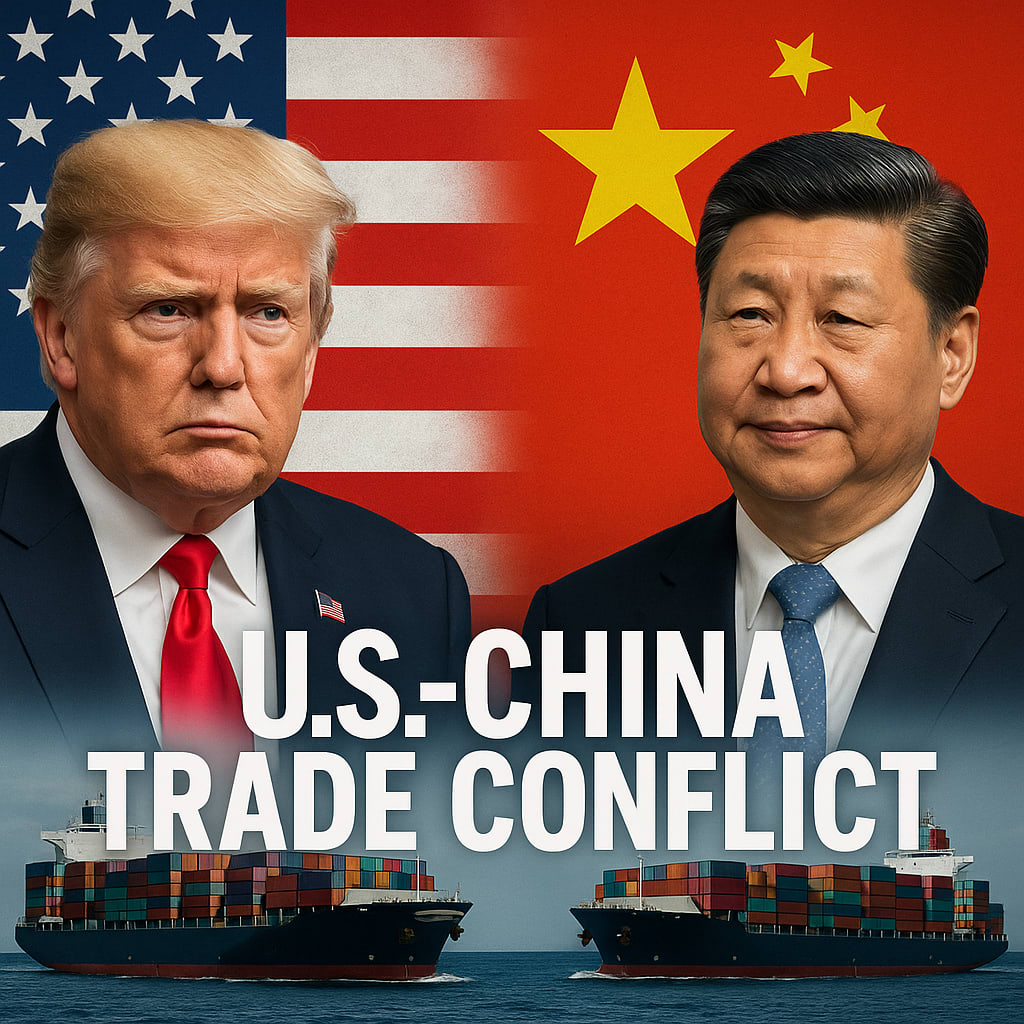
The U.S.-China trade conflict represents one of the most significant geopolitical and economic confrontations of the 21st century. What began as a dispute over trade imbalances has evolved into a multi-dimensional struggle involving technology, national security, and global influence. As the world watches closely, the implications of this conflict stretch far beyond bilateral relations — they have redefined international trade norms and reshaped alliances across the globe.
Origins of the Conflict
The roots of the U.S.-China trade war trace back decades, but tensions escalated dramatically during Donald Trump's presidency. In 2018, Trump launched a series of tariffs on Chinese goods, aiming to reduce the U.S. trade deficit and penalize China for alleged unfair trade practices, including intellectual property theft, forced technology transfers, and subsidies to state-owned enterprises.
China retaliated with its own tariffs, targeting American agricultural products, automobiles, and industrial goods. The result was a tit-for-tat tariff escalation that disrupted global supply chains, roiled markets, and strained relations between the world’s two largest economies.
Key Issues Behind the Trade War
1. Trade Imbalance
The U.S. consistently runs a large trade deficit with China. While American consumers benefit from low-cost Chinese goods, U.S. policymakers argue that China’s state-driven economic model creates an uneven playing field.
2. Intellectual Property Rights
American companies and policymakers have long accused China of intellectual property theft. Reports of forced technology transfers — where foreign firms must share tech to access Chinese markets — have been a major grievance.
3. Industrial Policy and State Capitalism
China’s “Made in China 2025” plan, which aims to dominate advanced technologies like AI, semiconductors, and robotics, has alarmed Western nations. The U.S. views this initiative as a challenge to its technological and economic supremacy.
4. National Security Concerns
Beyond economics, the trade war has also reflected deepening mistrust. The U.S. has placed restrictions on Chinese tech firms like Huawei and TikTok, citing data security and espionage fears, while China sees these moves as attempts to curb its rise.
Impact on Global Trade and Markets
The economic fallout from the conflict has been widespread. Global companies reliant on Chinese manufacturing or American markets have faced uncertainty, rising costs, and supply chain disruptions. For example:
Apple has seen production risks in China.
U.S. farmers suffered due to China halting soybean and pork imports.
Technology firms have been caught in crossfire over semiconductor bans and licensing issues.
Stock markets have responded to trade developments with volatility, and the World Trade Organization (WTO) has faced criticism for its inability to effectively mediate disputes of this magnitude.
Strategic Shifts and New Alliances
As the conflict deepened, both nations adapted their strategies:
China accelerated trade diversification, seeking deeper ties with Southeast Asia, the EU, and African nations. Initiatives like the Regional Comprehensive Economic Partnership (RCEP) and the Belt and Road Initiative have increased China’s economic influence in the Global South.
The U.S. has sought to “de-risk” its economy by encouraging reshoring of manufacturing, strengthening ties with allies (e.g., Japan, South Korea, India), and forming economic blocs like the Indo-Pacific Economic Framework (IPEF).
These shifts reflect a broader trend: a decoupling of the two economies in critical sectors, particularly in high-tech industries like semiconductors, AI, and telecommunications.
Where Are We Now?
As of 2025, trade tensions remain high. Under a second Trump administration, tariffs have been reintroduced or expanded, with recent moves to impose 145% tariffs on certain Chinese goods, prompting Beijing to respond with 125% counter-tariffs. These actions have reignited fears of a full-scale trade war, further destabilizing markets and prompting fresh warnings from economists about global recession risks.
At the same time, both countries have expressed interest in limited negotiations to stabilize relations. In April 2025, U.S. and Chinese trade envoys met in Geneva for backchannel talks, with hopes of reaching a truce or at least establishing ground rules for future engagement.
Global Reactions and Consequences
Other nations have been forced to adapt to the new reality. Countries like Vietnam, India, and Mexico have benefited from companies relocating manufacturing operations to diversify away from China. Meanwhile, the European Union is walking a diplomatic tightrope, trying to balance economic ties with both the U.S. and China.
International institutions, including the WTO and IMF, have called for a rules-based multilateral framework to resolve disputes, though both the U.S. and China have shown increasing skepticism toward these bodies.
The Future of U.S.-China Trade Relations
Looking ahead, the trade conflict is unlikely to disappear anytime soon. Instead, it’s evolving into a broader strategic competition that includes economic influence, military presence, and ideological alignment. Some analysts warn of a "new Cold War" where both sides form competing blocs with limited cooperation.
Yet, there’s also a recognition that complete decoupling is neither feasible nor desirable. Both economies are deeply interconnected, and global challenges like climate change, pandemic response, and AI governance demand collaboration.
Conclusion
The U.S.-China trade conflict is more than a dispute over tariffs — it’s a reflection of a shifting world order. As Washington and Beijing navigate an increasingly complex relationship, their choices will shape the global economy for decades. Whether through rivalry, cooperation, or cautious coexistence, the trajectory of U.S.-China relations remains one of the most critical stories of our time.
About the Creator
Silver Price Boom: What Is Driving This Sudden Market Shift
The silver price has been rising sharply, surprising both investors and regular buyers. This sudden boom is caused by multiple factors that influence the market. Understanding why the silver price is moving can help you make better decisions whether you are investing, buying silver jewelry, or using it for business purposes.
By John.doe7985 days ago in Trader
Australia Industrial Gas Cylinders Market to Surge as Manufacturing and Healthcare Demand Expands
The Australia industrial gas cylinders market reached USD 133.02 million in 2024 and is forecast to climb to USD 191.31 million by 2033, exhibiting a compound annual growth rate (CAGR) of 4.12% during the period from 2025 to 2033. This growth reflects increasing demand across multiple industry verticals, notably manufacturing and healthcare, where high-pressure cylinders play a crucial role in processes such as welding, cutting, medical gas delivery and specialty gas storage.
By Rashi Sharma5 days ago in Trader




Comments
There are no comments for this story
Be the first to respond and start the conversation.