
The Pitfalls of Trading: Why You Can't Be Successful
By Benjamin Carson


Why can't I be successful in trading?
Most traders come across this career off a successful friend or colleague or from a story or video they read on the internet.
That is basically setting them up for failure immediately. Imagine you watched a pro baseball player win a game and at the end of the day you joined a Rec league to learn and decided to go pro a month later.
You’d be eaten alive.
However, because the barrier to entry is so low for trading, people do just that. Here’s what you need to realize instead.
The average window it takes to learn this career and all the nuances and specifics you need to actually succeed here is between 5–10 years.
Most people hear they can make as much as a doctor but get frustrated if they can’t learn how in 6 months of hard weekend work. It takes a doctor 12 years of school and practice to make that type of money but traders expect it by buying a course for $1997.
That’s a lie. Sold by a failed trader to an aspiring trader.
Here’s how you succeed.
- Accept that anyone can enter this business. As a result of a low barrier to entry, the washout rate is going to be extremely high. Think 90% plus within 24 months.
- No one knows what works for them when they start so they try it all. Breakouts, pullbacks, ranges, equities, forex, options. They are chasing 13 strategies at a time and going no where.
- You have to master one setup on one market before you move on. If you don’t know what to master first, take up to a month to decide trying out all of them on demo and then decide. This market does not reward the jack of all trades master of none.
- Real risk management is not turning a $5,000 into $50,000. That’s massive gambling. Anyone who says that’s the way to succeed is a colossal salesman. If that was truly repeatable over and over again, they wouldn’t sell a system for $500-$5000, they’d just rinse and repeat their system.
- Risk management is risking 1–2% of your account per trade. On a small account you may not be able to follow those rules, but you need to be thinking long term about trading a 6 figure account. Would you be taking this trade if you were risking $1,000 on it? If no, why take it just because you’re only risking $100?
- Traders who put their own time limit on this fail. It might take you 10 years to master this. If it does, would you still do it?
- Money is the reason most start trading. Working from home, making more money, financial freedom, whatever it is. That can be a starting factor but it won’t give you the motivation to stick with the grind. Find your why, and you’ll get through the throat punches rather easily.
- When you master a system, get it coded and automate as much as you can of it. The ultimate goal here is to build an edge and keep yourself out of the equation as much as possible.
- Whatever personal demons you have will show up in trading, you have to find a way to get past them. Everyone is unique here.
- Books are someone’s life story in paper form. Trading books are exceptionally helpful. Read a book a month if not a week. There’s so much knowledge you can learn this way.
- Technical and fundamental analysis both rely on personal decisions. There’s no perfect technical or fundamental buy point. It’s all a range that will be proved right or wrong by the market.
- There’s no holy grail. What works on Monday fails on Tuesday. It’s about accepting its a coin flip but if you win $2 and lose $1 and do that 1000x you’ll make a lot of money. It’s all about making more on winners than you lose on your losers.
- Have a hard stop. Always. Mental stops means you’ll adjust when it’s hit.
- Don’t start if you aren’t truly wanting to finish. This is the toughest game on the planet. Money is not enough of a reason here.
- Trading isn’t gambling. Learn the differences.
- Find a mentor or a coach but only if they help you work on you. Copying someone’s else’s system is guaranteed failure long term. You’ll always be buying their new system or doubting their calls when they have a few losers. It’s an awful approach.
Trust your edge once it’s there.
Fintwit is free. Trust the opinions of theirs accordingly.
About the Creator
Edge Alexander
Captivating wordsmith, crafting transformative narratives that spark curiosity, ignite conversation, and leave an indelible mark.
https://gogetfunding.com/to-make-a-difference/
Keep reading
More stories from Edge Alexander and writers in Trader and other communities.
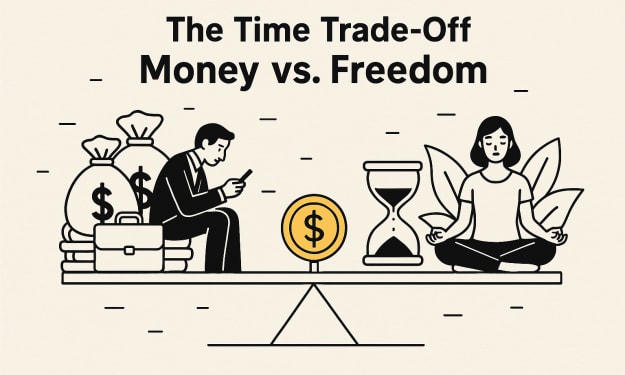
Money vs. Freedom
Time is the one resource we can never truly get back. We often sacrifice it in the pursuit of financial success, believing that more money will lead to greater freedom. But does it? Many people find themselves stuck in a cycle where their time is constantly traded for wealth, leaving little room for personal well-being. This struggle raises a crucial question: Are we using time wisely, or are we simply selling it to the highest bidder?
By Edge Alexander8 months ago in Trader
Australia Cosmetics Market: Beauty Demand, Innovation & Consumer Trends
Australia Cosmetics Market Overview The Australia cosmetics market is experiencing robust growth as consumer interest in beauty, personal grooming and wellness continues to rise. Cosmetics — including makeup, skin care, fragrances, hair care and colour cosmetics products — are essential components of modern personal care routines. The Australia cosmetics market size reached USD 8.40 Billion in 2024. Looking forward, the market is expected to reach USD 12.62 Billion by 2033, exhibiting a growth rate (CAGR) of 4.63% during 2025-2033. This growth reflects increasing beauty awareness, evolving product innovations, strong omni-channel retail presence and a younger population segment that places higher value on appearance, self-care and premium beauty experiences.
By Amyra Singh2 days ago in Trader
Center Stage with Paul Stewart
*** I'm keen to republish the interviews I did for my series with Vocal creators. It's been a few years and I thought it might be nice to revisit these wonderful conversations. I'll be releasing them one at a time for a few weeks/months.
By Heather Hublera day ago in Interview



Comments
There are no comments for this story
Be the first to respond and start the conversation.