
The Journey of Pursuing a Forex Trading Dream in South Africa Despite Family and Friends' Doubts
Overcoming Skepticism and Isolation


The room fills with tense silence as I close my laptop, my fingers lingering for a moment on the keyboard. I just lost another trade. In seconds, the market dropped, my stop-loss hit, and boom—I’m down another hundred. I stare at the screen, still trying to process how it went so wrong so quickly. Trading is hard enough, but doing it without a support system feels even harder.
When I first told my family I wanted to trade Forex, they thought I was crazy. It was two years ago, and I remember sitting across from my dad, the weight of his stare making my hands clammy. “Forex?” he said, as if the word was some kind of joke. “Trading currencies online? That’s not a job. That’s just... gambling.”
My mom didn’t say much. She rarely does in these situations, but the look on her face said enough. The polite, disappointed smile, the slight shake of her head, her eyes already looking elsewhere. I tried explaining how the market works, the idea of technical analysis, and all the strategies I’d been reading up on, but they’d already tuned out.
My friends weren’t much better. “Why don’t you just get a normal job?” they’d ask, laughing like I’d told the punchline to a joke. “The markets are rigged, man. You’re never going to make any real money.” Some of them even teased me, saying I’d be broke by the end of the year. “Why don’t you just go into crypto if you’re gonna risk it all?” one of them snickered. That one hurt. I wanted to say, “Because I actually believe in this. I’m not chasing a quick buck.”
It was so hard to keep going in the face of that. In South Africa, Forex trading isn’t exactly a respected career choice. It’s usually associated with scams, with people selling dreams of instant riches, flashy cars, and Instagram fame. And I get it. It’s why my family’s skeptical. They don’t want to see me get sucked into something that could leave me broke and desperate. But what they don’t see—what no one really sees—is the hours I spend studying, the nights I stay up analyzing charts, the spreadsheets I pore over until my eyes blur. They don’t see the actual work.
One night, I’m up at 2 a.m., my eyes glued to the screen as I watch the USD/ZAR chart, heart pounding as I follow every dip and rise. I’ve been up since 5 a.m. for my day job, and I know I’ll pay for this sleep deprivation tomorrow, but right now, it’s worth it. I feel a thrill, a sense of purpose. The market moves up, and I see my entry point—green light. My fingers move automatically, setting the trade, watching as my position goes live. For a few minutes, I’m riding the high, until suddenly, the chart dips in a flash. I’m scrambling, adjusting my stop-loss, but the market slips away faster than I can react.
I lose, but weirdly, it doesn’t crush me. I feel the frustration, yes, but it’s mixed with a strange satisfaction. I’m learning, adapting. For every trade that goes wrong, I’m one step closer to mastering this. I know there’s something here for me.
At family dinners, they don’t ask about my trades anymore. I can’t tell them how close I came to a breakthrough last month or how I’m fine-tuning my strategy. They don’t see that I’ve started reading economic reports, studying charts like my life depends on it, or that I’m saving up to invest more seriously. I try mentioning a trade I’d done well on, just to see if they might show a flicker of interest, but my dad quickly changes the subject to my brother’s recent promotion.
I meet other traders online who get it, who know what it’s like to wake up in the middle of the night to check your position, to feel your pulse quicken as you execute a trade. These strangers understand my passion in a way my family and friends never could. I trade tips with them, swap stories of both wins and losses. They tell me to keep going, that it’s possible to make it if I don’t give up. Sometimes I wish I could introduce them to my parents, show them that these people are real, with lives and families, and not just some anonymous scammers online.
Then, one day, something changes. I’m visiting my cousin, who has always been more open-minded, and she casually mentions that she’s heard people can actually make good money in Forex if they’re smart and careful. I feel a spark of hope. “Yeah,” I say, cautiously, “but it takes a lot of time and work. It’s not a get-rich-quick thing.”
She nods, genuinely interested, and for the first time, I don’t feel like I’m explaining myself to someone who’s already written me off. I tell her about the strategies I’m working on, the accounts I follow, the books I’m reading. She listens, really listens, and when I leave her house that day, I feel lighter. Maybe I can do this, even if most people don’t get it.
Months pass, and I finally have my first big win. I’ve been tracking the USD/ZAR exchange rate for weeks, watching it follow a predictable pattern. It’s early in the morning, just as the market opens, and I execute a trade. I watch as the price moves in my favor, hitting my target perfectly. When I close the trade, I’ve made more money in a single day than I used to make in a month at my old retail job. I’m so overwhelmed, I don’t know whether to laugh or cry.
When I tell my family, they don’t believe me at first. But slowly, things change. My dad asks questions, cautious and skeptical, but there’s a hint of curiosity in his tone. My mom starts telling her friends that I’m “doing something interesting with trading,” though she still doesn’t quite get it. It’s a small victory, but it feels huge to me. For the first time, I feel a sliver of support.
I still have a long way to go, and trading hasn’t magically fixed my life. But it’s given me purpose, a goal that’s mine and mine alone. In a world where I felt misunderstood and written off, I’m finally finding my own path, even if it’s not the one my family had in mind for me.
About the Creator
Keep reading
More stories from Tebogo Mmotla and writers in Trader and other communities.
From Beginner to Expert
Chapter 1: The Rookie Trader (Beginner) I still remember the first time I opened a trading platform; it felt like entering a chaotic marketplace in a foreign land. I’d read about the stock market and watched videos on forex, thinking I could learn the ropes quickly. My first mistake was expecting quick riches – a misconception that cost me dearly. I started trading impulsively, convinced I could predict price movements. Without a strategy, every loss felt like a personal failure. But I was determined to improve, and slowly, I started to see losses as lessons instead of setbacks.
By Tebogo Mmotlaabout a year ago in Trader
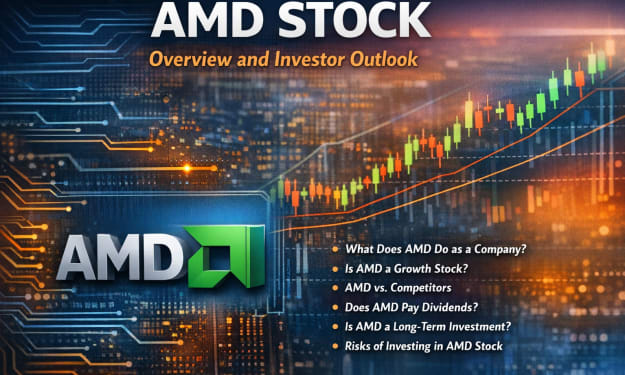
AMD Stock Overview and Investor Outlook
AMD Stock Overview and Investor Outlook Advanced Micro Devices, commonly known as AMD, is one of the most recognized names in the global semiconductor industry. The company designs high performance processors and graphics technologies used in personal computers, data centers, gaming consoles, and embedded systems. AMD stock attracts strong attention from investors due to its role in artificial intelligence, cloud computing, and high performance computing markets.
By America today 6 days ago in Trader
When Everything Rises at Once
Equity markets are printing record highs. Gold is rewriting its historical peak. Silver is accelerating with unusual force. At the same time, the U.S. dollar remains firm. Under normal market logic, these moves should not coexist. One asset class rising typically implies pressure elsewhere. Yet today, that textbook balance has broken down.
By crypto genie8 days ago in Trader


Comments
There are no comments for this story
Be the first to respond and start the conversation.