
The Day the Market Stood Still:
The Day the Market Stood Still” is a powerful stock market crash story about chaos, stillness, and rediscovering what truly matters when money loses its meaning. A heartfelt tale of resilience, humanity, and hope beyond numbers.

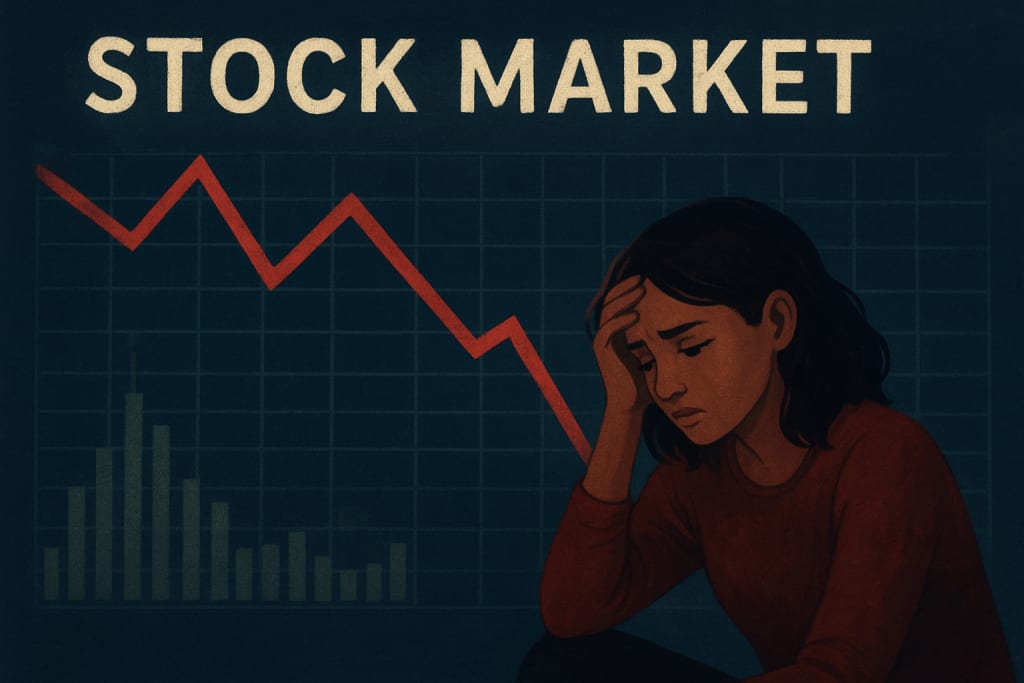
The world never expected the screens to go dark.
Not the traders on Wall Street.
Not the analysts in Singapore.
Not the young investors scrolling through their apps over morning coffee.
But one morning, the numbers simply stopped moving.
No prices changed. No trades went through. The stock market the beating heart of global finance had frozen.
And in that silence, millions realized how much of their lives revolved around something they couldn’t even touch.
For Maya Patel, a small-town trader from Mumbai, it was more than just numbers vanishing from a screen it was her entire way of life collapsing in real time.
This is a stock market crash story not about loss, but about rediscovery about what happens when the world’s obsession with profit suddenly meets the stillness of truth.
When the Screens Went Black?
At first, everyone thought it was just another glitch.
Markets go down. Systems lag. Apps crash.
It was nothing new.
But then, minutes turned into hours.
By noon, traders around the world were calling it The Freeze.
No data. No trades. No updates.
Banks couldn’t access funds. Portfolios vanished. Stock tickers across New York, London, and Tokyo showed nothing but a still line flat, unmoving, lifeless.
The chaos didn’t come from the crash itself.
It came from the silence.
People panicked, not because they lost money but because they couldn’t see their worth anymore.
Maya’s Ordinary Morning:
Maya wasn’t a big investor.
She traded small penny stocks, mutual funds, bits of crypto here and there.
Her world was a secondhand laptop, a cup of strong chai, and a dream that someday she could help her parents retire early.
When the markets froze, she didn’t panic.
At first.
She simply refreshed the page. Then again. Then again.
Still nothing.
Her chat group of traders was exploding with messages:
“Market’s dead!”
“Global crash!”
“Is this the end?”
For the first time in years, Maya felt something strange quiet.
She looked around her small apartment.
The plants she’d forgotten to water.
The half-read books gathering dust.
The sky outside, orange with morning light.
For once, she wasn’t chasing numbers.
She was simply there.
The Domino Effect:
By evening, chaos had spilled into the streets.
Supermarkets ran low on supplies.
Banks limited withdrawals.
Investors protested outside offices demanding answers.
News channels played the same headlines: “Global Market Freeze Continues.”
Experts argued over causes cyberattack, system overload, government sabotage but no one really knew.
The stock market had always been a symbol of movement, energy, and ambition.
Now it had become a symbol of fragility.
What happens when a world built on constant motion suddenly stops?
A City Without Currency:
Maya walked to the grocery store the next morning.
The digital payment app she used wouldn’t open.
The card machine didn’t work.
Cash was all that mattered again and she didn’t have much of it.
The store owner, an old man named Ravi, recognized her.
He smiled faintly and said, “Take what you need. Pay me later.”
It was such a small moment a gesture most people would overlook but it broke something inside Maya.
She’d spent years believing numbers defined value.
Now, kindness was the new currency.
Days Turn into Lessons:
As the days passed, life shifted in strange ways.
Neighbors who barely spoke began sharing food.
People bartered old clothes for bread, books for milk, time for trust.
The stock market crash story became something deeper a story about human connection.
Maya began to trade again, but not in the way she once did.
She traded her skills.
She taught local teens about budgeting and finance with chalk and a blackboard instead of graphs and apps.
She started to see the beauty in simplicity.
The joy of helping someone understand their first savings.
The peace of not checking numbers every hour.
The stillness that once frightened her had become her freedom.
Meanwhile, the World Burned:
Governments scrambled to restore systems.
Corporations tried to rebuild trust.
But people were changing faster than the system could recover.
Without the constant noise of stocks rising and falling, many began questioning everything:
Why were they working endless hours?
What did wealth really mean?
Was the system ever truly stable?
Some called it a crisis.
Others, a reset.
For Maya, it was a revelation that even the most powerful systems are only as strong as the humans behind them.
When the Market Finally Returned:
On the 10th day, the screens came back to life.
The lines moved again.
The prices flickered.
The world collectively exhaled.
People rushed to trade, to buy, to sell, to feel control again.
But Maya didn’t rush.
She watched quietly as numbers danced once more across her screen.
She smiled not in relief, but in recognition.
Because this time, she knew something everyone else had forgotten:
The market could stop again tomorrow, but life real life would keep moving.
The New Trade:
Maya decided to start something new a small community exchange in her neighborhood.
No money. No banks.
People traded skills, food, and time.
A tailor fixed clothes for a baker.
A teacher offered lessons for a farmer’s produce.
A carpenter repaired old furniture in exchange for a few meals.
It wasn’t glamorous, but it was real.
It was the first economy she’d seen that didn’t need graphs to prove its worth.
Maya wrote on the blackboard at the center of the exchange:
“Trade with kindness. Earn with honesty.”
It became the new motto of her life.
The Lesson Beneath the Numbers:
This stock market crash story isn’t about losing everything.
It’s about seeing clearly what was never lost.
Maya realized that she’d spent years measuring success by screens, by graphs, by profits that came and went.
But in those ten silent days, she found something that numbers could never calculate self-worth, connection, and peace.
We often think stability comes from systems.
But real stability comes from people from the ability to care, adapt, and rebuild when everything else breaks.
A World Changed Forever:
Months later, the crash was just a memory.
Markets recovered. Analysts moved on.
But something had shifted.
More people started saving consciously.
Communities created small trade circles.
Investors became more mindful about where they put their money.
And somewhere in Mumbai, Maya still hosted her weekly barter meet now called The Human Market.
It wasn’t about profit.
It was about purpose.
Because she’d learned that the day the market stood still was the day the world finally learned to move again slowly, sincerely, and together.
Conclusion:
When the world of numbers stopped, the world of hearts began to move.
This stock market crash story reminds us that no system is truly unbreakable and maybe that’s a good thing.
Because only when everything stops do we hear what really matters.
Maya didn’t just survive the crash.
She changed her meaning of wealth.
And maybe that’s the lesson the rest of the world was waiting for.
About the Creator
Zeenat Chauhan
I’m Zeenat Chauhan, a passionate writer who believes in the power of words to inform, inspire, and connect. I love sharing daily informational stories that open doors to new ideas, perspectives, and knowledge.
Keep reading
More stories from Zeenat Chauhan and writers in Trader and other communities.
Global Stock Market Today: Major Indices Rally as Investors React to U.S. Inflation and Tech Earnings
The global stock market today is buzzing with energy. Investors around the world are watching closely as major indices swing in response to fresh U.S. inflation data and powerful tech earnings. From Wall Street to Tokyo, markets are showing signs of renewed optimism but also a hint of caution.
By Zeenat Chauhan5 months ago in Trader
Silken Chains
Silhouettes of the female form were given flesh and bone. Silken skin glistened under the spotlight. Dry ice rose around our Icons as they danced atop their podiums in the Square. Heralded for their beauty, their movements were slight, powerful, and sensual.
By Paul Stewart4 days ago in Fiction




Comments
There are no comments for this story
Be the first to respond and start the conversation.