
Technical AI SEO Checklist for AI Crawlers and LLM Indexing
A Practical Technical Guide to Optimizing Your Website for AI Crawlers, Large Language Models, and Next-Generation Search Visibility

If you want to learn How to use AI for SEO, you need more than basic keyword tricks. Today, AI SEO is about helping AI crawlers and large language models understand, trust, and rank your content.
Search engines are changing fast. AI tools now scan, summarize, and recommend content to users. This is why AI SEO has become a key part of modern digital marketing.
In this guide, you will learn a full technical checklist to improve AI SEO, boost LLM indexing, and increase visibility across AI platforms.
AI Crawlers and LLM Indexing
AI crawlers are smart bots that read and understand web pages. They do more than scan keywords. They look at structure, meaning, and context.
LLM indexing means your content is stored and understood by large language models. When your site follows strong AI SEO practices, it becomes easier for AI systems to quote, summarize, or recommend your content.
For example, if your article clearly answers a question, AI tools may use it in generated responses.
Why AI SEO Matters More Than Traditional SEO?
Traditional SEO focused on keywords and backlinks. AI SEO focuses on meaning, structure, and trust.
Search engines now use AI models to judge quality. If your content is confusing, AI may ignore it.
AI SEO helps:
Improve content clarity
Increase AI-driven search visibility
Boost chances of being featured in AI answers
Support voice search and smart assistants
Websites that ignore AI SEO may slowly lose traffic over time.
Technical Foundation for AI-Friendly Websites
Your technical setup is the base of strong AI SEO. Without it, even good content may fail.
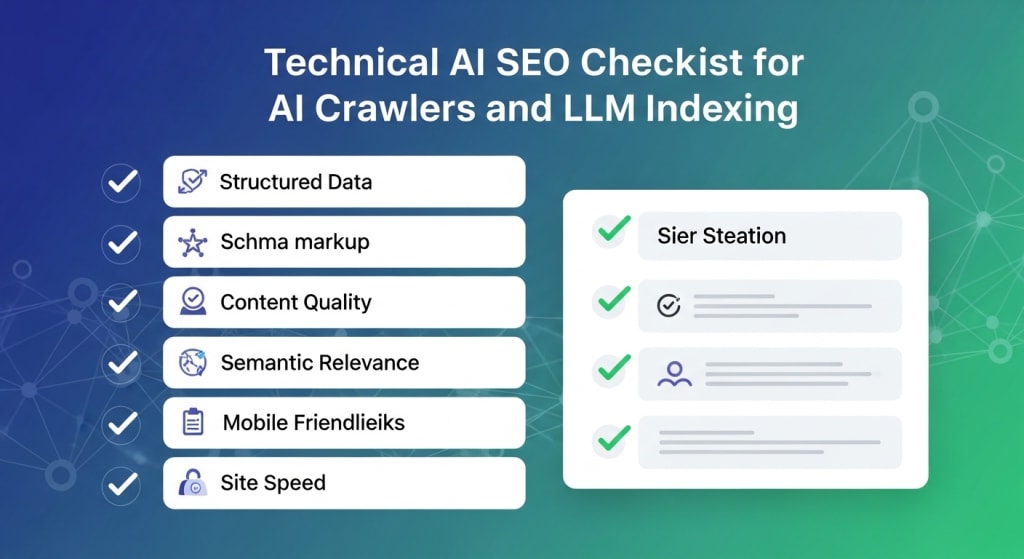
Here is a simple checklist:
Use clean HTML structure
Add proper title and meta descriptions
Create an XML sitemap
Use robots.txt correctly
Improve page loading speed
Make your website mobile-friendly
AI crawlers prefer websites that are fast and easy to read. A slow or broken site can block AI indexing.
Structured Data and Semantic Markup
Structured data helps AI understand your content better. It gives clear signals about what your page is about.
For example, adding FAQ schema shows AI that your content answers questions. This improves AI SEO because machines prefer organized information.
Use:
Schema markup
Clear heading hierarchy (H1, H2, H3)
Bullet points for lists
Short paragraphs
When content is structured well, AI tools can extract answers quickly.
Content Clarity and Context Optimization
AI models read context, not just keywords. So your writing must be simple and direct.
Use short sentences. Avoid complex words.
For strong AI SEO:
Answer one question per section
Define terms clearly
Avoid keyword stuffing
Use natural language
For example, instead of writing robotic text, write like you are explaining to a friend.
This improves both user experience and AI understanding.
How to Use AI for SEO in Content Planning?
Many marketers ask, How to use AI for SEO in a smart way. The answer starts with research and planning.
You can use AI tools to:
Find topic gaps
Analyze search intent
Generate content outlines
Study competitor structure
But do not rely fully on automation. AI SEO works best when humans guide the strategy and edit the content carefully.
For example, AI can suggest headings, but you must ensure they match user needs.
Crawlability and Indexing Control
AI SEO also depends on proper crawl access. If AI bots cannot access your content, it cannot rank.
Check these points:
No blocked important pages in robots.txt
No broken internal links
Clear navigation menu
Logical URL structure
Internal linking is very important. It helps AI understand relationships between pages.
For example, linking related blog posts builds topic authority.
Optimizing for AI Search Interfaces
AI search tools show summarized answers. Your content must be ready for this.
To improve AI SEO for LLM visibility:
Write direct answers at the start of sections
Use question-based headings
Add summary boxes
Keep paragraphs short
AI systems prefer clear, extractable answers. If your page gives value fast, it has a better chance of appearing in AI-generated responses.
Entity Optimization and Topic Authority
AI models understand entities like people, brands, and concepts. AI SEO now focuses on topic depth instead of single keywords.
To build authority:
Cover related subtopics
Use consistent terminology
Link to trusted sources
Update content regularly
For example, if your topic is AI SEO, also discuss indexing, crawling, structured data, and content clarity.
This builds strong semantic signals.
Trust Signals and Content Authenticity
AI tools evaluate trust and credibility. Low-quality or copied content may be ignored.
Improve trust by:
Showing author information
Adding real examples
Using updated statistics
Avoiding misleading claims
Authentic content improves AI SEO performance. When your content is useful, AI platforms are more likely to reference it.
Performance Monitoring and Continuous Improvement
AI SEO is not a one-time task. It requires regular updates.
Track:
Organic traffic changes
Crawl errors
Page speed
Engagement metrics
Use analytics tools to study user behavior. If users leave quickly, improve clarity.
You can also test How to use AI for SEO tools to analyze content quality and structure. But always review results manually.
Content Formatting for Better Machine Understanding
Formatting affects how AI reads your page. Clean formatting supports AI SEO.
Follow these rules:
Use one H1 per page
Break text into small sections
Use lists for steps
Avoid long blocks of text
For example, AI can easily scan bullet points. Large text blocks are harder for machines to summarize.
Good formatting helps both humans and AI crawlers.
Final Thoughts
AI SEO is no longer optional. It is essential for modern search visibility.
If you truly want to understand How to use AI for SEO, focus on structure, clarity, trust, and technical strength. Optimize your site for AI crawlers, improve semantic depth, and make your content easy to extract and summarize.
AI SEO is about helping machines understand your content the same way humans do. When your site is clean, helpful, and structured, it becomes easier for AI systems and LLM indexing tools to recommend it.
About the Creator
Intel Stock Analysis: Can Intel Maintain Its Leadership in Semiconductor Innovation?
Introduction Intel stock is a cornerstone of the semiconductor sector, representing decades of technological innovation and global market influence. Intel Corporation is renowned for designing and manufacturing microprocessors, chipsets, and other semiconductor solutions for computers, data centers, and emerging technologies. As the demand for AI, cloud computing, gaming, and edge computing grows, Intel stock offers investors exposure to both cyclical and structural growth in technology markets.
By Hammad Nawaza day ago in Trader



Comments
There are no comments for this story
Be the first to respond and start the conversation.