
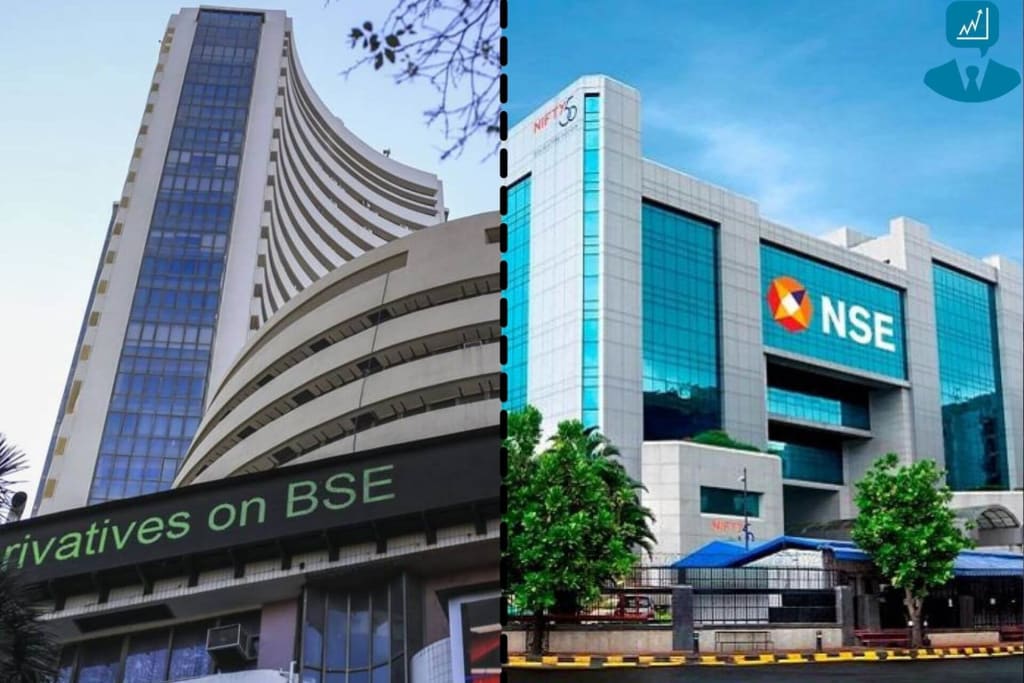
The two Stock Exchange of India are NSE(National Stock Exchange) and BSE(Bombay Stock Exchange). The Stock Exchange in India is regulated by Security and Exchange Board of India(SEBI)
The Bombay Stock Exchange (BSE) was established in 1875 and is one of the oldest stock exchanges in Asia. It was set up as a voluntary non-profit organization and was initially known as "The Native Share and Stock Brokers' Association". The exchange initially conducted its trading activities on the street and later moved to different rented premises before settling at the Phiroze Jeejeebhoy Towers in Dalal Street, Mumbai in 1887.
In the early days, trading on BSE was done through open outcry system, where members would gather in a ring and shout out their buy and sell orders. In 1995, BSE introduced the first-ever electronic trading system, BOLT (BSE On-Line Trading System) which replaced the open outcry system with an automated, screen-based trading platform.
Over the years, BSE has played a pivotal role in the development of the Indian capital market. It has been a trusted name in the Indian stock market for over a century and is considered to be one of the most respected and regulated stock exchanges in the world.
BSE has also been a pioneer in introducing various new products, services, and initiatives to the Indian capital market. It was the first exchange in Asia to introduce the concept of an index-based derivative, S&P BSE SENSEX, in 1986. BSE also launched the first-ever commodity derivative trading in India in 2000.
In 2012, BSE became the first exchange in India to get recognized as a stock exchange under the Securities and Exchange Board of India (SEBI) regulations. It also got recognition as a global exchange by the World Federation of Exchanges (WFE) in 2013.
Today, BSE is the world's fastest exchange with a median trade speed of 6 microseconds and it has more than 5000 companies listed on its platform, making it the largest SME platform in the world.
The National Stock Exchange (NSE) was established in 1992 and began operations in 1994. It was the first demutualized electronic exchange in the country. NSE was set up by a group of leading Indian financial institutions, with the aim of bringing transparency to the Indian capital market.
In the early days, NSE faced competition from the established Bombay Stock Exchange (BSE), which had been in operation for more than a century. However, NSE's advanced technology and trading systems quickly attracted a large number of traders and investors.
NSE's trading systems were fully-automated, which allowed for faster and more efficient trading. This was a major advantage over the BSE, which still used an open outcry system for trading. NSE also introduced the concept of electronic clearing and settlement, which made the trading process more efficient and secure.
In the year 2000, NSE became the first exchange in India to launch internet-based trading platform, which made trading more accessible to retail investors. It also launched its own indices, Nifty 50 and Nifty Next 50, which have become widely followed and used as benchmark indexes.
NSE has also been recognized for its transparent governance practices and has been granted permanent recognition as a Stock Exchange by the Securities and Exchange Board of India (SEBI) in 1993.
In the last few years, NSE has implemented various measures to improve the efficiency, transparency and governance of the Indian capital market. It has also been expanding its product portfolio and has launched new products such as currency derivatives, interest rate derivatives and commodity derivatives. It is also recognized as the exchange with the highest number of derivatives contracts in the world by the World Federation of Exchanges (WFE) in 2017.
NSE outshines BSE:
The National Stock Exchange (NSE) is considered to be one of the premier exchanges in India and is known for its advanced technology and trading systems. Some of the key advantages of NSE over the Bombay Stock Exchange (BSE) include:
Faster and more efficient trading systems: NSE has a fully-automated trading system, which allows for faster and more efficient trading.
Larger trading volume: NSE has a larger trading volume compared to BSE, making it a more liquid and active market.
Listed companies: NSE has a larger number of listed companies, providing investors with a wider range of investment options.
Better transparency and governance: NSE has better transparency and governance practices in place, which helps to protect the interests of investors.
International Recognition: NSE is recognized as the exchange with the highest number of derivatives contracts in the world by the World Federation of Exchanges (WFE) in 2017.
Indexes: NSE has more widely recognized indexes such as Nifty50 and Nifty Next 50 which are more widely followed and used as benchmark index.
Trading Platforms: NSE has more advanced trading platform such as NSE NOW, which allows for faster and more efficient trading for retail traders
Overall, NSE is considered to be more advanced, well-regulated and well-governed than BSE, providing investors with a more secure and efficient platform for trading. It is also more widely recognized and followed by international investors.
About the Creator
Buddy
Buddy is there with Youuuu!!
Philippines Steel Market: Infrastructure Demand, Industrial Growth & Strategic Expansion
Philippines Steel Market Overview The Philippines steel market is a cornerstone of the nation's industrial and infrastructure development, playing a pivotal role in construction, manufacturing, transport, energy and other key economic segments. The Philippines steel market size reached USD 19,488.00 Million in 2024. The market is projected to reach USD 25,695.28 Million by 2033, exhibiting a growth rate (CAGR) of 3.12% during 2025-2033. This growth reflects rising investment in infrastructure projects, urbanisation, industrial expansion and demand from residential and non-residential construction activities — all of which rely heavily on steel products for durability, safety and performance.
By Manisha Dixit7 days ago in Trader




Comments
There are no comments for this story
Be the first to respond and start the conversation.