
Smart Lock Market Size and Forecast 2026–2034
Smart Homes, Safer Cities: How Smart Locks Are Redefining Global Security

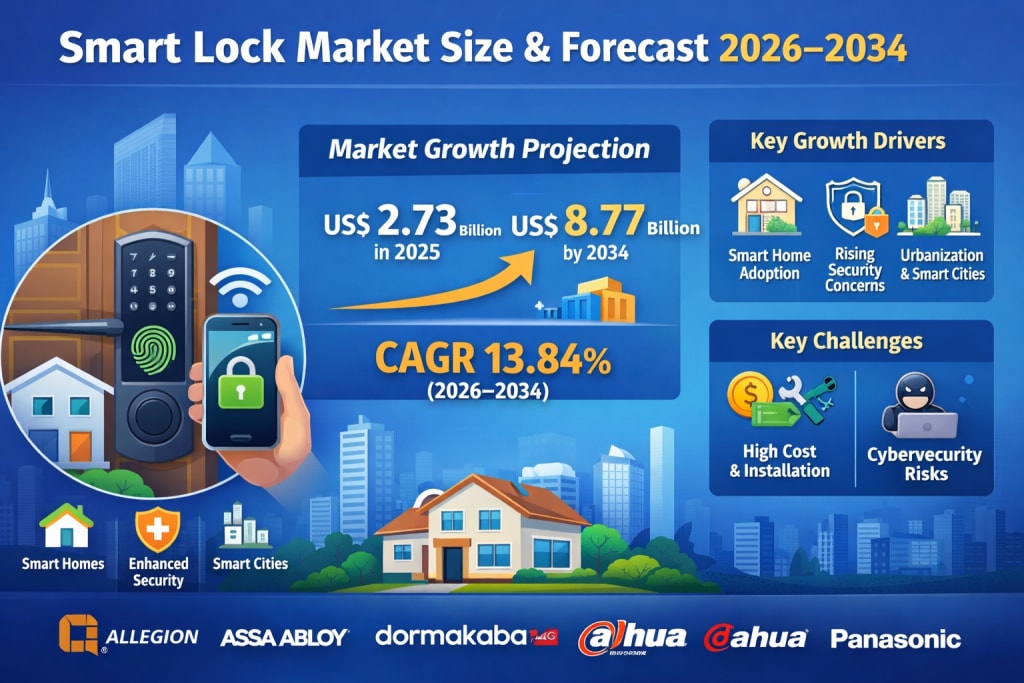
The global smart lock market is entering a transformative growth phase as the world embraces connected homes, digital infrastructure, and advanced security technologies. Traditional lock-and-key systems are gradually being replaced by intelligent security solutions that provide convenience, safety, and remote accessibility.
According to industry insights, the Smart Lock Market is projected to grow from US$ 2.73 Billion in 2025 to US$ 8.77 Billion by 2034, expanding at a compound annual growth rate (CAGR) of 13.84% between 2026 and 2034. This impressive growth trajectory reflects the rising demand for smart home devices, increasing urbanization, and the growing need for reliable digital security solutions worldwide.
Smart locks are rapidly becoming a cornerstone of modern homes, commercial buildings, hospitality spaces, and enterprise environments. As technology continues to evolve and consumers prioritize convenience and safety, the adoption of smart lock solutions is expected to accelerate across both developed and emerging economies.
Smart Lock Market Outlook
A smart lock is an advanced electronic locking device that allows users to secure or access doors without traditional mechanical keys. Instead, these locks utilize digital authentication technologies such as smartphone applications, biometric recognition, PIN codes, Bluetooth, Wi-Fi connectivity, and facial recognition systems.
Unlike conventional locks, smart locks allow users to control access remotely, monitor entry activity, and integrate their security systems with other smart devices within a home or office ecosystem.
The popularity of smart locks has grown significantly among homeowners, property managers, hospitality operators, and corporate organizations. Their ability to provide enhanced control, real-time monitoring, and seamless connectivity with other Internet of Things (IoT) devices has positioned them as a crucial component of the global smart home revolution.
Additionally, increasing digitalization, improved internet connectivity, and the widespread use of smartphones have made smart lock technology more accessible than ever before. As smart living environments continue to expand globally, smart locks are expected to become an essential element of modern security infrastructure.
Growth Drivers of the Smart Lock Market
Increasing Adoption of Smart Home Technologies
One of the most influential drivers of the smart lock market is the growing adoption of smart home ecosystems worldwide. Consumers are increasingly integrating devices such as smart lighting systems, surveillance cameras, voice assistants, and connected appliances to improve convenience and safety in their homes.
Smart locks play a critical role in this ecosystem by enabling remote access control and automation of door security. Homeowners can unlock doors through mobile apps, create temporary access codes for guests, and integrate locks with voice assistants or home automation systems.
In the United States alone, more than 60.8 million households—around 41.3%—adopted smart home technologies in 2024, making it one of the most mature smart home markets globally.
Smart home installations often accompany new residential construction projects, with many developers integrating digital security systems directly into modern housing developments. As consumer awareness increases and smart home ecosystems expand, smart locks are becoming an indispensable component of connected homes.
Rising Security Concerns and Demand for Advanced Access Control
Security concerns remain one of the most powerful factors driving the adoption of smart lock technology.
Traditional locks are susceptible to duplication, forced entry, or unauthorized access. Smart locks address these vulnerabilities by providing advanced authentication methods including biometric verification, encrypted digital access, and real-time monitoring capabilities.
Homeowners and businesses can track who enters their property, receive notifications of suspicious activity, and manage access permissions remotely. This level of control significantly enhances property security compared to conventional locking systems.
Corporate offices, commercial buildings, and multi-family residential complexes are also increasingly adopting smart locks to streamline access management and improve overall building security.
In February 2026, Yale and Master Lock—part of Fortune Brands Innovations—introduced new smart lock solutions specifically designed for professional customers. The solutions target multi-family residential properties and commercial spaces, highlighting the increasing demand for advanced access control technologies.
Growth of Urbanization and Smart Infrastructure Development
Global urbanization and the expansion of smart cities are also contributing significantly to the growth of the smart lock market.
As populations continue migrating toward urban areas, demand for modern housing complexes, apartments, hotels, and office buildings is rising rapidly. These modern infrastructures often incorporate digital technologies designed to improve efficiency, security, and convenience.
Smart locks are increasingly deployed in:
Residential apartments
Co-living spaces
Office buildings
Hotels and resorts
Rental properties
Additionally, the rapid growth of short-term rental platforms and property management systems has increased the demand for remote access solutions. Smart locks enable property owners to grant temporary access to guests without physical keys, making them particularly useful for vacation rentals and serviced apartments.
With governments worldwide investing heavily in smart city initiatives and digital infrastructure, the demand for advanced building security solutions such as smart locks is expected to grow steadily in the coming years.
Challenges of the Smart Lock Market
High Initial Cost and Installation Expenses
Despite their advantages, smart locks face adoption barriers due to high initial costs and installation expenses.
Compared to traditional locks, smart locks require complex electronic components, connectivity modules, and software integration, making them more expensive.
Additionally, installation often requires professional technicians, especially in large residential complexes or commercial buildings. This adds to the overall cost, making smart locks less attractive for price-sensitive consumers in developing markets.
Maintenance costs can also be a concern, as many smart locks rely on battery power and require periodic battery replacements.
However, as technology advances and manufacturing scales increase, the cost of smart lock systems is expected to decline gradually, enabling wider adoption across global markets.
Cybersecurity Risks and Technical Reliability Concerns
Cybersecurity remains another important challenge in the smart lock ecosystem.
Since smart locks rely on internet connectivity and mobile applications, they may be vulnerable to hacking attempts or unauthorized access if security protocols are not properly implemented.
Consumers also express concerns regarding data privacy, system failures, and connectivity disruptions.
To address these issues, manufacturers are increasingly focusing on end-to-end encryption, multi-factor authentication, and improved software security frameworks. Continuous innovation in cybersecurity technologies will play a crucial role in strengthening consumer trust in smart lock systems.
Smart Deadbolt Lock Market
Smart deadbolt locks represent one of the most widely adopted smart lock types due to their enhanced security capabilities.
These locks are designed to replace traditional deadbolt mechanisms while offering advanced features such as:
Keyless entry
Remote locking and unlocking
Biometric authentication
Mobile application control
Smart deadbolt locks utilize encrypted digital technology that prevents unauthorized access, making them a preferred solution for residential homes, apartments, and commercial properties.
Manufacturers are increasingly integrating features such as voice control, auto-lock functionality, and remote monitoring, making smart deadbolt locks both secure and user-friendly.
As consumers continue prioritizing home security and smart home integration, demand for smart deadbolt locks is expected to increase globally.
Wi-Fi Smart Lock Market
Wi-Fi enabled smart locks are experiencing rapid growth due to their ability to provide real-time connectivity and remote access control.
These locks connect directly to a building’s Wi-Fi network, allowing users to control and monitor the lock from anywhere through smartphones, tablets, or computers.
Key benefits of Wi-Fi smart locks include:
Remote unlocking capabilities
Activity monitoring
Integration with smart home ecosystems
Instant notifications and alerts
They are widely used in residential homes, offices, rental properties, and vacation homes. As global internet infrastructure continues to expand and connected devices become more common, the demand for Wi-Fi smart locks is expected to rise significantly.
App-Based Smart Lock Market
App-based smart locks are gaining popularity due to their simplicity and user-friendly operation.
Through mobile applications, users can:
Lock or unlock doors remotely
Share digital access with guests
Monitor entry and exit activities
Manage access permissions
This technology has proven particularly valuable for property managers, Airbnb hosts, and homeowners who frequently grant temporary access to visitors or service providers.
With smartphone penetration increasing rapidly across the globe, app-based smart lock solutions are expected to attract a wider consumer base in the coming years.
Residential Smart Lock Market
The residential sector currently holds one of the largest shares of the smart lock market.
Homeowners are increasingly replacing traditional locks with digital security solutions that offer greater convenience and safety.
Residential smart locks provide features such as:
Remote door control
Biometric authentication
Real-time alerts
Activity tracking
The rapid growth of smart home technology, combined with increasing security awareness, has significantly boosted the adoption of smart locks in residential settings.
Developers of modern apartment complexes and gated communities are also integrating smart lock solutions into their infrastructure, further driving market growth.
Hospitality Smart Lock Market
The hospitality industry has emerged as another major adopter of smart lock technology.
Hotels and resorts are increasingly implementing smart lock systems to offer keyless entry through mobile applications, digital keys, or access codes.
This technology enhances guest convenience while allowing hotel management to streamline operations and improve security.
Smart locks eliminate the need for physical key cards, reduce operational costs, and enable real-time monitoring of room access.
As the hospitality sector continues adopting digital solutions to improve guest experiences, the demand for smart lock technology is expected to increase significantly.
Regional Insights
United States Smart Lock Market
The United States represents one of the most technologically advanced smart lock markets globally.
High smartphone penetration, widespread smart home adoption, and strong technological infrastructure have fueled the demand for connected security solutions.
In July 2025, Nuki Smart Lock became available to American consumers, providing keyless solutions designed to enhance home security and user convenience.
The presence of major smart lock manufacturers and strong consumer awareness continues to support the growth of the market across the United States.
United Kingdom Smart Lock Market
The smart lock market in the United Kingdom is expanding steadily as homeowners and commercial property owners adopt smart home solutions.
Urbanization, technological advancements, and growing awareness of digital security are driving market demand.
In January 2026, Yale launched the Linus Smart Lock L2 Lite featuring KeySense™ technology, which simplifies locking and unlocking processes while enhancing user convenience.
India Smart Lock Market
India is emerging as a promising market for smart lock solutions due to rapid urbanization, rising disposable incomes, and increasing awareness of home security technologies.
The growing adoption of smartphones and internet services has accelerated the adoption of smart home devices across urban areas.
In September 2024, community security startup myGate launched a new line of smart lock devices under the brand Mygate Locks, allowing homeowners to control door access remotely through mobile applications and encrypted digital systems.
The expansion of smart residential complexes and digital infrastructure is expected to drive the smart lock market in India over the coming years.
Saudi Arabia Smart Lock Market
Saudi Arabia is witnessing steady growth in the adoption of smart lock technology due to rising investments in smart city development and modern infrastructure.
Luxury residential developments, hotels, and commercial establishments are increasingly adopting advanced security systems.
In August 2025, EZVIZ launched the Y3000FVP Plus smart lock, which features facial recognition and palm vein authentication technologies designed to provide advanced security for homeowners.
As Saudi Arabia continues to modernize its infrastructure under digital transformation initiatives, the smart lock market is expected to expand further.
Competitive Landscape and Key Companies
The global smart lock market is highly competitive, with several major companies focusing on innovation, security technology, and product diversification.
Key players in the market include:
Allegion plc
Avent
AssaAbloy
DormaKaba Holding AG
Samsung
Zhejiang Dahua Technology Co., Ltd.
Spectrum Brands Holdings, Inc.
Panasonic Corporation
These companies compete through technological innovation, product development, strategic partnerships, and expanding distribution networks.
Final Thoughts
Smart locks are transforming the way individuals and organizations approach security. As digital technologies continue to evolve, traditional locking mechanisms are gradually giving way to intelligent systems that offer convenience, connectivity, and enhanced protection.
With increasing urbanization, the expansion of smart home ecosystems, and rising concerns about security, the global smart lock market is poised for substantial growth over the next decade.
As innovation continues to reshape the security landscape, smart locks will likely become a standard feature in homes, offices, hotels, and smart cities around the world.
About the Creator
Keep reading
More stories from shibansh kumar and writers in Trader and other communities.
Frozen Vegetables Market Size and Forecast 2026–2034: Convenience Foods and Cold-Chain Innovation Drive Global Demand
Frozen Vegetables Market Size and Forecast 2026–2034 The global frozen vegetables market is entering a period of consistent expansion as consumers increasingly prioritize convenience, nutrition, and year-round food availability. According to insights from Renub Research, the Frozen Vegetables Market is expected to reach US$ 58.76 billion by 2034, rising from US$ 37.75 billion in 2025, growing at a compound annual growth rate (CAGR) of 5.04% between 2026 and 2034.
By shibansh kumarabout 12 hours ago in Trader
Stanislav Kondrashov Examines the Economic Impact of Maritime Blockade Situations
International trade relies heavily on open sea routes. Every day, thousands of cargo vessels move across oceans carrying raw materials, components, and finished products. When access to an important maritime route is restricted by a blockade, the interruption can quickly spread through global commerce. Stanislav Kondrashov highlights that even a limited disruption in maritime transport can produce widespread economic consequences.
By Stanislav Kondrashova day ago in Trader
Australia Agribusiness Market 2026: Agri-Tech Innovation, Sustainable Farming & Export Growth
Australia Agribusiness Market Overview The Australia agribusiness market is a key pillar of the country’s economy, encompassing farming, food production, agricultural processing and export activities. The sector supports domestic food supply while also contributing significantly to international trade through exports of grains, meat, dairy products and horticultural goods. Australia’s strong agricultural infrastructure, advanced farming technologies and strict quality standards have helped position the country as a leading global supplier of agricultural commodities.
By Amyra Singh5 days ago in Trader
Becca
"Everything is so... flat." Denille said stupidly as she looked around her new neighborhood. She looked around at the muted desert where even the smallest sign of life seemed to have given up. The plant life was shrubs that were half cooked by the heat and where there should have been a lawn, a mess of white rocks laid glistening in the sun. Even the sky looked stretched thin, like the sun had ironed it smooth. She’d moved from Riverside, where at least there were hills, but here in Barstow, everything felt baked and brittle.
By Sara Wilson8 days ago in Fiction


Comments
There are no comments for this story
Be the first to respond and start the conversation.