
Silver Prices Shatter Records as Spot Rates Surge Past $80 an Ounce
While investors prepare for increased volatility, industrial demand, supply shortages, and shifting global markets fuel silver's historic rally.

As 2025 draws to a close, financial markets are witnessing one of the most dramatic rallies in precious metals in decades — not in gold, but silver. In a historic breakthrough, spot silver prices have surged past the $80 per ounce mark for the first time in history, with futures and spot rates hitting record levels before pulling back slightly amid profit-taking.
It’s more than just a momentary spike. Silver’s rally — which has seen prices climb over 180 % this year — reflects a powerful mix of macroeconomic forces, supply-demand imbalances, and shifting investor sentiment that has turned the versatile white metal into one of 2025’s most compelling commodities stories.
The most eye-catching development is silver’s breakout above $80 an ounce — a level previously considered almost unreachable until recent weeks. On the Multi Commodity Exchange (MCX) in India, silver futures for March delivery jumped 6 %, touching an all-time high of roughly ₹2.54 lakh per kilogram, mirroring strength in global markets.
Analysts point to multiple drivers behind this surge. Industrial demand for silver — particularly in solar panels, electric vehicles, electronics, and emerging technologies like AI data centers — has expanded rapidly, tightening supplies against ever-greater consumption. Structural deficits in production, heightened resource allocations toward renewable energy infrastructure, and supply constraints from major producers have all pushed prices upward.
At the same time, macroeconomic conditions have added momentum. Expectations of U.S. Federal Reserve interest rate cuts in 2026, a weaker U.S. dollar, and heightened geopolitical tensions have made precious metals more attractive as both hedges and speculative assets. Silver’s non-yielding nature — like gold — becomes more appealing when traditional financial instruments offer lower real returns.
This year’s rally hasn’t been linear or subdued. Spot silver briefly topped $83.62 per ounce before retreating modestly as traders booked profits, a classic sign of volatility in a market undergoing rapid repricing.
Even as prices eased back slightly from their peaks, silver remained near the $80 mark, illustrating both robust demand and ongoing speculative interest. Globally, precious metals markets broadly have been buoyant — with platinum and palladium also reaching new highs, and gold continuing its upward climb earlier in the year.
In both developed and emerging markets, investors are increasingly shifting capital into silver and gold, seeking shelter amid broader uncertainty in equities, currencies, and geopolitical flashpoints. Precious metals have emerged as key asset classes in portfolios as traders hedge against potential inflation, policy shifts, and systemic risk.
Unlike gold, silver doesn’t simply serve as a store of value; it plays an irreplaceable role in industrial applications. Its unique physical properties — excellent electrical and thermal conductivity — make it essential in solar technology, electronics, and electric vehicles. As the global push toward clean energy and technological infrastructure accelerates, demand for silver has climbed alongside usage.
This dual role — both as a precious metal and a critical industrial commodity — sets silver apart. It’s not just being bought for safekeeping. It’s being consumed in real production, which tightens supply further as inventories struggle to keep up with the growing pipeline of demand.
Some analysts warn that this structural squeeze could remain in place well into 2026, especially if export restrictions — such as those recently implemented by China — continue to disrupt global supply flows.
With dramatic price runs come debates about sustainability and risk. High-profile investors and commentators have raised questions about whether silver’s latest rally could signify a bubble rather than a long-term repricing of the market. Rapid gains often attract speculative flows — including from retail traders and exchange-traded products — which can amplify price swings in a market as comparatively small and less liquid as silver’s.
Indeed, silver’s smaller market size relative to gold means it's more prone to sharp rises — and equally sharp retracements — when sentiment shifts or when profit-taking intensifies. Experts caution that while structural drivers are strong, traders should expect volatility and potential corrective phases.
Looking forward, analysts see a complex picture. On one hand, continued industrial demand, supply shortages, and macroeconomic support could sustain silver prices at elevated levels — with some forecasting even higher ceilings if current trends persist. On the other hand, profit-taking, shifting interest-rate expectations, and adjustments in macro risk sentiment could trigger intermittent pullbacks.
In any case, silver's performance this year has redefined its position in global markets, lifting it out of the shadow of gold to take center stage in the commodity narrative for 2025. For investors, manufacturers, and industrial buyers alike, the white metal’s journey is far from over — even if the path ahead remains as volatile as its recent climb.
About the Creator
Keep reading
More stories from Raviha Imran and writers in Trader and other communities.
Pop Mart Stock Drops, Exposing Risks in the Collectibles Boom as Labubu Craze Fades
A few years ago, visiting a Pop Mart flagship store in Shanghai or Hong Kong was like stepping into a carnival for collectors. Crowds spilled out onto sidewalks, queues snaked around corners, and shoppers clutched mystery blind boxes with the eagerness of treasure hunters. The company had brought its cult favorite Labubu figure — a cartoon character with mischief in its eyes and a legion of enthusiasts in its wake — to the world, and investors were watching the phenomenon with dollar signs in their eyes.
By Raviha Imran17 days ago in Trader
Australia Mobile Device Management Market: Security, Mobility & Enterprise Transformation
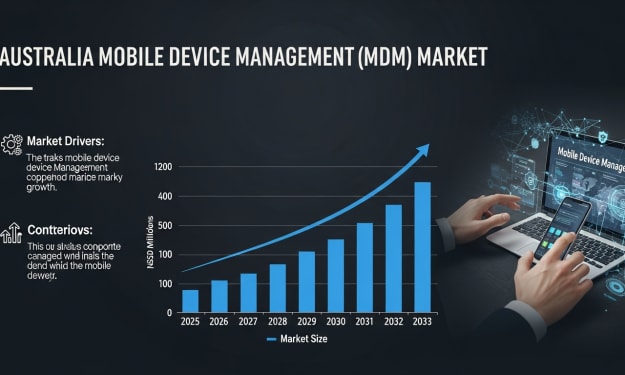
Australia Mobile Device Management Market Overview The Australia mobile device management (MDM) market is experiencing robust growth as organisations across sectors adopt digital workplaces, hybrid work models, and distributed device ecosystems. Mobile device management refers to software solutions and platforms that enable enterprises to secure, monitor, configure and manage mobile endpoints — including smartphones, tablets, laptops, wearables and Internet of Things (IoT) devices — from a centralised console. The Australia mobile device management (MDM) market size reached USD 266.0 Million in 2024. Looking forward, IMARC Group expects the market to reach USD 1,664.6 Million by 2033, exhibiting a growth rate (CAGR) of 22.60% during 2025-2033. This growth reflects heightened cybersecurity concerns, the proliferation of connected devices, increased adoption of bring-your-own-device (BYOD) policies, and regulatory imperatives that prioritise data protection and governance.
By Amyra Singh4 days ago in Trader
The Ritual of Winter Challenge Winners
Welcome to the Winners Announcement for The Ritual of Winter challenge. This prompt focused on winter rituals and the meaning that settles into them over time. The top pieces stay grounded in ordinary acts and repeated routines, letting winter shape the work through pace, attention, and restraint.
By Vocal Curation Team2 days ago in Resources



Comments
There are no comments for this story
Be the first to respond and start the conversation.