
Saudi Arabia Non-Invasive Prenatal Testing Market Size & Forecast 2025–2033
Saudi Arabia’s NIPT market is set for rapid expansion as technology, awareness, and healthcare reforms reshape prenatal screening across the Kingdom.

Introduction: A New Era in Prenatal Screening
Saudi Arabia’s healthcare sector is undergoing a significant transformation, driven by modernization efforts, technological adoption, and a strong national focus on improving patient outcomes. Among the many areas benefiting from this transformation is prenatal diagnostics, particularly Non-Invasive Prenatal Testing (NIPT). This advanced screening method has quickly become one of the most promising tools in maternal and fetal healthcare, offering safer, more accurate, and earlier detection of genetic abnormalities compared to traditional invasive procedures.
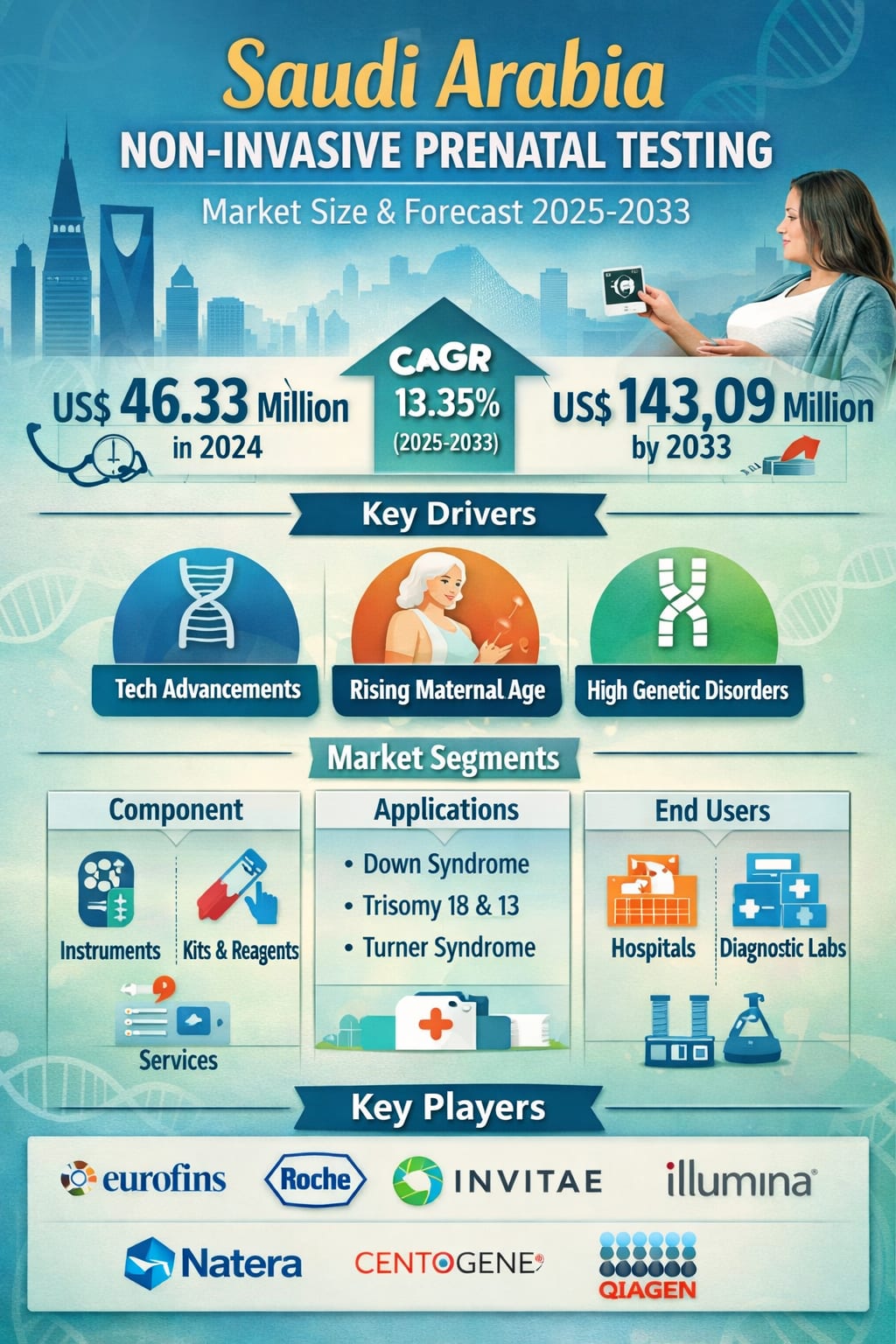
According to Renub Research, the Saudi Arabia Non-Invasive Prenatal Testing Market is expected to grow from US$ 46.33 million in 2024 to US$ 143.09 million by 2033, registering a robust CAGR of 13.35% from 2025 to 2033. This impressive growth reflects not only technological progress but also rising awareness among healthcare professionals and expectant parents, improved access to diagnostic services, and broader healthcare reforms under the Kingdom’s Vision 2030 initiative.
Non-invasive prenatal testing works by analyzing fetal DNA fragments present in the mother’s blood. Unlike procedures such as amniocentesis or chorionic villus sampling (CVS), NIPT does not carry a risk of miscarriage. This safety advantage, combined with high accuracy rates for detecting chromosomal abnormalities such as Down syndrome (Trisomy 21), Edwards syndrome (Trisomy 18), and Patau syndrome (Trisomy 13), has made NIPT an increasingly preferred screening option in Saudi Arabia.
As prenatal care standards continue to evolve, NIPT is no longer seen as a niche or luxury test. Instead, it is steadily becoming a core component of modern prenatal screening strategies across hospitals and diagnostic laboratories in the Kingdom.
Saudi Arabia Non-Invasive Prenatal Testing Industry Overview
The NIPT industry in Saudi Arabia is being shaped by three major forces: technological innovation, healthcare system modernization, and changing patient expectations. In recent years, the country has invested heavily in upgrading its healthcare infrastructure, expanding access to advanced diagnostics, and encouraging the adoption of cutting-edge medical technologies.
NIPT fits perfectly into this vision. By offering accurate genetic screening through a simple blood test, it aligns with the broader goals of improving patient safety, reducing procedure-related risks, and enhancing early diagnosis. For expectant mothers, the appeal is clear: NIPT provides peace of mind without the anxiety associated with invasive testing methods.
Healthcare providers in Saudi Arabia are also increasingly recognizing the clinical and economic value of early detection. Identifying chromosomal abnormalities early in pregnancy allows families and doctors to make informed decisions, plan appropriate medical care, and, in some cases, prepare for specialized interventions after birth. This proactive approach to prenatal care is gradually becoming standard practice, particularly in urban centers and large hospitals.
Government initiatives aimed at expanding healthcare access across the country have further supported the spread of NIPT. As more hospitals and diagnostic labs incorporate advanced genetic testing services, availability is improving not only in major cities but also in secondary healthcare hubs. This widening access is a crucial factor behind the strong growth outlook projected by Renub Research.
Market Growth Drivers
1. Technological Advancements
One of the most powerful drivers of the Saudi Arabia NIPT market is rapid technological progress in genetic testing. The adoption of next-generation sequencing (NGS) and advanced bioinformatics tools has significantly improved the accuracy and reliability of fetal DNA analysis. These technologies enable laboratories to detect even subtle chromosomal abnormalities with high precision.
Initially, NIPT was primarily used to screen for common trisomies such as Down syndrome, Edwards syndrome, and Patau syndrome. Today, however, technological improvements have expanded its scope to include microdeletions and certain single-gene disorders, making NIPT a more comprehensive screening tool.
For clinicians, this means greater diagnostic confidence. For expectant parents, it means earlier and more reliable insights into fetal health—without the risks associated with invasive procedures. As these technologies continue to evolve and become more cost-efficient, their adoption across Saudi Arabia’s healthcare system is expected to accelerate further.
2. Rising Maternal Age
Another important factor fueling demand for NIPT is the increase in maternal age. Like many other countries, Saudi Arabia is witnessing a gradual shift in family planning patterns, with more women choosing to have children later in life due to career priorities, education, and changing social dynamics.
Medical research consistently shows that the risk of chromosomal abnormalities increases with maternal age, particularly for women over 35. As a result, pregnancies in this age group are more likely to be classified as higher risk, prompting doctors to recommend advanced screening methods such as NIPT.
Because NIPT is both safe and highly accurate, it has become the preferred option for older expectant mothers who want reliable information without exposing themselves or their babies to unnecessary risks. This demographic trend is expected to remain a strong long-term growth driver for the Saudi NIPT market.
3. High Prevalence of Genetic Disorders
Saudi Arabia has a relatively high prevalence of certain genetic and chromosomal disorders, partly due to demographic and genetic factors. Conditions such as Down syndrome and other chromosomal abnormalities continue to represent a significant public health concern.
This reality has increased the importance of early and reliable prenatal screening. NIPT offers a practical solution by enabling early detection without the physical and emotional stress associated with invasive tests. As awareness of genetic health issues grows among both healthcare professionals and the general population, the demand for advanced screening tools like NIPT is expected to rise steadily.
In addition, families with a history of genetic disorders are more likely to seek comprehensive prenatal screening, further supporting market growth.
Challenges Facing the Market
1. Limited Awareness and Knowledge
Despite its advantages, limited awareness remains a major barrier to wider NIPT adoption in Saudi Arabia. Many expectant mothers are still unfamiliar with what NIPT is, how it works, and what benefits it offers compared to traditional screening methods.
Surveys conducted between December 2023 and February 2024 highlight this challenge: a significant proportion of respondents demonstrated limited or incorrect knowledge about NIPT, and a large share had never heard of the test at all. This knowledge gap can lead to missed opportunities for early and safer screening.
Addressing this issue will require coordinated efforts from healthcare providers, policymakers, and public health campaigns to educate women and families about the value of modern prenatal diagnostics.
2. High Cost and Limited Insurance Coverage
Cost is another critical challenge. NIPT is generally more expensive than conventional screening methods, and insurance coverage remains limited in many cases. This financial barrier restricts access, particularly for lower- and middle-income families.
Research suggests that while many women would be willing to undergo NIPT if it were affordable or covered by insurance, far fewer are prepared to pay the full cost out of pocket. This situation creates inequality in access to advanced prenatal care and slows the overall market penetration of NIPT.
Expanding insurance coverage and encouraging more cost-effective testing solutions will be essential for unlocking the full growth potential of the market.
Market Segmentation Overview
The Saudi Arabia Non-Invasive Prenatal Testing Market is segmented as follows:
By Component
Instruments
Kits and Reagents
Services
By Application
Down Syndrome (Trisomy 21)
Edwards Syndrome (Trisomy 18)
Patau Syndrome (Trisomy 13)
Turner Syndrome
Other Applications
By End User
Hospitals
Diagnostic Labs
Hospitals currently represent a major share of testing volume due to their integrated prenatal care services, while diagnostic laboratories play a crucial role in expanding access and improving testing capacity across different regions.
Competitive Landscape and Key Companies
The Saudi NIPT market features a mix of global diagnostic and biotechnology leaders that bring advanced technologies, strong R&D capabilities, and extensive clinical experience. Key players covered in the market include:
Eurofins Scientific
F. Hoffmann-La Roche Ltd
Invitae Corporation
Illumina Inc.
Natera Inc.
Centogene NV
Qiagen
These companies are actively focusing on product innovation, strategic partnerships, and expansion of testing services. Their efforts are helping to improve test accuracy, reduce turnaround times, and gradually lower costs—factors that will be crucial for long-term market growth in Saudi Arabia.
Future Outlook: What Lies Ahead
Looking ahead, the outlook for the Saudi Arabia Non-Invasive Prenatal Testing Market is highly optimistic. With Renub Research projecting growth to US$ 143.09 million by 2033, the sector is set to become an increasingly important part of the Kingdom’s prenatal care ecosystem.
Several trends will shape the future of the market:
Continued investment in healthcare infrastructure under Vision 2030
Growing integration of genetic testing into routine prenatal care
Rising awareness among patients and clinicians
Gradual improvements in insurance coverage and affordability
Ongoing technological innovation in sequencing and data analysis
As these factors converge, NIPT is likely to move from being a specialized test to a more widely adopted standard screening tool, particularly for high-risk pregnancies.
Final Thoughts
The Saudi Arabia Non-Invasive Prenatal Testing Market is entering a decisive growth phase. With the market expected to expand from US$ 46.33 million in 2024 to US$ 143.09 million by 2033 at a CAGR of 13.35%, NIPT is poised to play a transformative role in the future of prenatal care in the Kingdom.
While challenges such as limited awareness and high costs remain, the long-term fundamentals are strong. Technological advancements, demographic trends, and healthcare modernization efforts are all working in favor of wider adoption. As education improves and access expands, NIPT is likely to become an essential component of safer, smarter, and more proactive prenatal healthcare in Saudi Arabia.
In the years ahead, this market will not only reflect economic growth but also symbolize a broader shift toward patient-centered, technology-driven healthcare—where early detection, safety, and informed decision-making take center stage in maternal and fetal medicine.
About the Creator
Keep reading
More stories from shibansh kumar and writers in Trader and other communities.
United States Non-Invasive Prenatal Testing Market Size & Forecast 2025–2033
United States Non-Invasive Prenatal Testing Market: A New Era of Safer Prenatal Screening The United States Non-Invasive Prenatal Testing (NIPT) Market is entering a phase of remarkable expansion, driven by rapid technological progress, increasing awareness among expectant parents, and growing support from healthcare systems. According to Renub Research, the market is expected to grow from US$ 1,072.48 million in 2024 to US$ 3,249.94 million by 2033, registering a strong compound annual growth rate (CAGR) of 13.11% from 2025 to 2033.
By shibansh kumar2 days ago in Trader
Bluetooth Speaker Market Set to Soar to USD 66.1 Billion by 2034 | At CAGR 14.10%
Overview Bluetooth Speaker Market Bluetooth speakers are wireless audio devices that use Bluetooth technology to connect with smartphones, tablets, laptops, and other digital devices. The market has experienced significant expansion as wireless audio solutions replace traditional wired speakers. The increasing popularity of music streaming platforms, podcasts, and mobile entertainment has strengthened the demand for high-performance Bluetooth speakers globally.
By James Smitha day ago in Trader
How to Stay Ahead in the Rapidly Changing World of Web3 and Crypto
The "Wild West" era of cryptocurrency has been officially tamed. As we navigate 2026, the industry has graduated from a retail-driven speculative playground to a mission-critical global financial layer. Institutional capital is no longer just "exploring" the space with pilot programs; they are building the very rails the global economy will soon run on.
By Tech Updatesa day ago in Trader




Comments
There are no comments for this story
Be the first to respond and start the conversation.