
Saudi Arabia IVF Market Size & Forecast 2025–2033: A New Era for Fertility Care
How rising infertility rates, delayed parenthood, and cutting-edge reproductive technologies are reshaping Saudi Arabia’s IVF industry

Saudi Arabia IVF Market Outlook
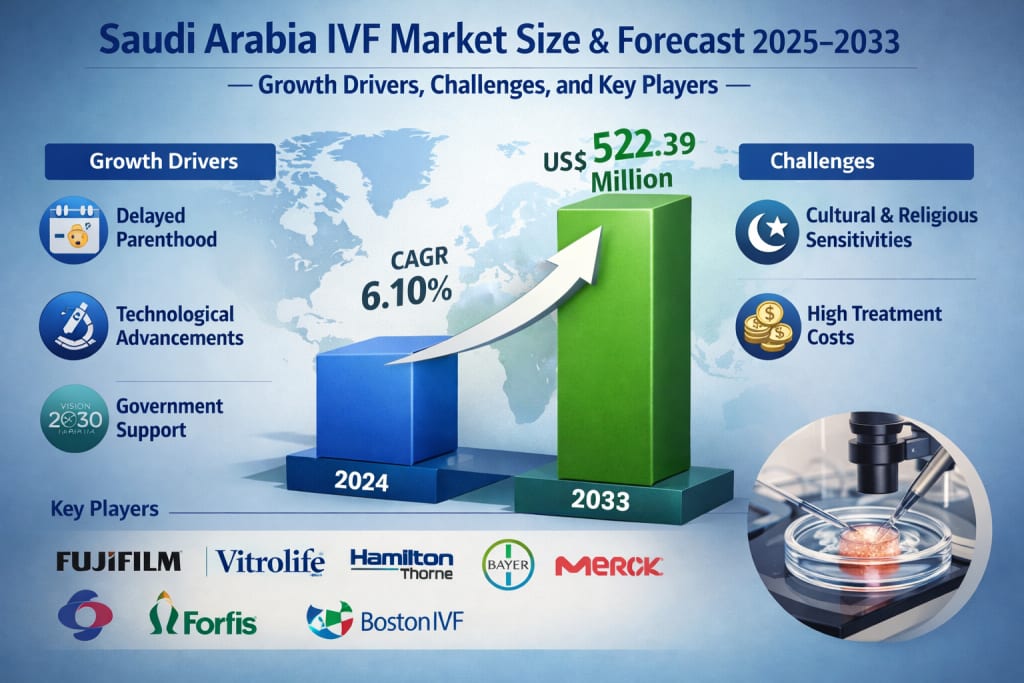
The Saudi Arabia IVF Market is on a strong growth trajectory and is expected to reach US$ 522.39 million by 2033, up from US$ 306.59 million in 2024, registering a CAGR of 6.10% from 2025 to 2033. This steady expansion reflects profound changes in demographics, healthcare priorities, and social attitudes toward fertility treatment across the Kingdom.
Infertility is no longer viewed only as a private or taboo issue in Saudi Arabia. Instead, it is increasingly recognized as a medical condition that can be treated with modern science. Rising infertility rates, growing awareness, delayed parenthood, rapid technological progress in reproductive medicine, and supportive government healthcare reforms are all contributing to the market’s expansion.
At the same time, Saudi Arabia’s broader healthcare transformation under Vision 2030 has created fertile ground for specialized medical services, including fertility care. Investments in hospital infrastructure, medical tourism, and advanced treatment facilities are helping position the Kingdom as a regional hub for high-quality reproductive healthcare.
Saudi Arabia IVF Industry Overview
In vitro fertilization (IVF) is a medical procedure designed to help individuals or couples conceive when natural pregnancy is difficult or impossible. The process involves fertilizing an egg with sperm outside the body in a laboratory setting. Once an embryo is formed and carefully monitored, it is transferred into the woman’s uterus with the goal of achieving a successful pregnancy.
IVF is commonly used to treat a wide range of fertility issues, including male infertility, blocked or damaged fallopian tubes, ovulation disorders, endometriosis, and unexplained infertility. Modern IVF treatments often involve additional procedures such as hormone therapy, egg retrieval, embryo freezing, and genetic screening to improve the chances of success and reduce the risk of genetic disorders.
In Saudi Arabia, the IVF market is benefiting from a convergence of social, medical, and economic factors. Lifestyle changes, rising stress levels, and the increasing age of first-time parents are contributing to higher infertility rates. At the same time, social attitudes are evolving, and there is greater acceptance of assisted reproductive technologies than ever before.
Technological advancements such as intracytoplasmic sperm injection (ICSI), preimplantation genetic testing (PGT), and embryo vitrification have significantly improved success rates and patient confidence. Coupled with government support and expanding private healthcare investment, these developments are turning IVF into a mainstream medical service rather than a niche or last-resort option.
Key Growth Drivers of the Saudi Arabia IVF Market
1. Delayed Parenthood
Delayed parenthood is one of the most influential drivers behind the growth of the Saudi Arabian IVF market. Across the Kingdom, more individuals and couples are choosing to focus on higher education, career development, and financial stability before starting a family. As a result, the average age of first-time parents is steadily increasing.
Biologically, fertility declines with age—especially for women—making conception more challenging. This demographic shift has led to a rising demand for fertility treatments, including IVF. Changing social norms, greater participation of women in the workforce, and later marriages are reinforcing this trend.
As delayed motherhood becomes more common, infertility treatments are no longer seen as rare or exceptional. IVF is increasingly viewed as a practical, scientifically proven solution to age-related fertility challenges, directly fueling market growth.
2. Technological Advancements in Reproductive Medicine
Technology is playing a central role in transforming the IVF landscape in Saudi Arabia. Innovations such as ICSI, PGT, and advanced embryo freezing techniques have improved success rates, reduced risks, and expanded the pool of patients who can benefit from treatment.
These advancements not only enhance clinical outcomes but also build trust among patients who may have previously been hesitant to pursue fertility treatment. Modern laboratories, improved culture media, and sophisticated monitoring systems have made IVF safer, more efficient, and more predictable.
A notable development occurred in September 2024, when Burjeel Holdings PLC, a leading super-specialty healthcare provider, announced plans to introduce IVF services in Saudi Arabia. Its Trust Fertility Clinic at Burjeel Medical City (BMC) is set to integrate gynecology, fetal medicine, pediatric subspecialties, and IVF services under one roof. With advanced NICU and PICU facilities, BMC aims to offer comprehensive mother-and-baby care, further strengthening the Kingdom’s reproductive healthcare ecosystem.
3. Government Support and Vision 2030
Government backing is another powerful engine driving the Saudi Arabia IVF market. Under Vision 2030, Saudi Arabia is committed to improving healthcare quality, accessibility, and efficiency. Fertility treatment is increasingly seen as part of this broader healthcare modernization agenda.
The Ministry of Health regulates and licenses fertility clinics, ensuring safety, quality, and ethical standards. In some cases, financial support or subsidies are provided to eligible patients to reduce the economic burden of treatment. Meanwhile, large-scale investments in hospitals, medical cities, and specialized centers are expanding access to advanced fertility services across the country.
These initiatives not only encourage domestic demand but also support Saudi Arabia’s ambition to become a regional destination for medical tourism, particularly in high-value specialties such as reproductive medicine.
Challenges Facing the Saudi Arabia IVF Market
1. Cultural and Religious Sensitivities
Despite strong growth prospects, the IVF market in Saudi Arabia faces important cultural and religious constraints. In a society deeply rooted in Islamic values, certain assisted reproduction practices—such as surrogacy or third-party gamete donation—are generally not permitted under Islamic law.
These restrictions limit the range of IVF treatments available compared to some Western countries. In addition, conservative social norms can discourage open discussion about infertility, sometimes leading to stigma or emotional stress, particularly for women.
Some individuals may delay or avoid seeking treatment due to fear of social judgment or misunderstanding. Addressing these challenges requires culturally sensitive education, awareness campaigns, and patient counseling that respects religious values while promoting medical solutions.
2. High Treatment Costs
Cost remains one of the biggest barriers to wider adoption of IVF in Saudi Arabia. IVF treatments require advanced equipment, highly trained specialists, and often multiple cycles before success is achieved. This makes the overall process expensive for many families.
While some government support exists, it is not universal, and many private insurance plans do not fully cover infertility treatments. As a result, lower- and middle-income families may struggle to afford care, leading to delayed or discontinued treatment.
These financial barriers not only limit access but also add emotional stress for patients. Expanding insurance coverage and developing more cost-effective treatment models will be critical for making IVF accessible to a broader segment of the population.
Recent Developments in the Saudi Arabia IVF Industry
The Saudi IVF landscape has seen several noteworthy developments in 2024, highlighting the sector’s growing scientific and clinical sophistication.
July 2024: Researchers at King Faisal Specialist Hospital & Research Centre (KFSHRC) published a groundbreaking study on the protein Phospholipase C Zeta (PLCζ). The study demonstrated that PLCζ plays a crucial role in early embryo development and successful implantation. Defects in this protein may lead to infertility or implantation failure, opening new pathways for future reproductive treatments and diagnostic tools.
April 2024: Al Hokail Hospital was ranked as Saudi Arabia’s top IVF facility, thanks to its advanced technology and highly specialized medical team. The center is known for its state-of-the-art equipment for fertilization, egg retrieval, and embryo preservation, as well as modern incubators that optimize embryo viability and improve treatment success rates.
These developments underscore Saudi Arabia’s growing role in both clinical practice and reproductive research.
Saudi Arabia IVF Market Segmentation
The Saudi Arabia IVF market is segmented across several key dimensions:
By Procedure Type
Fresh non-donor
Frozen non-donor
Fresh donor
Frozen donor
By Instrument
Disposable devices
Culture media
Equipment
By Surgery / Media Type
Embryo culture media
Cryopreservation media
Sperm processing media
Ovum processing media
By End Users
Fertility clinics
Hospitals & other settings
This segmentation reflects the increasing complexity and specialization of IVF services, as well as the growing role of both standalone fertility clinics and large hospital systems.
Competitive Landscape and Key Players
The Saudi Arabia IVF market features a mix of global healthcare and life sciences companies, each contributing through technology, equipment, consumables, and clinical expertise. Companies are typically analyzed across four dimensions: Company Overview, Key Persons, Recent Developments & Strategies, and Sales Analysis.
Some of the key players operating in or influencing the market include:
FUJIFILM Holdings Corporation
Hamilton Thorne Ltd.
Vitrolife AB
Thermo Fisher Scientific, Inc.
Bayer AG
Merck & Co., Inc.
Boston IVF
Fortis Healthcare
These companies are actively involved in developing advanced equipment, culture media, diagnostics, and treatment solutions that support the growth and modernization of IVF services in Saudi Arabia.
Final Thoughts
The Saudi Arabia IVF market is entering a transformative phase. With market value projected to rise from US$ 306.59 million in 2024 to US$ 522.39 million by 2033, the sector is clearly positioned for sustained growth. Demographic shifts, delayed parenthood, technological innovation, and supportive government policies are reshaping how fertility care is perceived and delivered across the Kingdom.
At the same time, challenges related to cost, cultural sensitivities, and access remain important hurdles. Addressing these issues through policy reforms, insurance expansion, and public awareness will be essential for unlocking the market’s full potential.
As Saudi Arabia continues to invest in healthcare infrastructure and medical excellence under Vision 2030, IVF and reproductive medicine are likely to play an increasingly prominent role. The coming decade will not only see market expansion but also a deeper integration of fertility care into the Kingdom’s modern healthcare system—offering hope, choice, and advanced medical solutions to thousands of families.
About the Creator
Asia Pacific Pediatric Interventional Cardiology Market Size and Forecast 2025–2033
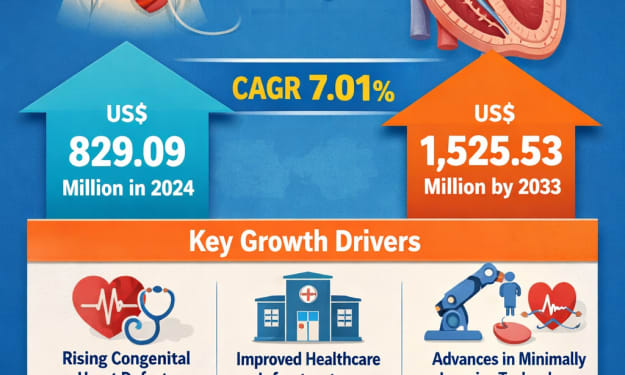
Introduction The Asia Pacific Pediatric Interventional Cardiology Market is entering a period of sustained and meaningful growth as healthcare systems across the region place increasing emphasis on advanced, child-focused cardiac care. According to Renub Research, the market is expected to reach US$ 1,525.53 million by 2033, rising from US$ 829.09 million in 2024, at a compound annual growth rate (CAGR) of 7.01% from 2025 to 2033.
By shibansh kumar7 days ago in Trader
Salesforce Stock Analysis: Is Salesforce Poised for Continued Growth in the Cloud CRM Market?
Introduction Salesforce stock is widely regarded as one of the leading growth stocks in the cloud computing and customer relationship management (CRM) space. Salesforce has transformed the way businesses manage customer relationships, sales, marketing, and analytics through its cloud-based platform. Its software-as-a-service (SaaS) model provides recurring revenue and global scalability, making Salesforce stock a key holding for investors interested in enterprise technology. The critical question is whether Salesforce can maintain its leadership amid intensifying competition and evolving enterprise technology trends.
By Hammad Nawaz3 days ago in Trader


Comments
There are no comments for this story
Be the first to respond and start the conversation.