
Pyridine Market Size and Forecast 2026–2034
Growing Demand from Agrochemicals, Pharmaceuticals, and Specialty Chemicals Drives Global Market Expansion

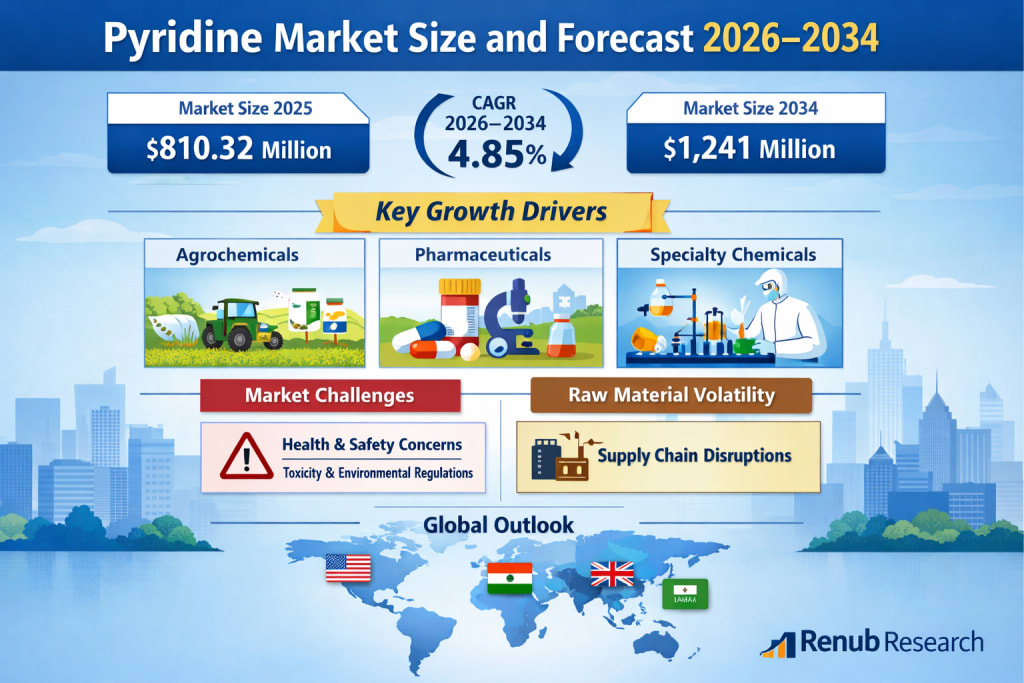
The global Pyridine Market is projected to witness steady growth in the coming years. According to Renub Research, the market is expected to expand from US$ 810.32 Million in 2025 to US$ 1,241 Million by 2034, growing at a CAGR of 4.85% during the forecast period 2026–2034. Increasing demand from agrochemical, pharmaceutical, and chemical manufacturing sectors continues to support this expansion. The compound’s versatility as both a chemical intermediate and solvent has made pyridine a crucial component across numerous industries.
As agricultural productivity becomes more critical, pharmaceutical manufacturing expands globally, and specialty chemical production grows, pyridine remains a foundational building block in many industrial processes. These trends collectively position the pyridine market for stable long-term growth.
Pyridine Market Outlook
Pyridine is a basic heterocyclic organic compound composed of a six-membered ring containing five carbon atoms and one nitrogen atom. It appears as a colorless to pale yellow liquid with a strong, distinct odor and is highly soluble in water and several organic solvents. These chemical characteristics make pyridine a valuable solvent and reactive intermediate in industrial synthesis.
The compound plays a vital role in producing agrochemicals, pharmaceuticals, vitamins, dyes, rubber chemicals, adhesives, and specialty chemicals. Its ability to dissolve diverse compounds and participate in complex chemical reactions gives it significant industrial importance.
Globally, pyridine has gained popularity due to its versatility and broad application range. In agriculture, it acts as a precursor for herbicides, fungicides, and insecticides. In pharmaceuticals, pyridine derivatives are widely used in the synthesis of medicines, vitamins such as niacin, and antiseptics.
The growth of pharmaceutical production, increasing demand for crop protection chemicals, and the expansion of chemical manufacturing industries have significantly increased the global consumption of pyridine. Additionally, its widespread use in research laboratories and specialty chemical synthesis further strengthens its position in modern industrial chemistry.
Growth Drivers of the Pyridine Market
Expanding Demand from the Agrochemical Industry
One of the most influential growth drivers for the pyridine market is the rapid expansion of the agrochemical sector. Pyridine and its derivatives serve as critical intermediates in the formulation of herbicides, fungicides, and insecticides. These products play a major role in enhancing crop protection and improving agricultural yields.
With the global population steadily increasing, governments and agricultural organizations are focusing on improving food production. This has encouraged the adoption of advanced crop protection solutions, many of which rely on pyridine-based compounds.
Developing nations are increasingly investing in modern farming technologies and efficient agrochemical solutions, further boosting demand for pyridine. The need to minimize crop losses and improve agricultural efficiency continues to drive the adoption of advanced pesticides and fungicides.
For example, July 2025 saw Corteva launch a new fungicide called Zorvec Vinabel, which uses active ingredients such as fluopicolide and ametoctradin to combat downy mildew in vineyards. Innovations like these highlight the growing role of chemical intermediates such as pyridine in modern agriculture.
As global agriculture becomes more technology-driven and productivity-focused, pyridine demand from agrochemical manufacturers is expected to remain strong.
Rising Pharmaceutical and Healthcare Applications
Another significant contributor to market growth is the expansion of pharmaceutical and healthcare industries worldwide. Pyridine compounds are widely used in the synthesis of active pharmaceutical ingredients (APIs), vitamins, antiseptics, and specialty drugs.
Several global healthcare trends are driving this demand:
Increasing healthcare spending
Aging populations
Rising prevalence of chronic diseases
Growing demand for affordable medicines
Pyridine derivatives offer excellent stability and biological compatibility, making them valuable components in pharmaceutical synthesis. They are used in producing vitamin supplements, anti-inflammatory drugs, and other essential medications.
Furthermore, research and development initiatives continue to create new pyridine-based compounds, opening additional opportunities for pharmaceutical innovation.
In 2024, Resonance Specialties strengthened its global distribution network for pyridine, enabling easier access for pharmaceutical and agrochemical companies worldwide. Such strategic expansions improve supply reliability and help meet the increasing demand from pharmaceutical manufacturers.
As pharmaceutical production continues expanding across emerging economies, the importance of pyridine as a chemical intermediate is expected to increase significantly.
Growth of Chemical and Specialty Chemical Manufacturing
The rising demand for specialty chemicals and industrial intermediates is another major factor supporting the pyridine market.
Pyridine is widely used as a solvent and intermediate in the production of:
Dyes
Adhesives
Rubber chemicals
Corrosion inhibitors
Industrial coatings
Rapid industrialization, particularly across Asia-Pacific and emerging economies, has increased the demand for specialty chemicals in industries such as textiles, construction, automotive manufacturing, and electronics.
Manufacturers prefer pyridine because of its reactivity and compatibility with complex chemical processes. Advances in chemical synthesis technologies have further enhanced production efficiency and expanded the scope of pyridine applications.
For instance, September 2023 saw Merck and Sigma-Aldrich collaborate to develop a pyridine-based catalyst for efficient green hydrogen production. Innovations like this illustrate how pyridine continues to find new roles in advanced chemical processes.
As global industries expand and demand high-performance materials, the need for pyridine-based chemical intermediates will continue growing steadily.
Challenges in the Pyridine Market
Health, Safety, and Environmental Concerns
Despite its industrial importance, pyridine also presents several health and environmental challenges.
The compound is toxic, flammable, and characterized by a strong odor, which can pose risks during handling and production. Prolonged exposure may cause:
Respiratory issues
Skin irritation
Eye irritation
Other health complications
As a result, manufacturers must implement strict safety measures, increasing operational costs. Governments and regulatory agencies worldwide are also introducing stricter guidelines for chemical handling, emissions, and waste disposal.
Compliance with these environmental and safety regulations may limit production capacity or increase manufacturing costs. Additionally, growing awareness regarding environmental protection could encourage the development of safer chemical alternatives, which may impact pyridine demand in the long term.
Raw Material Price Volatility and Supply Chain Issues
Another challenge facing the pyridine market is the fluctuation in raw material prices.
Pyridine production relies heavily on petroleum-derived feedstocks and chemical intermediates, which are closely linked to global crude oil prices. Any instability in oil markets can directly influence production costs and pricing structures.
Supply chain disruptions, trade restrictions, and logistical challenges can also affect the availability of raw materials and finished products. These issues may reduce profitability for manufacturers, especially smaller companies with limited financial flexibility.
Managing these fluctuations while maintaining consistent product supply remains a key challenge for pyridine producers.
Key Application Markets
Pyridine N-Oxide Market
Pyridine N-oxide is gaining increasing attention due to its role as a catalyst and chemical intermediate in organic synthesis. It enhances reaction efficiency, improves oxidation processes, and increases selectivity in complex chemical reactions.
This compound is widely used in pharmaceuticals, agrochemicals, and specialty chemical synthesis, where precision and reaction control are essential. Rising research activity in laboratories and chemical industries has significantly boosted demand for pyridine N-oxide.
As industries continue to develop high-value compounds and advanced chemical formulations, the pyridine N-oxide market is expected to expand steadily.
Beta Pyridine Market
Beta pyridine serves as an essential intermediate in pharmaceutical, agrochemical, and specialty chemical manufacturing. Its molecular stability and chemical properties allow it to participate in highly controlled synthesis processes.
In agriculture, beta pyridine is used in the development of advanced crop protection chemicals. The increasing focus on agricultural productivity and sustainable farming practices indirectly supports demand for beta pyridine intermediates.
Additionally, research institutions and chemical laboratories increasingly use beta pyridine in developing new chemical entities and innovative formulations, strengthening market growth.
Medicines Pyridine Market
The medicines pyridine market is expanding rapidly due to the compound’s role in producing vitamins, antiseptics, anti-inflammatory drugs, and other medications.
Pyridine derivatives interact effectively with biological systems, making them suitable for pharmaceutical applications. The increasing demand for healthcare services and medicines worldwide continues to drive pharmaceutical production.
Generic drug manufacturing, particularly in emerging markets, has also increased the use of pyridine derivatives. As healthcare accessibility improves globally, the medicines pyridine market is expected to grow consistently.
Paints and Dyes Pyridine Market
Pyridine is widely used as a solvent and intermediate in the production of pigments and dyes. These compounds improve color stability, adhesion properties, and chemical performance in paints and coatings.
The expansion of construction, automotive, and textile industries has increased demand for high-performance paints and coatings. Urbanization and infrastructure development further support this trend.
Advancements in dye chemistry and specialty coatings are also creating new opportunities for pyridine applications in this segment.
Pharmaceuticals Pyridine Market
The pharmaceutical sector remains one of the largest application segments for pyridine.
Pyridine derivatives are critical in producing:
Antibiotics
Antihistamines
Cardiovascular drugs
Vitamin-based medications
The compound’s chemical stability and versatility make it ideal for complex pharmaceutical synthesis processes.
Increasing pharmaceutical research, expanding drug approvals, and the growth of pharmaceutical manufacturing facilities—especially in emerging economies—are driving the demand for pyridine in this sector.
Regional Market Insights
United States
The United States has a well-established pyridine market supported by advanced chemical manufacturing infrastructure. Strong pharmaceutical, agrochemical, and specialty chemical industries continue to drive demand.
In July 2024, Resonac Holdings Corporation announced the creation of Crasus Chemical Inc., a subsidiary formed to spin off its petrochemical business. The unit includes production of organic chemical products such as pyridine and picolines.
Research activity, high manufacturing standards, and industrial demand continue to strengthen the U.S. pyridine market.
United Kingdom
The United Kingdom market is supported by strong pharmaceutical research, specialty chemical manufacturing, and laboratory applications.
The country’s focus on high-value chemicals and innovation encourages the use of advanced pyridine derivatives in research and production. Sustainable agriculture initiatives also contribute to demand for pyridine-based agrochemicals.
India
India represents one of the fastest-growing pyridine markets globally. The country’s rapidly expanding pharmaceutical and agrochemical industries significantly contribute to demand.
India is also a major global exporter of generic pharmaceuticals and specialty chemicals, increasing the consumption of pyridine derivatives.
In November 2023, a new multipurpose agro-intermediate plant in Bharuch, Gujarat, began operations to manufacture specialized agro-intermediates, expanding pyridine derivative production capacity.
Saudi Arabia
Saudi Arabia’s pyridine market is growing gradually due to industrial diversification and petrochemical expansion.
The country’s strategy to strengthen downstream chemical industries has increased interest in value-added intermediates like pyridine. Expanding construction and coatings industries further support demand.
Market Segmentation
By Type
Pyridine N-Oxide
Alpha Picoline
Beta Picoline
Gamma Picoline
2-Methyl-5-Ethylpyridine (MEP)
By Application
Medicines
Rubber
Paints and Dyes
Pesticides
Solvent
Food Flavouring
Others
By End Use
Pharmaceuticals
Agrochemicals
Food
Chemicals
Others
Competitive Landscape
Leading companies operating in the global pyridine market include:
Jubilant Life Sciences Ltd.
Lonza Group Ltd.
Resonance Specialties Limited
Shandong Luba Chemical Co., Ltd.
Koei Chemical Company, Limited
Nippon Steel & Sumikin Chemical Co., Ltd.
Barentz International B.V.
Novasyn Organics Pvt. Ltd.
Market evaluations typically analyze these companies through five key viewpoints:
Company overview
Key leadership
Recent developments
SWOT analysis
Revenue and strategic performance
Final Thoughts
The global pyridine market is positioned for consistent and sustainable growth through 2034. Its widespread applications in agrochemicals, pharmaceuticals, and specialty chemicals make it an essential industrial compound.
Although challenges such as regulatory pressures and raw material price fluctuations exist, ongoing industrial expansion, chemical innovation, and growing healthcare demand will continue to drive market growth.
As industries focus on improving productivity, developing advanced medicines, and expanding chemical manufacturing capabilities, pyridine will remain a critical building block in modern chemical and pharmaceutical industries.
About the Creator
Marks and Spencer Share Price Outlook: What Investors Should Watch
The marks and spencer share price has been showing interesting trends recently, prompting investors to ask what’s driving the change. Understanding these movements is important before deciding to buy, hold, or sell. This article explores the factors influencing the marks and spencer share price, potential risks, and tips for investors. For a deeper look at similar retail stocks, see our guide on UK Retail Stocks Worth Watching.
By John.doe7984 days ago in Trader
Becca
"Everything is so... flat." Denille said stupidly as she looked around her new neighborhood. She looked around at the muted desert where even the smallest sign of life seemed to have given up. The plant life was shrubs that were half cooked by the heat and where there should have been a lawn, a mess of white rocks laid glistening in the sun. Even the sky looked stretched thin, like the sun had ironed it smooth. She’d moved from Riverside, where at least there were hills, but here in Barstow, everything felt baked and brittle.
By Sara Wilson7 days ago in Fiction




Comments
There are no comments for this story
Be the first to respond and start the conversation.