
Precision Medicine Market Set to Transform Global Healthcare by 2033
How Genomics, Big Data, and Personalized Therapies Are Reshaping the Future of Treatment

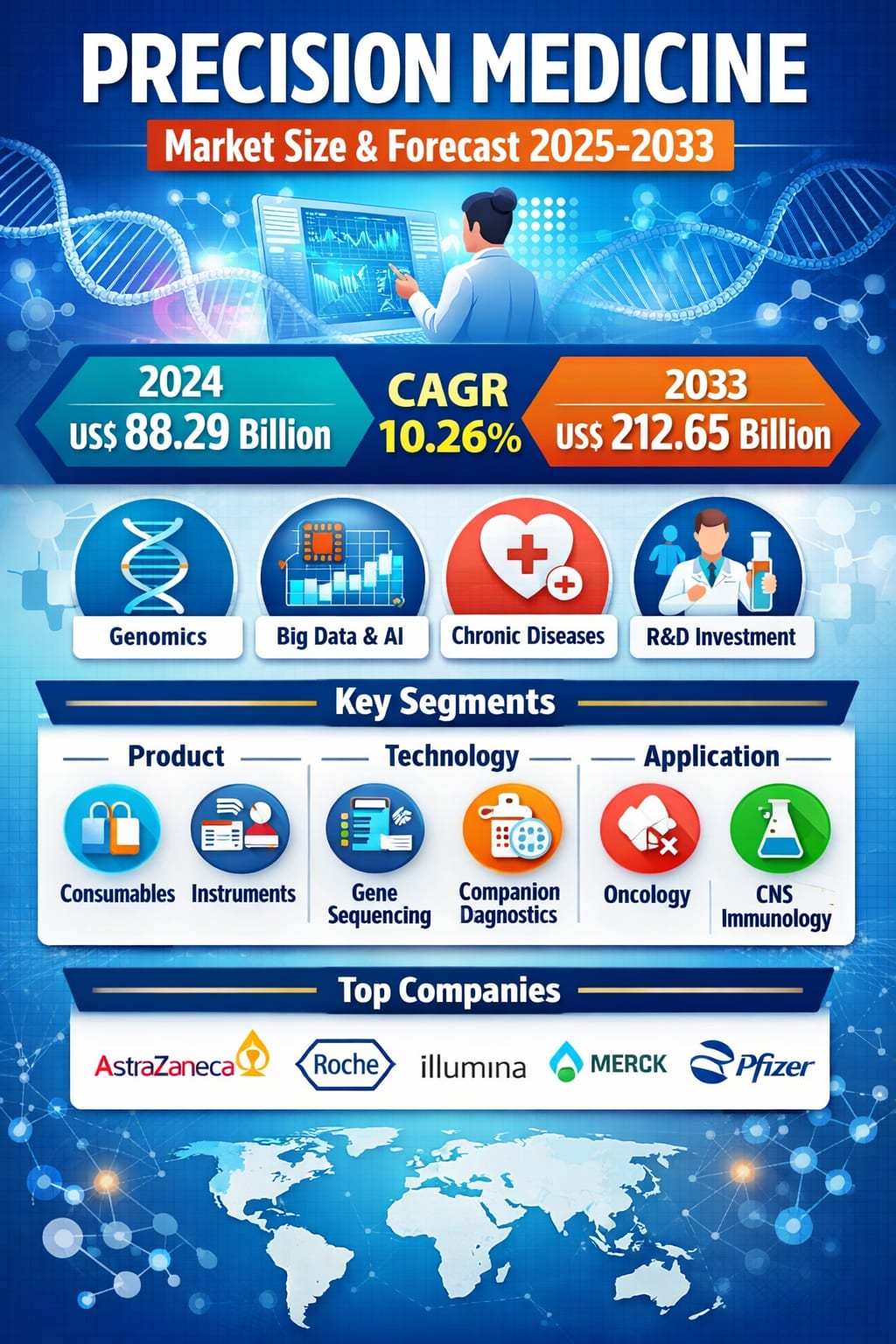
Precision Medicine Market Size and Forecast 2025–2033
The Precision Medicine Market is expected to reach US$ 212.65 billion by 2033, up from US$ 88.29 billion in 2024, registering a CAGR of 10.26% from 2025 to 2033. This impressive growth reflects a major shift in global healthcare—from generalized treatment approaches to highly targeted, patient-specific therapies.
Precision medicine, often referred to as personalized medicine, tailors medical treatment based on an individual’s genetic profile, lifestyle, and environmental factors. Instead of applying a “one-size-fits-all” solution, this approach aims to deliver the right treatment to the right patient at the right time, improving outcomes while reducing unnecessary side effects and healthcare costs.
The market’s rapid expansion is being fueled by advances in genomics, big data analytics, artificial intelligence (AI), and bioinformatics, along with rising investment in research and development. At the same time, the growing global burden of chronic diseases—particularly cancer, cardiovascular disorders, and rare genetic conditions—is accelerating the demand for more precise, effective, and efficient treatment strategies.
Global Precision Medicine Market Overview
The worldwide precision medicine market is evolving at a remarkable pace, driven by breakthroughs in biotechnology, data science, and molecular diagnostics. Over the past decade, the cost of genome sequencing has fallen dramatically, making genetic testing more accessible to healthcare systems, researchers, and even individual patients. This accessibility has opened the door to more accurate diagnoses, better disease risk prediction, and highly targeted therapies.
One of the most transformative areas for precision medicine is oncology. Cancer treatment has shifted from traditional chemotherapy toward targeted therapies and immunotherapies that focus on the specific genetic mutations driving a patient’s tumor. This approach not only improves treatment effectiveness but also reduces harmful side effects, significantly enhancing patient quality of life.
Beyond oncology, precision medicine is gaining traction in neurology, cardiology, immunology, and rare genetic disorders. The integration of big data, AI, and machine learning into healthcare systems allows researchers and clinicians to analyze massive datasets, identify new biomarkers, and design more personalized treatment plans.
Collaboration is another major force shaping the market. Partnerships between pharmaceutical companies, biotech firms, academic institutions, and healthcare providers are accelerating innovation and shortening the time it takes for new therapies to move from the lab to the clinic. However, challenges remain, including high development costs, complex regulatory pathways, data privacy concerns, and the need for standardized clinical practices. Despite these hurdles, the long-term outlook for precision medicine remains extremely positive, with the potential to fundamentally reshape global healthcare delivery.
Key Drivers and Challenges in Precision Medicine
Rising Prevalence of Chronic Diseases
One of the most important drivers of the precision medicine market is the increasing global burden of chronic diseases such as cancer, diabetes, and cardiovascular disorders. These conditions are among the leading causes of death and disability worldwide and place enormous pressure on healthcare systems.
Precision medicine offers a powerful solution by enabling tailored treatment strategies based on a patient’s unique genetic and molecular profile. This personalized approach improves treatment success rates, reduces trial-and-error prescribing, and lowers the risk of adverse drug reactions. As the prevalence of chronic and complex diseases continues to rise, the demand for precision medicine solutions is expected to grow steadily.
Increasing Research and Development Expenditure
Another major growth driver is the surge in research and development (R&D) investment from governments, pharmaceutical companies, and private organizations. Significant funding is being directed toward biomarker discovery, companion diagnostics, gene therapies, and targeted drug development.
These investments are critical for translating scientific discoveries into real-world clinical applications. As more innovative therapies and diagnostic tools reach the market, the adoption of precision medicine is expected to accelerate, further expanding its market share within the global healthcare industry.
Regulatory and Reimbursement Challenges
Despite its promise, precision medicine faces significant regulatory and reimbursement hurdles. Regulatory frameworks for personalized therapies vary widely across countries, often making the approval process complex, time-consuming, and expensive. This can delay patient access to potentially life-saving treatments.
Reimbursement is another major concern. Many precision medicine solutions, including genomic testing and targeted therapies, come with high costs. In several regions, reimbursement policies are still unclear or inconsistent, making it difficult for healthcare providers to offer these advanced treatments to a broader patient population.
Limited Awareness and Education
A lack of awareness and education remains a key barrier to widespread adoption. Many healthcare professionals are still unfamiliar with the latest developments in precision medicine or lack the training needed to interpret genetic data and integrate it into clinical decision-making. Similarly, patients may not fully understand the benefits of personalized therapies, which can slow acceptance and uptake. Expanding education and training programs will be essential to unlock the full potential of this field.
Regional Market Insights
United States Precision Medicine Market
The United States represents one of the largest and most advanced precision medicine markets in the world. Strong government support, including initiatives such as the Precision Medicine Initiative, has helped accelerate research, data sharing, and clinical adoption. The U.S. is a global leader in genomics, biotechnology, and pharmaceutical innovation, with substantial investment flowing into drug development and healthcare infrastructure.
However, challenges such as high treatment costs, regulatory complexity, and reimbursement limitations still exist. Even so, the country’s robust innovation ecosystem ensures that it will remain at the forefront of precision medicine development and commercialization.
United Kingdom Precision Medicine Market
The UK has made significant progress in personalized healthcare, particularly through programs like the 100,000 Genomes Project, which aims to integrate genomic data into the National Health Service (NHS). Precision medicine is increasingly used in oncology, rare diseases, and cardiology, enabling more targeted and efficient treatment strategies.
While cost pressures and regulatory complexities remain, continued investment in research infrastructure and collaboration between public and private sectors positions the UK as a key player in the European precision medicine landscape.
India Precision Medicine Market
India’s precision medicine market is still in an early growth stage, but it holds enormous potential due to the country’s large and genetically diverse population. Advances in digital health, biotechnology, and genomics research are gradually improving access to personalized healthcare solutions.
Government initiatives and international collaborations are helping integrate genomics into the healthcare system. However, challenges such as limited awareness, high costs, and restricted access to advanced testing remain. With increasing investment and a stronger focus on affordable healthcare, India is expected to see faster adoption of precision medicine in the coming years.
Saudi Arabia Precision Medicine Market
Saudi Arabia’s precision medicine sector is gaining momentum under the Vision 2030 framework, which aims to modernize the country’s healthcare system. Investments in genomics, digital health, and advanced medical technologies are supporting the growth of personalized medicine, particularly in oncology and genetic disorders.
Although infrastructure limitations, high costs, and awareness gaps still pose challenges, ongoing partnerships with global healthcare organizations and increased research funding are setting the stage for long-term market expansion.
Market Segmentation Overview
By Product
Consumables
Instruments
Services
By Technology
Big Data Analytics
Bioinformatics
Gene Sequencing
Drug Discovery
Companion Diagnostics
Others
By Application
Oncology
Central Nervous System (CNS)
Immunology
Respiratory Medicine
Infections
Others
By End User
Hospitals and Clinics
Diagnostic Centers
Pharma and Biotech Companies
Healthcare IT Firms
Others
Regional Coverage
North America: United States, Canada
Europe: France, Germany, Italy, Spain, United Kingdom, Belgium, Netherlands, Turkey
Asia-Pacific: China, Japan, India, Australia, South Korea, Thailand, Malaysia, Indonesia, New Zealand
Latin America: Brazil, Mexico, Argentina
Middle East & Africa: South Africa, Saudi Arabia, United Arab Emirates
Competitive Landscape and Key Players
The global precision medicine market is highly competitive, with leading companies focusing on innovation, strategic partnerships, and portfolio expansion. Key players include:
AstraZeneca plc
Bayer AG
bioMérieux SA
Bristol-Myers Squibb Company
Eli Lilly and Company
F. Hoffmann-La Roche AG
Illumina Inc.
Laboratory Corporation of America Holdings
Merck KGaA
Novartis AG
Pfizer Inc.
Qiagen N.V.
Quest Diagnostics Incorporated
Thermo Fisher Scientific Inc.
These companies are evaluated across four major dimensions: company overview, key leadership, recent developments and strategies, product portfolio, and financial insights.
Final Thoughts
The precision medicine market is no longer a futuristic concept—it is rapidly becoming a core pillar of modern healthcare. With the market projected to grow from US$ 88.29 billion in 2024 to US$ 212.65 billion by 2033, the shift toward personalized, data-driven treatment is clearly accelerating.
Driven by advances in genomics, AI, and data analytics, and supported by rising R&D investments, precision medicine is transforming how diseases are diagnosed and treated. While challenges related to regulation, reimbursement, and awareness remain, the long-term benefits—better patient outcomes, more efficient healthcare systems, and smarter drug development—are too significant to ignore.
As healthcare systems around the world continue to embrace innovation, precision medicine is set to play a defining role in shaping the future of global healthcare.
About the Creator
Sakshi Sharma
Content Writer with 7+ years of experience crafting SEO-driven blogs, web copy & research reports. Skilled in creating engaging, audience-focused content across diverse industries.
Keep reading
More stories from Sakshi Sharma and writers in Trader and other communities.
Global Multiple Myeloma Market Size and Forecast 2025–2033
Introduction: A Market at the Crossroads of Innovation and Urgency The global healthcare landscape is undergoing a profound transformation, and nowhere is this more visible than in the field of oncology. Among the many cancers that continue to challenge healthcare systems worldwide, multiple myeloma stands out as both a clinical and commercial focal point. This complex blood cancer, which affects plasma cells in the bone marrow, has historically been difficult to treat. However, rapid advances in medical science are now reshaping patient outcomes—and the market that supports these therapies.
By Sakshi Sharma2 days ago in Trader
Germany Flight Disruptions Expose Growing Strain on European Air Travel
Germany flight disruptions have once again disrupted travel plans for thousands of passengers, underscoring the growing strain on Europe’s aviation network. A large number of flights were delayed or canceled in a single day, creating chaos across airports and raising concerns about the system’s ability to cope with rising travel demand. The situation reflects deeper structural challenges that continue to affect air travel across the region.
By Hammad Nawaza day ago in Trader
United States Diabetes Market Size, Trends, Growth & Forecast 2034
United States Diabetes Market Overview The United States diabetes market is expanding steadily due to the rising prevalence of diabetes, increasing awareness about early diagnosis, and continuous advancements in treatment and monitoring technologies. Diabetes remains one of the most common chronic diseases in the country, affecting millions of individuals across different age groups. Sedentary lifestyles, unhealthy dietary habits, obesity, and genetic predisposition are major factors contributing to the growing patient population.
By Kim Soo hyun3 days ago in Trader
Foot Bindings
I asked my grandmother how she knew she'd fallen in love. I am not sure I ever did love him, she said. This was before I met my husband. I was naive, a naked spring, a raw nerve of a thing. That cannot ever be me, I knew. Sadness swept in gently like a Moscow thaw. It is no simple thing, looking into a woman's vast soul and seeing its foot bindings. Now, in Italy divorced with my skin singed off, when I say I don't love him mean: I have succeeded at feeling nothing most days and it mostly works. Do you want the comfort of Nothing? Do you want Nothing, too? Be warned: you'll never be free, even when you are nothing. Here is what doesn't work: Accepting the stages of grief. Talking about it. Sitting with the feeling. Missing him—no, the person you were when you believed in death do us part. Writing poetry. That, too. When I say I don't love him I mean: I feel capsized in an endless, starved tide. What sometimes works: selective memory. You must forget ripe tomatoes and his beard and feeling perfectly sheltered in a big blue world. Forget coffee in bed, laughter watching TV, blowing out the candles on the birthday cake and the quiet all-encompassing knowledge that you are chosen. Remember only how love turned to a banal everyday survival act, a trapeze act unsure whether he will catch you, how the warmth stagnated and became sour, remember the foot bindings and remember the resentment boiling in your veins as you stick it out for the kids. Six-hour Netflix binges help, too. A man's fingers tracing your spine. Frozen pizza at 2 a.m. Random trips to the museum just to stand near things that last a while. The realization that crying won’t change anything. Seeing that life is just a dream, and refusing to participate in your own suffering. Bite your fist. Walk on eggshells around joy. When I say I don't love him, I mean he didn’t break my heart, he just stopped touching it and it forgot how to beat right.
By Ella Bogdanova6 days ago in Poets




Comments
There are no comments for this story
Be the first to respond and start the conversation.