
Philippines Renewable Energy Market: Clean Power Growth, Policy Push & Investment Momentum
How government targets, energy security goals and infrastructure expansion are accelerating renewable energy deployment in the Philippines

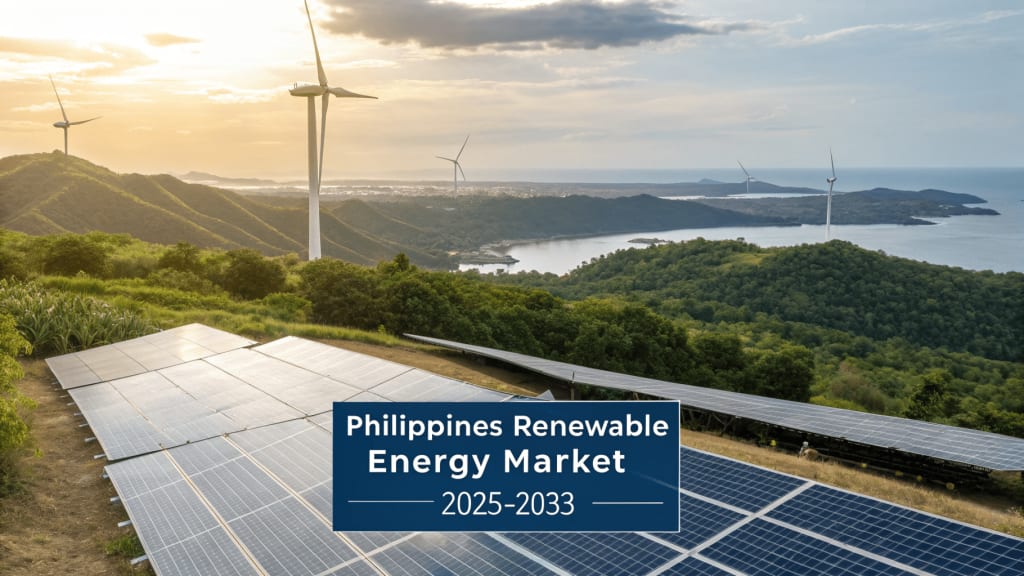
Philippines Renewable Energy Market
The Philippines renewable energy market is rapidly evolving as policy incentives, economic growth and energy security priorities drive increased deployment of clean power technologies. The Philippines renewable energy market size reached USD 19,218.0 Million in 2024. Looking forward, the market is projected to reach USD 39,716.6 Million by 2033, exhibiting a growth rate (CAGR) of 8.4% during 2025-2033.
The country’s renewable energy mix includes hydropower, geothermal, solar, wind and bioenergy — each contributing to a diversified cleaner energy landscape. With commitments to reduce greenhouse gas emissions and improve access to affordable electricity, the Philippines is positioning itself as a growing market for renewable energy investment.
What’s Driving Market Growth
1. Policy Framework & Government Targets
The Philippines has set ambitious renewable energy goals under its Renewable Energy Act and other regulatory frameworks. Initiatives such as feed-in tariffs, renewable portfolio standards and tax incentives have attracted investment into solar, wind and geothermal projects. These measures are designed to accelerate capacity additions and reduce reliance on imported fossil fuels.
2. Energy Security & Fuel Import Reduction
The nation is heavily reliant on imported oil and gas, making its energy security vulnerable to global price swings. Renewable energy presents a strategic alternative, allowing more stable, domestic energy generation and reducing fuel import costs. Solar and wind — in particular — provide scalable options that lessen dependence on external energy sources.
3. Growing Electricity Demand
Economic growth, urbanisation and industrial activity are increasing electricity consumption across the Philippines. Expanded access to power — especially in rural regions — supports development and improves business confidence. Renewable sources help bridge supply gaps while aligning with clean energy goals.
4. Declining Costs & Technology Advancements
Renewable technologies continue to become more cost-competitive with conventional generation sources. Solar panel costs have fallen sharply, and wind turbine efficiency has improved significantly. These trends make new renewable capacity economically attractive for independent power producers (IPPs) and investors alike.
Request a Sample Report with the Latest 2025 Data & Forecasts
What the Opportunities Are
1. Utility-Scale Solar & Wind Projects
Large solar farms and wind parks continue to attract investment due to declining levelised costs of energy (LCOE). Developers and investors can capture long-term returns through power purchase agreements (PPAs) with distribution utilities.
2. Distributed & C&I Renewable Solutions
Commercial and industrial energy consumers are increasingly adding rooftop solar and renewable hybrid systems to reduce operating costs and hedge against energy price volatility. These opportunities are ripe for financing, installation and service providers.
3. Energy Storage & Grid Integration
As renewable penetration increases, energy storage solutions — such as battery energy storage systems (BESS) — are critical for grid stability and peak load management. Investments in storage technologies support reliability and unlock higher renewable utilisation.
4. Geothermal Expansion
The Philippines sits in an optimal geologic region for geothermal power. There are opportunities for expansion of existing geothermal fields and development of new reservoirs, supported by improved drilling technologies.
5. Green Hydrogen & Clean Fuels
Renewable energy can power electrolysis for green hydrogen production — a growing area of interest for decarbonising heavy industry and transport segments, with export potential in future global markets.
Recent News & Developments in Philippines Renewable Energy Market
Jul 2025: The Department of Energy unveiled updated guidelines to enhance renewable energy permitting processes, reducing project development timelines and encouraging faster deployment of solar and wind projects across key provinces.
Sep 2025: Several utility-scale solar projects secured long-term power purchase agreements (PPAs) with major distribution utilities, demonstrating strong investor confidence and signalling significant capacity increases in the next five years.
Nov 2025: A consortium of renewable developers announced expansion of battery energy storage systems (BESS) in Luzon, intended to support grid stability and accommodate higher variable renewable energy penetration — a major step toward flexible energy infrastructure.
Why Should You Know About Philippines Renewable Energy Market?
You should know about this market because it represents a strategic intersection of energy security, environmental sustainability and economic development in one of Southeast Asia’s fastest-growing economies. Renewable energy is no longer a fringe segment — it is a core engine of future electricity supply, job creation and clean infrastructure investment.
For investors, the market offers diversified entry points — from large project finance and utility scale development, to distributed solar portfolios and energy storage systems. Policy support, declining technology costs and robust demand growth create a favourable investment climate.
For businesses and communities, renewable energy solutions help reduce energy costs, improve resilience to power outages and decrease reliance on imported fossil fuels. For policymakers, expanding renewables aligns with climate commitments and long-term energy planning.
About the Creator
Keep reading
More stories from Manisha Dixit and writers in Trader and other communities.
Philippines Computer Vision Market: AI Adoption, Automation & Digital Transformation
Philippines Computer Vision Market The Philippines computer vision market is witnessing accelerated growth as organisations across industries adopt artificial intelligence (AI) and machine-learning technologies to improve efficiency, security and decision-making. The Philippines computer vision market size reached USD 92.25 Million in 2024. The market is projected to reach USD 184.72 Million by 2033, exhibiting a growth rate (CAGR) of 7.19% during 2025-2033.
By Manisha Dixitabout a month ago in Trader
Australia Car Wash Services Market Accelerates Toward Sustainability and Digital Growth
The Australia Car Wash Services Market is on a steady growth trajectory as professional vehicle cleaning gains momentum with increasing environmental awareness, disposable income, and digital convenience. According to the latest IMARC Group research, the market reached USD 985.6 million in 2025 and is expected to grow to USD 1,242.8 million by 2034, representing a compound annual growth rate (CAGR) of 2.61% between 2026 and 2034.
By Rashi Sharmaabout 10 hours ago in Trader
ivp stock: The Quiet Investment Set to Gain Momentum
ivp stock has stayed under the radar, but it shows signs of growing interest. Many investors focus on fast-moving shares and miss quiet opportunities. In this article, we explore why ivp stock could gain momentum soon, its key strengths, and why patient investors should pay attention.
By John.doe7983 days ago in Trader
Rachel Reviews: The Spiral Archive by Pieter Hendrik
It's difficult for me to know where to start with a review of this book as it was, for me, an entirely unique experience and one that I'll probably never have again. I don't want that to be interpreted as unenjoyable but it has left me scratching my head a little and ruminating on its content, its themes and its characters.
By Rachel Deeminga day ago in BookClub



Comments
There are no comments for this story
Be the first to respond and start the conversation.