
Philippines Charcoal Market 2026: Biomass Energy Use, Household Fuel Demand & Sustainable Production
How cooking fuel needs, rural livelihoods and eco-friendly practices are shaping the Philippines charcoal market

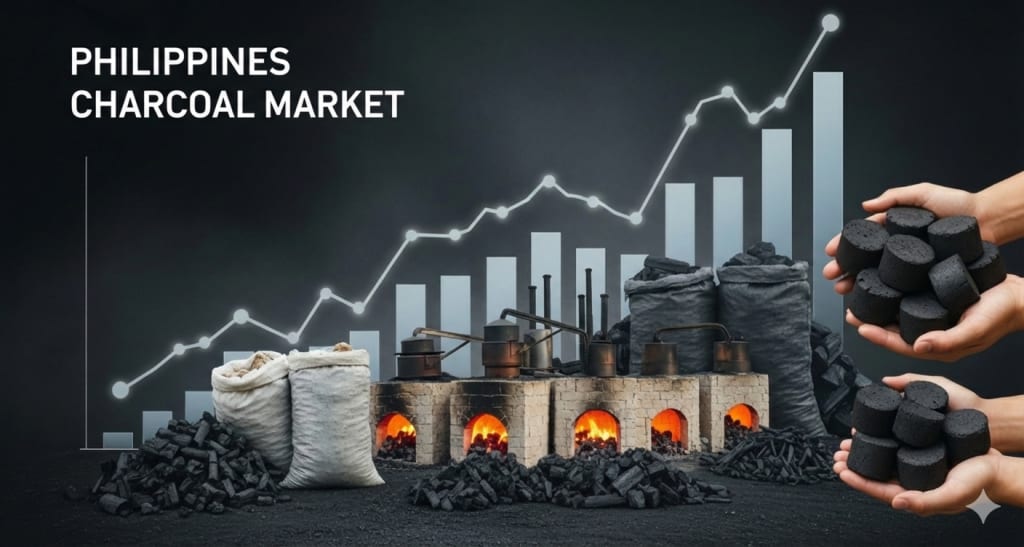
Philippines Charcoal Market Overview
The Philippines charcoal market plays an important role in the country’s biomass energy landscape, serving as a traditional and widely used fuel for household cooking, food service operations and small-scale industrial applications. Charcoal is produced through the carbonization of wood and other biomass materials and is valued for its relatively high energy density, low cost and ease of storage. Despite increasing electrification and the gradual shift toward modern cooking fuels, charcoal remains an essential energy source, particularly in rural areas and low-income households.
According to IMARC Group, The Philippines charcoal market growth reached USD 42.8 Million in 2025. Looking forward, IMARC Group expects the market to reach USD 68.7 Million by 2034, exhibiting a growth rate (CAGR) of 5.24% during 2026-2034. This steady growth reflects persistent demand from household cooking, rising use in barbecue and food service sectors, and growing interest in sustainably produced charcoal and briquettes.
Charcoal in the Philippines is consumed in lump form, briquettes and increasingly in processed or blended variants designed for consistent burning and reduced smoke. While domestic production supplies a significant share of demand, imports and cross-regional trade also contribute to market dynamics.
Driving Growth in the Philippines Charcoal Market
One of the primary drivers of market growth is continued reliance on biomass fuels for cooking. In many rural and peri-urban areas, charcoal remains more accessible and affordable than electricity or LPG. Cultural cooking practices that favor charcoal-fired stoves further support demand.
Another important factor is expansion of food service and street food sectors. Barbecue stalls, roadside eateries and small restaurants commonly use charcoal because it imparts desirable flavor characteristics and allows high-temperature grilling.
Population growth and urbanization also contribute to demand. As cities expand, informal food vendors and small eateries proliferate, supporting charcoal consumption.
Rising interest in charcoal briquettes and improved cookstoves is influencing market structure. Briquettes offer more consistent quality and longer burn times, while improved stoves reduce fuel consumption.
Growing awareness of sustainable forestry and responsible sourcing is shaping production practices. Programs promoting regulated harvesting and tree planting support more sustainable charcoal supply chains.
Request a Sample Report with the Latest 2026 Data & Forecasts
What the Opportunities Are
The Philippines charcoal market presents a wide range of opportunities across production, processing, distribution and sustainability initiatives.
1. Expansion of Charcoal Briquette Production
Briquettes made from agricultural residues, coconut shells and sawdust provide consistent quality and better combustion efficiency. Investing in briquette plants can improve product standardization and margins.
2. Development of Eco-Friendly and Low-Emission Charcoal
Charcoal products designed to produce less smoke and ash appeal to health-conscious consumers and foodservice operators.
3. Sustainable Plantation-Based Charcoal Production
Establishing dedicated tree plantations for charcoal production reduces pressure on natural forests and improves supply security.
4. Improved Kiln and Carbonization Technologies
Modern kilns increase yield, reduce emissions and improve charcoal quality. Technology providers can supply equipment and training.
5. Export-Oriented Charcoal Products
High-quality lump charcoal and coconut-shell charcoal are increasingly demanded in international barbecue and foodservice markets.
6. Branded and Packaged Charcoal Products
Retail-ready packaging and consistent quality enable premium positioning in supermarkets and hardware stores.
7. Integration with Clean Cooking Initiatives
Combining efficient charcoal with improved cookstoves supports cleaner cooking solutions.
8. Digital Distribution and Direct Sales
Online platforms and mobile ordering can improve access for small retailers and foodservice operators.
Operational Considerations
Charcoal production can face regulatory scrutiny related to deforestation and emissions. Compliance with forestry and environmental regulations is essential.
Supply chain fragmentation and informal production practices affect quality consistency. Transportation costs influence pricing due to bulky nature of charcoal.
Ensuring sustainable raw material sourcing remains a key challenge.
Recent News & Developments in the Philippines Charcoal Market
• Jan 2025: The Department of Environment and Natural Resources reported the establishment of over 12,000 hectares of community-managed tree plantations aimed at supporting sustainable charcoal and biomass fuel production.
• Mar 2025: Several cooperatives launched small-scale briquette manufacturing facilities with combined annual capacity exceeding 45,000 metric tons, using coconut shells and agricultural waste as feedstock.
• Jun 2025: Government clean cooking programs distributed more than 180,000 improved charcoal cookstoves in rural communities to reduce fuel consumption and indoor air pollution.
• Aug 2025: Export shipments of coconut-shell charcoal exceeded 32,000 metric tons, reflecting rising international demand for Philippine charcoal products.
• Oct 2025: Industry estimates showed a 13% year-on-year increase in domestic sales of packaged charcoal and briquettes, driven by retail and foodservice growth.
Why Should You Know About Philippines Charcoal Market?
Understanding the Philippines charcoal market provides insight into how traditional biomass fuels continue to support household energy needs and rural livelihoods while gradually transitioning toward more sustainable practices. The sector highlights the balance between affordability, cultural preferences and environmental responsibility.
For businesses, the market offers opportunities in briquette production, sustainable sourcing, export development and clean cooking solutions. For policymakers, it underscores the importance of supporting responsible forestry and improved production technologies. Overall, the charcoal market demonstrates how biomass energy remains a relevant and evolving part of the Philippines’ energy mix.
About the Creator
Keep reading
More stories from Manisha Dixit and writers in Trader and other communities.
Philippines Petroleum Market 2026: Fuel Demand, Energy Security & Infrastructure Development
Philippines Petroleum Market Overview The Philippines petroleum market remains a critical pillar of the country’s energy system, supplying fuels that power transportation, industrial operations, power generation and household consumption. Despite gradual progress toward renewable energy adoption, petroleum products continue to account for a significant share of the national energy mix due to their reliability, established infrastructure and wide applicability. The market includes refined products such as gasoline, diesel, aviation turbine fuel, liquefied petroleum gas (LPG), fuel oil and other derivatives used across multiple sectors.
By Manisha Dixita day ago in Trader



Comments
There are no comments for this story
Be the first to respond and start the conversation.