
Philippines Ammonia Market 2026: Industrial Demand, Fertiliser Growth & Energy Transition Dynamics
How agriculture demand, industrial processes and evolving energy applications are shaping the ammonia market in the Philippines

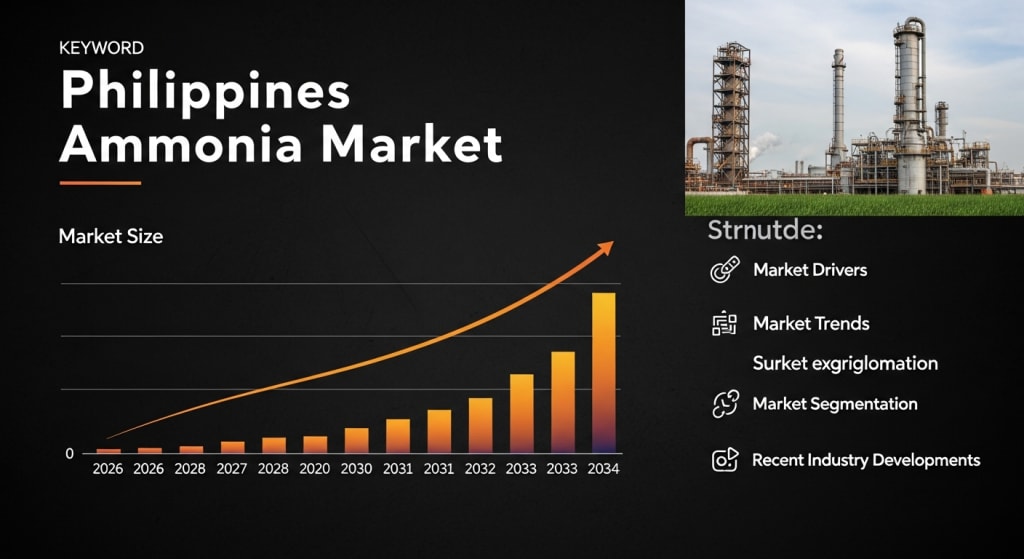
The Philippines ammonia market is expanding steadily as demand from agriculture, industrial applications and emerging energy sectors continues to rise in line with economic activity and infrastructure development. According to market estimates, the Philippines ammonia market size reached USD 1,733.75 Million in 2025 and is projected to grow to USD 2,476.56 Million by 2034, exhibiting a CAGR of 4.04% during 2026–2034. Ammonia — a key nitrogen-containing compound — is widely used as a feedstock in fertiliser production, industrial chemicals, refrigerants, and increasingly being explored as a low-carbon energy carrier in future energy systems.
In the Philippines, where agriculture remains a pivotal economic sector and industries such as chemicals, refrigeration and power generation require nitrogen-based inputs, the ammonia market plays a crucial role in driving productivity, operational efficiency and supply chain stability.
What’s Driving Market Growth?
Agricultural & Fertiliser Demand Agriculture is a major user of ammonia via its derived products like urea, ammonium nitrate, and ammonium sulphate — essential fertilisers that enhance crop yields, manage soil nutrients, and align with seasonal planting cycles. The continual demand in the Philippines agricultural sector to boost productivity, enhance food security, and embrace modern farming techniques supports consistent ammonia usage.
Industrial & Chemical Uses In addition to fertilizers, ammonia serves as an essential ingredient in industrial chemicals, including nitric acid, explosives, plastics, dyes, and synthetic fibers. Manufacturing sectors depend on ammonia-derived resources for production operations that bolster infrastructure, automotive, consumer products, and industrial equipment industries—leading to ongoing demand.
Refrigeration & Cooling Systems Ammonia’s properties as a refrigerant — especially in large industrial refrigeration, cold storage and processing facilities — make it a go-to choice in applications requiring high heat transfer efficiency. As food processing, cold-chain logistics and manufacturing capacities expand in the Philippines, ammonia-based refrigeration systems remain important for temperature-controlled operations.
Energy Transition & Low-Carbon Potential Emerging interest in green ammonia — ammonia produced using renewable energy and low-carbon hydrogen — highlights future pathways for energy transition. While currently nascent in the Philippines, opportunities in green ammonia as an energy carrier, hydrogen storage vector and fuel input for zero-carbon power generation are attracting research interest and strategic exploration.
Infrastructure & Construction Sector Growth Infrastructure development — including bridges, road networks, industrial parks, ports and urban utilities — stimulates demand for chemicals and materials that rely on ammonia-based precursors. As construction activity expands, industrial chemical demand — indirectly linked to ammonia — rises alongside broader economic growth.
Market Segmentation & Key Insights
By Source The ammonia market is segmented by natural gas-based ammonia, coal-derived, and emerging green ammonia production sources. Natural gas-based ammonia remains the dominant segment due to established production technologies, cost-efficiency and feedstock availability, while green ammonia is gaining visibility as renewable hydrogen infrastructure develops.
By Application The market is categorised into fertilisers, industrial chemicals, refrigeration and cooling applications, power generation inputs, water treatment chemicals, and emerging energy carriers (e.g., hydrogen/ammonia blends). Fertiliser applications typically contribute the largest share due to ongoing agricultural demand.
By End-User Industry End users include agricultural producers and cooperatives, chemical manufacturers, industrial equipment producers, food processing and cold-chain businesses, power utilities, construction firms and emerging renewable energy initiatives. Agriculture and industrial segments are the most significant contributors to ammonia consumption.
By Distribution Channel Ammonia products move through chemical distributors, industrial supply chains, fertiliser supply networks, OEM partnerships, direct manufacturer contracts, bulk transport logistics and on-site production agreements. Distributors and supply partners ensure reliable delivery to farms, factories and processing facilities.
What the Opportunities Are?
Green & Low-Carbon Ammonia Development There is growing opportunity in green ammonia production using renewable energy sources and electrolytic hydrogen, which can position the Philippines as part of emerging regional hydrogen economies, support decarbonisation efforts, and attract climate-aligned investment.
Fertiliser Efficiency & Crop Nutrition Services Integrating ammonia with precision agriculture, soil health services and nutrient optimisation programmes can help farmers reduce input costs, increase yields, and improve environmental outcomes — enhancing agricultural profitability.
Industrial Chemicals Downstream Integration Ammonia serves as a building block for numerous industrial chemicals. Investing in local downstream chemical production facilities — including nitric acid, nitrates, plastics precursors and speciality chemicals — can expand value capture and reduce import dependence.
Cold-Chain & Refrigeration Innovation As the food processing sector grows, opportunities exist for energy-efficient ammonia refrigeration technologies, retrofits, leak-reduction systems and safety-focused cooling solutions that support cold-chain infrastructure across logistics and industrial hubs.
Export & Regional Market Collaboration The Philippines can explore cross-border ammonia trade, joint ventures and supply agreements with neighbouring economies to anchor regional fertiliser and chemical supply chains, leveraging competitive logistics, port infrastructure and agricultural markets.
Recent News and Developments in Philippines Ammonia Market
Jul 2025: Agricultural supply associations reported increased fertiliser uptake among large-scale growers ahead of peak planting cycles, driven by expectations of higher crop yields and stable price forecasts — supporting ammonia demand.
Sep 2025: Industrial chemical manufacturers expanded long-term supply contracts for ammonia feedstock to ensure continuity for nitric acid and polymer precursor production, reflecting strengthened supply chain planning.
Nov 2025: Energy forums and research symposia highlighted green ammonia potential in sustainable energy economies, encouraging industry stakeholders to explore renewable hydrogen partnerships and pilot low-carbon ammonia projects.
Why Should You Know About Philippines Ammonia Market?
This market is important to understand as it shows the interplay between critical chemical inputs, agricultural productivity, and industrial growth, all of which contribute to economic development and supply-chain strength in the Philippines. Ammonia is a key commodity that fuels fertiliser production, industrial activities, and temperature-sensitive operations, with its demand indicating larger structural requirements in agriculture, manufacturing, and infrastructure growth.
The ammonia market offers investors access to a stable commodity sector driven by demand, which supports essential economic activities. The expected CAGR of 4.04% indicates steady growth associated with agricultural cycles, industrial development, and emerging energy transformation stories.
For policymakers, planners and industry leaders, understanding ammonia’s role helps shape regulatory frameworks, supply chain strategies, agricultural support programmes and energy diversification plans that balance economic progress with sustainability goals.
In essence, the Philippines ammonia market captures how chemical inputs, agricultural stability and industrial capacity converge — making it a compelling segment that influences daily production, livelihood outcomes and long-term economic resilience.
About the Creator
Thomas
Market Research Analyst | Industry Trends & Forecasting | Turning market data into clear, actionable business insights across global sectors.
Australia Wellness Tourism Market Set for Explosive Growth Fueled by Holistic Experiences
The Australia wellness tourism market reached USD 18.1 billion in 2024 and is forecast to expand to USD 67.6 billion by 2033, exhibiting a robust compound annual growth rate (CAGR) of 14.6% between 2025 and 2033. This rapid growth reflects strong consumer interest in wellness oriented travel that blends physical, mental and cultural well being with leisure and outdoor experiences. Eco conscious retreats, premium spa services, nature immersion activities and wellness focused itineraries are reshaping Australia’s travel landscape, attracting both domestic and international visitors.
By Rashi Sharma7 days ago in Trader
Philippines AI in Fintech Market: Intelligent Finance, Digital Growth & Risk Innovation
Philippines AI in Fintech Market Overview The Philippines AI in fintech market is rapidly gaining momentum as financial institutions, digital payment platforms and emerging fintech startups adopt artificial intelligence (AI) technologies to enhance service delivery, operational efficiency and customer experience. AI in fintech covers a range of intelligent systems including machine learning models, virtual assistants, fraud detection tools, behavioural analytics and credit scoring systems that optimise decision-making and reduce risks. The Philippines AI in fintech market size reached USD 79.38 Million in 2024. The market is projected to reach USD 419.35 Million by 2033, exhibiting a growth rate (CAGR) of 18.11% during 2025-2033 as AI becomes integral to financial innovation and digital transformation across banking, payments and financial services.
By Manisha Dixit6 days ago in Trader



Comments
There are no comments for this story
Be the first to respond and start the conversation.