
P2M - RAAST Phase 3
Person to Merchant Payments through RAAST
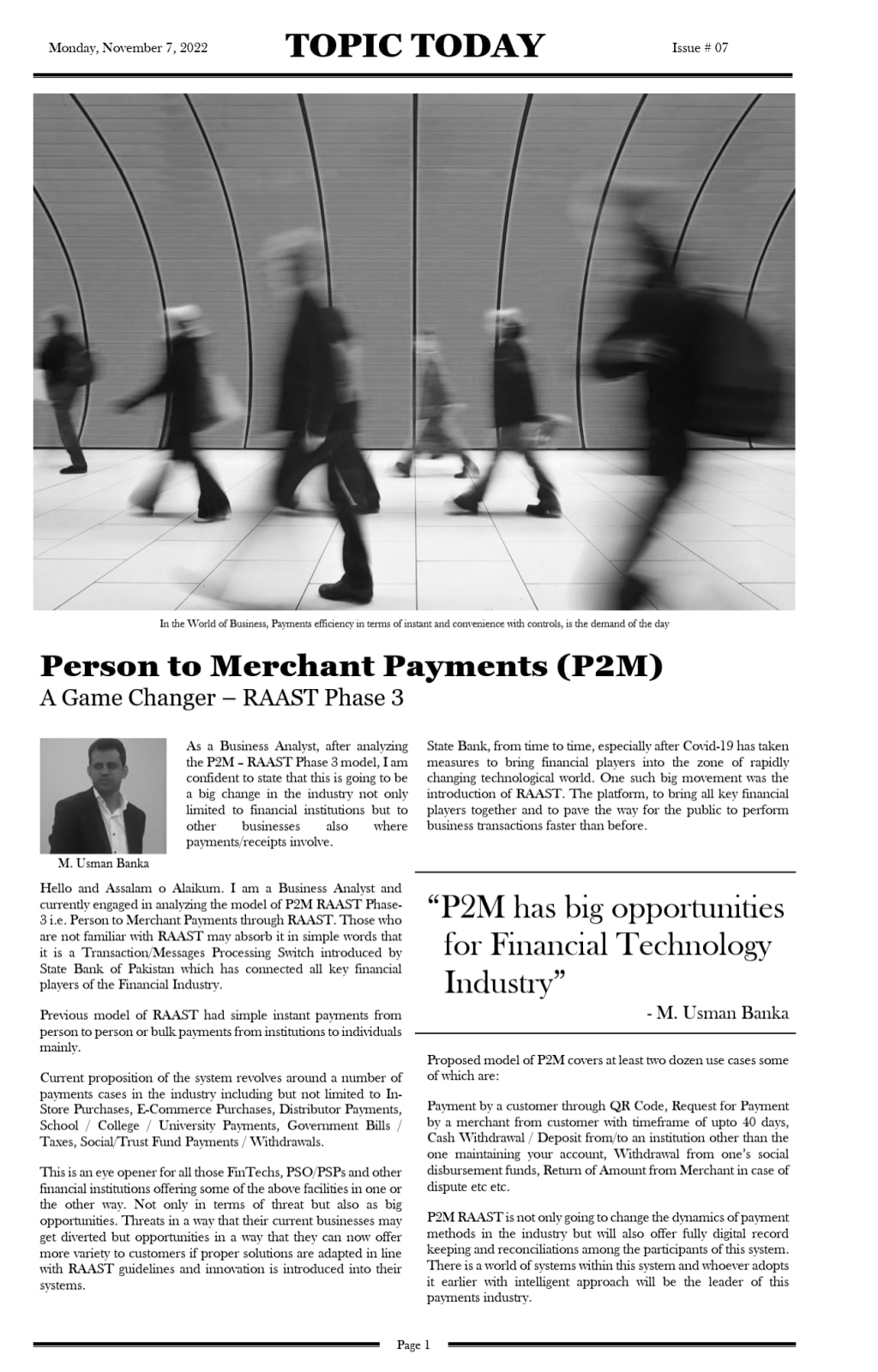
As a Business Analyst, after analyzing the P2M – RAAST Phase 3 model, I am confident to state that this is going to be a big change in the industry not only limited to financial institutions but to other businesses also where payments/receipts involve.
Hello and Assalam o Alaikum. I am a Business Analyst and currently engaged in analyzing the model of P2M RAAST Phase-3 i.e. Person to Merchant Payments through RAAST. Those who are not familiar with RAAST may absorb it in simple words that it is a Transaction/Messages Processing Switch introduced by State Bank of Pakistan which has connected all key financial players of the Financial Industry.
Previous model of RAAST had simple instant payments from person to person or bulk payments from institutions to individuals mainly.
Current proposition of the system revolves around a number of payments cases in the industry including but not limited to In-Store Purchases, E-Commerce Purchases, Distributor Payments, School / College / University Payments, Government Bills / Taxes, Social/Trust Fund Payments / Withdrawals.
This is an eye opener for all those FinTechs, PSO/PSPs and other financial institutions offering some of the above facilities in one or the other way. Not only in terms of threat but also as big opportunities. Threats in a way that their current businesses may get diverted but opportunities in a way that they can now offer more variety to customers if proper solutions are adapted in line with RAAST guidelines and innovation is introduced into their systems.
State Bank, from time to time, especially after Covid-19 has taken measures to bring financial players into the zone of rapidly changing technological world. One such big movement was the introduction of RAAST. The platform, to bring all key financial players together and to pave the way for the public to perform business transactions faster than before.
Proposed model of P2M covers at least two dozen use cases some of which are:
Payment by a customer through QR Code, Request for Payment by a merchant from customer with timeframe of upto 40 days, Cash Withdrawal / Deposit from/to an institution other than the one maintaining your account, Withdrawal from one’s social disbursement funds, Return of Amount from Merchant in case of dispute etc etc.
P2M RAAST is not only going to change the dynamics of payment methods in the industry but will also offer fully digital record keeping and reconciliations among the participants of this system. There is a world of systems within this system and whoever adopts it earlier with intelligent approach will be the leader of this payments industry.
State Bank, from time to time, especially after Covid-19 has taken measures to bring financial players into the zone of rapidly changing technological world. One such big movement was the introduction of RAAST. The platform, to bring all key financial players together and to pave the way for the public to perform business transactions faster than before.
Only the use case of QR Code has a world of data elements in it which can cover from a TIP amount to prompting customer to provide contextual information or any other information such as Mobile Number, Email Address or customer's address. The QR Generated has various data elements in it and it is under the umbrella of EMVCo standard QR Generation template which has a logic build into it that the string of the QR contains data elements and then the length of data element and then the value of that data element. Each data element denotes different things.
Apart from QR, the Request to Pay use case is one of the most demanded feature of the industry where bills can be generated, school fee vouchers can be pushed to parents and with only one click, they are payable along with all required details recorded into the system.
“P2M has big opportunities for Financial Technology Industry”
About the Creator
Keep reading
More stories from writers in Trader and other communities.
Egg Powder Market Size and Forecast 2026–2034: Rising Demand for Convenient Protein Ingredients Fuels Global Growth
Egg Powder Market Size and Forecast 2026–2034 The global egg powder market is expected to experience steady growth during the coming decade, supported by increasing demand from the food processing, bakery, confectionery, and ready-to-eat food industries. Egg powder offers numerous advantages compared to fresh eggs, including longer shelf life, easier storage, and lower transportation costs. These benefits make it a preferred ingredient for manufacturers looking for consistent quality and supply.
By shibansh kumara day ago in Trader
Australia Emergency Lighting Market 2026: Smart Lighting Adoption, Safety Regulations & Infrastructure Expansion
Australia Emergency Lighting Market Overview The Australia emergency lighting market plays an important role in ensuring building safety and compliance across commercial, industrial and public infrastructure. Emergency lighting systems provide essential illumination during power failures or emergency situations, enabling safe evacuation and improving overall building safety. These systems are widely installed in offices, hospitals, shopping centers, transportation hubs and industrial facilities.
By Amyra Singha day ago in Trader
📢 Raise Your Voice Thread: 03/05/2026
Our “Raise Your Voice Threads” are hosted most alternating Thursdays at 12PM ET to offer creators more avenues to uncover exceptional stories on Vocal. As we are continuously searching for fresh creators and inspiring stories, this thread provides an opportunity to exchange and discuss the stories that have moved and motivated us on Vocal.
By Raise Your Voice by Vocal5 days ago in Resources



Comments
There are no comments for this story
Be the first to respond and start the conversation.