
North America Salmon Fish Market Trends & Summary (2025–2033)
Health, Sustainability, and Innovation Drive the North American Salmon Industry Toward a USD 12.33 Billion Future

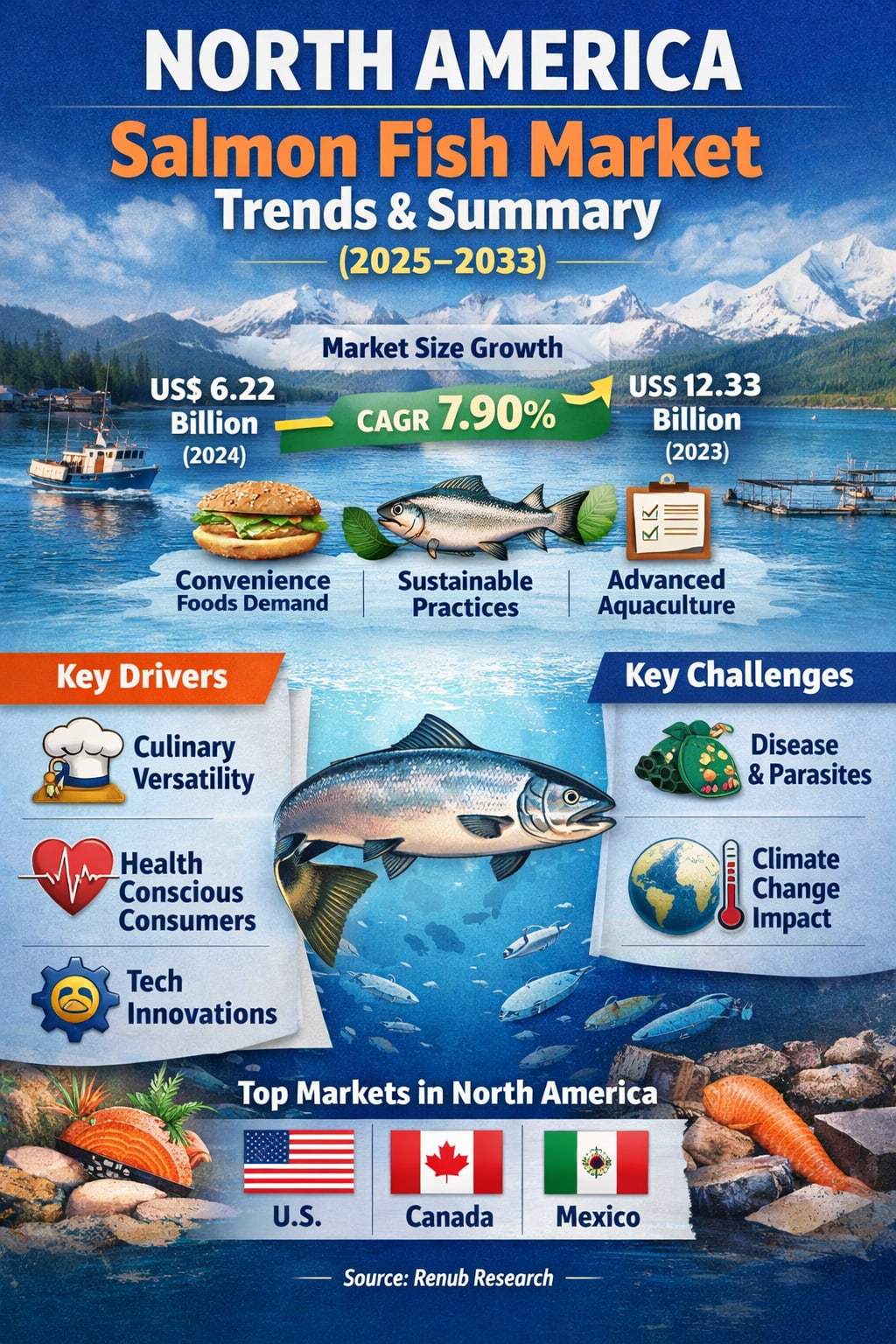
North America Salmon Fish Market at a Glance
The North America Salmon Fish Market is entering a strong growth phase, reflecting changing consumer lifestyles, rising health awareness, and the rapid evolution of seafood supply chains. According to Renub Research, the market is expected to expand from US$ 6.22 billion in 2024 to US$ 12.33 billion by 2033, growing at a CAGR of 7.90% from 2025 to 2033.
This impressive trajectory is being fueled by several converging forces. The growing preference for ready-to-consume and easy-to-cook food products, rising environmental awareness, and increasing interest in sustainable and ethically sourced seafood are reshaping purchasing decisions across the region. At the same time, improvements in cold chain logistics, processing technologies, and distribution networks are making salmon more accessible to consumers in both coastal and inland markets.
The North America Salmon Fish Market & Forecast report covers the industry by Form (Fresh, Frozen, Smoked, Canned, Others), Species (Chinook, Coho, Pink, Red, Silverbrite, Salmon Salar), Distribution Channel (Retail, HoReCa & Wholesale, Processed Food Industry, Other Institutional Customers), and Country (United States, Canada, Mexico, Rest of North America), along with detailed company analysis for the period 2025–2033.
Industry Overview: Why Salmon Holds a Premium Position
Salmon, a highly valued member of the Salmonidae family, is widely recognized for its distinctive pink flesh, rich buttery flavor, and exceptional nutritional profile. It plays a central role in cuisines across North America, from simple home-cooked meals to fine dining menus. Among the many varieties available, Atlantic and Pacific salmon species such as Chinook, Coho, Pink, and Sockeye (Red Salmon) dominate global consumption patterns.
Beyond taste, salmon’s reputation as a nutritional powerhouse is one of its biggest commercial strengths. It is rich in omega-3 fatty acids, high-quality protein, and essential nutrients such as vitamin D, vitamin B12, and selenium. These components are linked to benefits such as improved heart health, better cognitive function, and reduced inflammation—making salmon a staple choice for health-conscious consumers.
In North America, the expanding aquaculture sector has played a critical role in ensuring consistent supply throughout the year. At the same time, the growing demand for convenience foods has led to a surge in value-added salmon products, including frozen fillets, smoked salmon, canned salmon, spreads, jerky, and ready-to-cook meal kits. These formats cater perfectly to modern consumers who want nutritious meals without long preparation times.
Sustainability has also become a defining theme. As awareness grows about overfishing and ecosystem protection, both consumers and retailers are placing greater emphasis on certified sustainable fisheries and responsible aquaculture practices. Governments across the region have introduced stricter regulations for fishing and farming, which, while challenging for producers, are helping to create a more stable and environmentally responsible industry in the long run.
Market Momentum: Convenience, Sustainability, and Innovation
One of the most notable trends shaping the market is the shift toward value-added and ready-to-eat products. Smoked salmon, marinated fillets, portioned cuts, and meal kits are increasingly popular among busy urban consumers. These products not only save time but also maintain the premium image of salmon as a healthy, high-quality protein source.
Product innovation is also accelerating market growth. In March 2024, Multi X introduced Latitude 45 Smoked Salmon Candy Bites and Smoked Chipotle Salmon at Seafood Expo North America (SENA), offering bold, ready-to-eat flavors designed to inspire home cooks. Such launches highlight how companies are blending convenience, taste experimentation, and premium positioning to expand their consumer base.
At the same time, the efficiency of supply chains and cold logistics has become a key competitive advantage. Advances in freezing, packaging, and temperature-controlled transportation have extended shelf life and preserved product quality, allowing salmon to reach a wider geographic audience without compromising freshness.
Key Growth Drivers for the North America Salmon Fish Market
1. Culinary Flexibility and Broad Consumer Appeal
Salmon’s mild yet rich flavor and adaptable texture make it one of the most versatile seafood options available. It fits seamlessly into a wide range of culinary styles, from traditional American dishes to Asian, Mediterranean, and fusion cuisines. Whether grilled, baked, smoked, or served raw in sushi and poke bowls, salmon offers consistent taste and premium appeal.
This versatility has encouraged both restaurants and home cooks to experiment with new recipes and formats. The growing popularity of ready-to-eat products such as smoked salmon slices, salmon burgers, and poke bowls reflects changing eating habits and the demand for quick yet nutritious meals. As food culture continues to evolve, salmon’s flexibility ensures it remains a centerpiece in modern diets.
2. Rising Health Consciousness Among Consumers
Health awareness is one of the strongest long-term drivers of salmon consumption. As more people become conscious of heart health, brain function, and balanced nutrition, salmon stands out as a natural choice. Its high content of omega-3 fatty acids, combined with premium protein and essential vitamins, aligns perfectly with wellness-focused diets.
The rise in lifestyle-related conditions such as obesity and cardiovascular diseases has further pushed consumers toward nutrient-dense foods. In this context, salmon is increasingly viewed not just as a tasty option, but as a functional food that supports long-term health. This perception allows salmon to maintain a premium price position while still expanding its customer base.
3. Technological Advancements in Farming and Processing
Technological progress has significantly improved both the productivity and sustainability of salmon farming. Innovations such as selective breeding, improved feeding systems, and better disease management techniques have made aquaculture more efficient and environmentally responsible.
On the processing side, advances in vacuum packaging, rapid freezing, and cold-chain logistics have enhanced product quality and shelf life. These improvements ensure that salmon reaches consumers in optimal condition, even in distant inland markets. Together, these technologies are helping producers meet rising demand while maintaining consistent standards and reducing waste.
Key Challenges Facing the Market
1. Disease and Parasite Management
One of the most persistent challenges in the salmon industry is disease and parasite control, particularly in aquaculture operations. Issues such as sea lice, bacterial infections, and viral diseases can spread quickly, affecting both farmed and wild populations. These outbreaks can lead to higher mortality rates, lower product quality, and significant financial losses.
Managing these risks requires continuous monitoring, strong biosecurity measures, and investment in solutions such as vaccination programs, cleaner fish, and non-chemical treatment methods. However, these measures increase operational costs and require technical expertise. Balancing fish health, environmental safety, and profitability remains a complex task for the industry.
2. Climate Change and Changing Ocean Conditions
Climate change poses a long-term structural risk to the salmon market. Rising ocean temperatures, ocean acidification, and extreme weather events can disrupt salmon migration patterns, reduce oxygen levels in water, and increase the spread of diseases and parasites.
These environmental pressures affect both wild and farmed salmon populations, threatening growth rates, survival, and reproductive success. In addition, storms and flooding can damage aquaculture infrastructure, creating further supply uncertainties. Building climate resilience into farming practices and supply chains is becoming an essential priority for the industry’s future stability.
Country-Level Market Insights
United States Salmon Fish Market
The United States represents one of the largest and most dynamic salmon markets in North America. Demand is driven by health-conscious consumers, diverse culinary applications, and strong retail and foodservice distribution networks. Both wild-caught and farm-raised salmon play important roles in meeting year-round consumption needs.
Sustainability and traceability are becoming increasingly important purchasing criteria, pushing producers and retailers to adopt more transparent and responsible sourcing practices. Despite challenges such as rising costs and environmental concerns, the U.S. market continues to grow благодаря product innovation, premiumization, and expanding online and offline retail channels.
Recent developments highlight this momentum. In January 2024, King Oscar launched a new line of skinless and boneless Atlantic salmon in extra virgin olive oil in the U.S. market. The same month, Acme Smoked Fish opened a new facility in Florida to meet rising demand in the southeastern United States, underlining strong confidence in future consumption growth.
Canada Salmon Fish Market
Canada is a major player in the North American salmon industry, with production concentrated in regions such as British Columbia, New Brunswick, Nova Scotia, Newfoundland and Labrador, and Prince Edward Island. While Atlantic salmon dominates, Chinook and Coho are also significant.
The industry faces growing scrutiny over environmental impact and disease management, particularly in British Columbia. The Canadian government’s plan to phase out open-net pen salmon farming by 2029 and shift toward closed-containment systems represents a major structural change. While this transition presents technological and financial challenges, it also opens the door for more sustainable long-term growth. Despite these hurdles, salmon remains a critical contributor to Canada’s seafood exports and regional economies.
Mexico Salmon Fish Market
Mexico’s salmon market is primarily import-driven, as domestic production is limited. The country sources most of its salmon from Chile, Norway, and the United Kingdom, supported by strong import and distribution networks. Major wholesale hubs, such as La Nueva Viga in Mexico City, play a key role in supplying both domestic and export markets.
Rising health awareness and the growing popularity of seafood in both traditional and modern Mexican cuisine are boosting demand. Retailers offer salmon in fresh, frozen, and canned formats, catering to a wide range of consumers. Despite limited local production, strong import channels and expanding seafood consumption continue to support steady market growth.
Market Segmentation Snapshot
By Form:
Fresh
Frozen
Smoked
Canned
Others
By Species:
Chinook Salmon
Coho Salmon
Pink Salmon
Red Salmon
Silverbrite Salmon
Salmon Salar
By Distribution Channel:
Retail
HoReCa & Wholesale
Processed Food Industry
Other Institutional Customers
By Country:
United States
Canada
Mexico
Rest of North America
Competitive Landscape and Company Analysis
The market features a mix of global and regional players focusing on product quality, sustainability, supply chain efficiency, and innovation. Key companies covered in the analysis include:
Camanchaca Inc.
Atlantic Capes Fisheries, Inc.
Leroy Seafood Group ASA
Marine Harvest ASA
Multiexport Foods S.A.
Sea Trade
Atalanta Corporation
Each company is evaluated from four viewpoints: overview, key personnel, recent developments, and revenue performance, providing a comprehensive picture of competitive positioning in the North American market.
Final Thoughts
The North America Salmon Fish Market is on a strong growth path, supported by powerful trends in health, convenience, sustainability, and technological innovation. With the market projected to nearly double from US$ 6.22 billion in 2024 to US$ 12.33 billion by 2033, salmon is set to remain one of the most valuable and resilient segments of the seafood industry.
While challenges such as climate change, disease management, and regulatory pressures will continue to test producers, the industry’s ability to adapt through innovation and responsible practices offers a solid foundation for long-term expansion. For consumers, businesses, and investors alike, salmon represents not just a premium food choice—but a growing market shaped by the future of sustainable and health-focused eating.
About the Creator
Keep reading
More stories from shibansh kumar and writers in Trader and other communities.
North America Silicone Market Size and Forecast 2025–2033
North America Silicone Market Outlook The North America Silicone Market is entering a phase of steady and resilient growth, supported by expanding applications across construction, healthcare, electronics, transportation, and personal care industries. According to Renub Research, the market is expected to grow from US$ 5.94 billion in 2024 to US$ 9.22 billion by 2033, registering a compound annual growth rate (CAGR) of 5.00% from 2025 to 2033.
By shibansh kumar3 days ago in Trader
Mexico Electric Vehicle Charging Station Market Size & Forecast 2034
Mexico Electric Vehicle Charging Station Market Overview The Mexico Electric Vehicle Charging Station Market is witnessing rapid expansion as the country accelerates its transition toward sustainable mobility. The rising adoption of electric vehicles (EVs), combined with supportive government policies and private sector investments, is strengthening the development of charging infrastructure nationwide.
By Kim Soo hyuna day ago in Trader
Mortgage Rate Tips: How to Avoid Overpaying on Your Home Loan
Buying a home is exciting, but understanding the mortgage rate can save you thousands. Many homebuyers only look at the monthly payment and ignore hidden costs or fees. They will explain how mortgage rates work, common mistakes to avoid, and practical tips to get the best deal.
By John.doe7986 days ago in Trader




Comments
There are no comments for this story
Be the first to respond and start the conversation.