
Middle East & Africa Non-Lethal Weapons Market: Balancing Security and Human Rights
Rising Security Challenges Drive Demand for Non-Lethal Crowd Control Technologies Across the Region

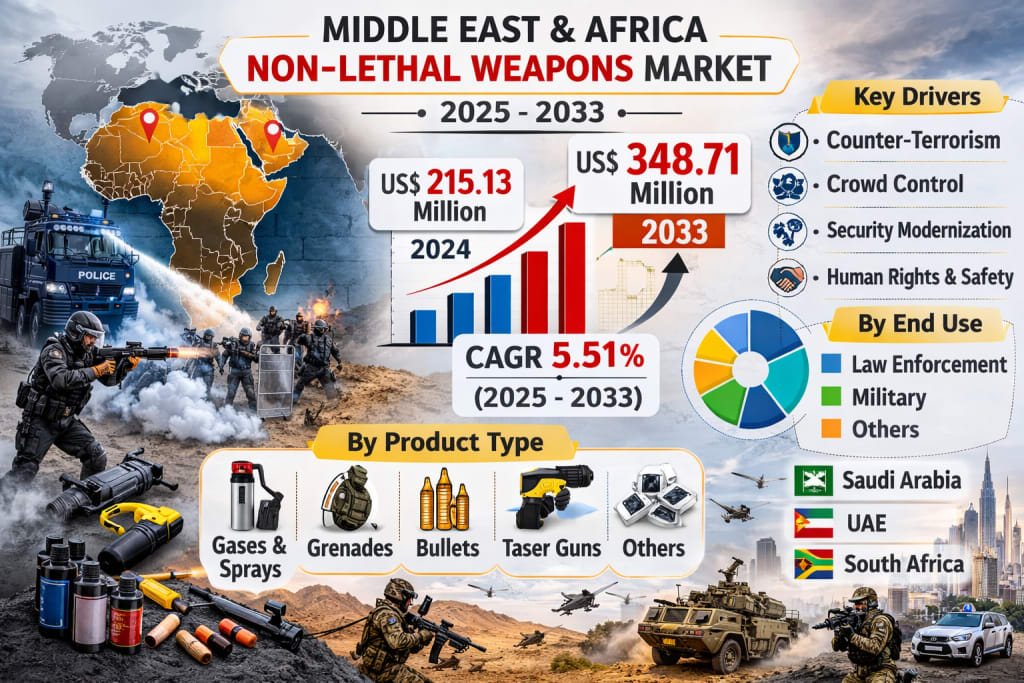
The Middle East & Africa (MEA) Non-Lethal Weapons Market is witnessing steady growth as governments and security agencies search for effective ways to maintain order without relying on deadly force. According to industry estimates, the market is projected to increase from US$ 215.13 million in 2024 to approximately US$ 348.71 million by 2033, expanding at a compound annual growth rate (CAGR) of 5.51% from 2025 to 2033.
Across the region, authorities are facing a complex mix of security challenges, including political unrest, terrorism threats, urban protests, and civil disturbances. In response, law enforcement agencies and military forces are increasingly adopting non-lethal weapons such as tear gas, rubber bullets, stun guns, and acoustic devices to manage conflicts and maintain public order while minimizing casualties.
These technologies are becoming vital tools for governments that must balance public safety with international standards on human rights and proportional use of force. As a result, the adoption of advanced non-lethal technologies is expanding across both developed and emerging security markets in the Middle East and Africa.
Middle East & Africa Non-Lethal Weapons Industry Overview
The demand for non-lethal weaponry in the MEA region is primarily driven by ongoing geopolitical tensions, internal conflicts, and increased urbanization. Governments and law enforcement organizations are increasingly deploying non-lethal systems to control crowds, manage riots, and prevent escalation during protests.
Non-lethal weapons offer a practical alternative to traditional firearms by incapacitating individuals or dispersing crowds without causing permanent harm. Commonly used tools include tear gas canisters, pepper spray, rubber bullets, stun grenades, and electroshock devices. These systems enable security personnel to respond effectively to volatile situations while reducing the risk of fatalities.
In areas experiencing political instability or civil demonstrations, such tools are essential for maintaining stability. For example, tear gas and rubber bullets are widely used for riot control, allowing authorities to disperse crowds and prevent violence without resorting to lethal force.
Additionally, non-lethal systems play a growing role in conflict zones, where military forces must manage civilians, checkpoints, and security operations without escalating tensions unnecessarily. These weapons help security forces handle situations involving insurgents or hostile groups while minimizing harm to nearby civilian populations.
Technological advancements are also reshaping the industry. Modern solutions such as directed energy systems, acoustic devices, and high-precision electroshock weapons provide enhanced accuracy and improved operational capabilities. These innovations enable security forces to respond quickly to threats while maintaining a controlled and measured approach.
Despite economic and political challenges in parts of the region, the MEA non-lethal weapons market continues to expand as governments prioritize public safety, security modernization, and ethical policing practices.
Increasing Defense Spending Supports Market Expansion
Another significant factor driving market growth is the rising defense and security spending across several Middle Eastern countries. Governments are allocating larger budgets to strengthen their military and law enforcement capabilities.
For instance, Saudi Arabia significantly increased its defense spending, planning to allocate approximately US$ 69 billion in 2023, which represented nearly 23% of its national budget. The investment aligns with the country’s Vision 2030 strategy, which includes efforts to strengthen domestic defense industries and modernize security infrastructure.
As part of these initiatives, law enforcement agencies are investing in advanced riot control and crowd management technologies, including non-lethal weapons. Equipment such as tear gas launchers, electroshock devices, and rubber bullets is increasingly used by police forces to address civil unrest and maintain public safety.
In Africa, countries such as South Africa also play a key role in the regional market. With rising urbanization and increasing public demonstrations, the demand for modern crowd control technologies is growing. Police agencies and private security companies in the country rely on non-lethal tools to deter crime and maintain order in densely populated urban environments.
Growth Drivers for the Middle East & Africa Non-Lethal Weapons Market
Counter-Terrorism Efforts
Counter-terrorism strategies are a major contributor to the increasing demand for non-lethal weaponry across the region. Governments in the Middle East and Africa face ongoing threats from extremist groups and insurgent organizations. In many cases, security forces must neutralize threats without escalating violence or causing unnecessary casualties.
Non-lethal weapons provide effective solutions in such situations. Tools such as stun guns, tear gas, flashbang grenades, and acoustic devices allow security personnel to immobilize suspects, disrupt hostile activities, and gain control of dangerous situations.
These weapons are particularly valuable in high-risk environments such as airports, border checkpoints, government facilities, and energy infrastructure sites, where minimizing collateral damage is crucial. Their ability to incapacitate individuals without causing permanent harm makes them an essential component of modern counter-terrorism strategies.
Modernization of Security Forces
Many countries across the Middle East and Africa are actively modernizing their law enforcement and military capabilities. Governments are investing in new technologies and advanced equipment to enhance the efficiency and preparedness of their security forces.
Non-lethal weapons are an important part of these modernization programs. Devices such as electroshock weapons, rubber bullet launchers, and tear gas systems are being integrated into standard security operations.
These tools allow security forces to manage crowd control situations more effectively while minimizing injuries and fatalities. Their adoption also reflects a shift toward modern policing practices, where authorities aim to reduce the use of deadly force and rely on controlled response strategies instead.
Furthermore, improved equipment helps security agencies maintain order during large public gatherings, protests, and political demonstrations—events that are becoming more frequent as urban populations grow.
Focus on Human Rights and Ethical Policing
In recent years, international organizations and civil society groups have emphasized the importance of human rights and ethical policing standards. Governments across the MEA region are under increasing pressure to ensure that law enforcement practices align with global human rights principles.
Non-lethal weapons provide a solution that allows authorities to maintain control without resorting to deadly force. Equipment such as tasers, pepper spray, and rubber bullets enables law enforcement officers to subdue individuals while reducing the risk of severe injuries.
By adopting non-lethal technologies, governments can demonstrate their commitment to protecting civilians and respecting international policing standards. This shift toward responsible security practices is playing a significant role in the expansion of the regional market.
Challenges in the Middle East & Africa Non-Lethal Weapons Market
Lack of Training and Infrastructure
Despite the growing demand for non-lethal weapons, many countries in the region face challenges related to training and operational infrastructure.
Effective use of non-lethal systems requires proper training programs that teach security personnel how to deploy these tools safely and responsibly. Without adequate training, officers may misuse equipment or fail to apply it effectively during critical situations.
In addition, infrastructure limitations such as insufficient storage facilities, maintenance systems, and logistical support can affect the performance and durability of non-lethal equipment.
These operational challenges can limit the full potential of non-lethal technologies, especially in developing regions where law enforcement resources are already stretched.
Budget Constraints and Resource Allocation
Economic limitations remain another barrier to the widespread adoption of non-lethal weapons across parts of Africa and the Middle East.
Many countries in the region face competing budget priorities, including healthcare, education, infrastructure development, and traditional defense spending. As a result, funding for non-lethal equipment procurement may be limited.
Smaller police departments and security agencies often struggle to allocate sufficient funds for purchasing advanced non-lethal systems, maintaining equipment, and training personnel.
These financial constraints can slow down the adoption of modern security technologies, even though non-lethal weapons offer significant benefits in terms of public safety and ethical law enforcement.
United Arab Emirates Non-Lethal Weapons Market
The United Arab Emirates (UAE) has emerged as one of the most technologically advanced security markets in the Middle East. The country is actively investing in modern law enforcement solutions to ensure public safety and maintain order during large events, public gatherings, and international exhibitions.
Non-lethal weapons are increasingly used by UAE police forces and security agencies to manage crowds and respond to potential threats without causing unnecessary harm.
The UAE market includes a wide range of products, including direct contact weapons, electroshock devices, directed energy systems, and crowd control equipment. These technologies help authorities handle civil disturbances while adhering to international standards regarding the use of force.
The presence of major defense technology companies also contributes to market development. Global manufacturers are collaborating with regional security agencies to introduce advanced non-lethal solutions that enhance operational efficiency.
Saudi Arabia Non-Lethal Weapons Market
Saudi Arabia represents one of the fastest-growing markets for non-lethal weapons in the region. Rising security concerns and the country’s ongoing defense modernization initiatives are fueling the demand for advanced crowd control technologies.
Security forces widely use tools such as rubber bullets, bean bag rounds, tasers, and tear gas systems to manage demonstrations, riots, and public safety situations.
In addition to law enforcement applications, the Saudi military is exploring non-lethal technologies for tactical operations where minimizing casualties is critical. The development of advanced systems with improved precision and effectiveness is further driving market expansion.
With continued investment in defense infrastructure and security technologies, Saudi Arabia is expected to remain a key contributor to the regional market's growth.
Middle East & Africa Non-Lethal Weapons Market Segmentation
By Product Type
Gases and Sprays
Grenades
Bullets
Taser Guns
Others
By Technology
Chemical
Electroshock
Mechanical and Kinetic
Acoustic / Light
Others
By End Use
Law Enforcement
Military
Others
By Country
South Africa
Saudi Arabia
United Arab Emirates
Key Companies Operating in the Market
Several global defense manufacturers are actively contributing to innovation and product development in the non-lethal weapons sector. Key companies operating in the Middle East and Africa market include:
Byrna Technologies Inc.
General Dynamics Corporation
Moog Inc.
Raytheon Technologies Corporation
Rheinmetall AG
Textron Inc.
Combined Systems Inc.
These companies focus on technological innovation, strategic partnerships, and regional expansion to strengthen their presence in the growing MEA security market.
Final Thoughts
The Middle East & Africa Non-Lethal Weapons Market is steadily expanding as governments seek balanced approaches to security and public safety. The growing need for effective crowd control, counter-terrorism operations, and ethical policing is driving the adoption of non-lethal technologies across the region.
While challenges such as training gaps and budget constraints persist, continued investments in defense modernization and technological innovation are expected to accelerate market growth. As security landscapes evolve, non-lethal weapons will play an increasingly important role in enabling law enforcement agencies and military forces to protect citizens while minimizing harm.
By combining advanced technology with responsible security practices, the MEA region is moving toward a future where public safety and human rights can coexist more effectively.
About the Creator
Colonoscopy Devices Market Size and Forecast 2025–2033
Introduction The global colonoscopy devices market is witnessing steady expansion as healthcare systems worldwide prioritize early disease detection and preventive screening. According to industry estimates, the market is expected to grow from US$ 1.90 billion in 2024 to approximately US$ 2.95 billion by 2033, representing a compound annual growth rate (CAGR) of 5.04% between 2025 and 2033. This growth is fueled by several factors, including the rising prevalence of colorectal diseases, technological advancements in diagnostic imaging, and increasing adoption of minimally invasive medical procedures.
By Sakshi Sharmaa day ago in Trader



Comments
There are no comments for this story
Be the first to respond and start the conversation.