
Market & Customer Penetration Strategy
Learn what market penetration means in business, explore customer and sales penetration strategies and see real-world examples like Apple’s market success.


Complete Guide for Business Growth
When people hear “market penetration,” it often sounds complicated or technical. In reality, it’s one of the most practical ideas in business. It’s not about launching something new or expanding into a different country. It’s about getting more value from the market share growth you are already in. Most businesses fail out in their initial years because they are putting all their efforts in the wrong direction.
What Is Market Penetration?
Market penetration refers to how much of your target market you have captured. It answers the question: How many potential customers in the market are actually buying from you? When we ask what penetration means in business, it simply means the process of entering deeper into a market. Compelling more customers to choose you over competitors or increasing how often existing customers buy from you.
Customer Penetration Strategy Explained
A customer penetration strategy focuses on people who already know your brand.

Think about it: it’s usually easier to sell again to an existing customer than to convince a new one to trust you. Businesses that grow steadily understand this well. Customer penetration often looks like:
- Encouraging repeat purchases.
- Offering upgrades or bundles.
- Creating loyalty programs.
- Personalizing offers based on past behavior.
Sales Penetration Strategy
A sales penetration strategy focuses on expanding sales in an existing market through multiple channels. It’s about making your product easier to find, buy and love. Sales teams do this by:
- Strengthening online visibility through e-commerce and social media.
- Expanding retail presence in new locations.
- Partnering with distributors or B2B networks.
- Offering promotions to boost sales in slower seasons.
A clear example of penetration pricing strategy is subscription-based services. Many platforms offer low introductory pricing knowing that once users are comfortable, they are less likely to leave. Even if prices increase later. This strategy works especially well in competitive markets where customers have many choices.
Penetration Pricing Strategy
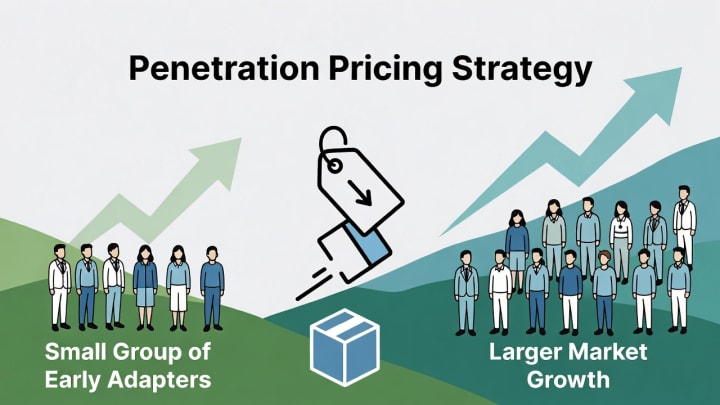
So what is penetration pricing? It’s a pricing model used to attract customers quickly by offering a product at a lower introductory price. The goal is simple: enter the market fast, capture attention and build loyalty before slowly raising prices later. When Netflix entered new markets, it offered subscriptions at very affordable rates. Once users got hooked, the brand built loyalty and increased prices gradually.
Industries like technology, FMCG and online services often use this model because it helps overcome hesitation and encourages faster product adoption.
Advantages of Penetration Pricing
There are several advantages of penetration pricing, but only if it’s used strategically.
- First, it helps with fast customer acquisition. People are more willing to try something new when the risk feels low.
- Second, it creates pressure on competitors. Smaller or newer brands often can’t afford to match aggressive pricing.
- Third, it builds awareness quickly. When many people start using your product, word spreads naturally.
- Finally, it increases product adoption rate. Once customers are familiar with your product, switching becomes less appealing.
The key is knowing when to stop discounting. Staying too cheap for too long can damage profit and brand perception.
Market Penetration Example: Apple’s Approach
Apple is one of the best-suited examples of market penetration. The market penetration of Apple is a great example because it shows that penetration doesn’t always mean low prices. Many assume Apple only grows through innovation, but a big part of its success comes from deepening market penetration. Older iPhone models are often sold at reduced prices, allowing new users to enter the ecosystem. Once they are in, repeat purchases follow naturally. Apple focused on brand adoption and customer retention rather than constant price competition. And it worked. Apple penetrated the market by:
- Fast customer acquisition.
- Strong barrier for competitors.
- Rapid brand awareness.
- Increased product adoption.
Best Practices for Market Penetration
Successful penetration strategies usually share a few things in common:
1. Choosing the right pricing model
Understand your customers’ price sensitivity. Competitive pricing works well in new or saturated markets, but premium pricing can support perceived quality.
2. Understanding customer behavior
Study what drives purchases like convenience, trust, or trend? Build campaigns around those motivations.
3. Competitive analysis
Competitive analysis helps identify gaps where your brand can outperform others.
4. Timing the penetration strategy correctly
Launching a penetration strategy during demand peaks or right after a new product drop can multiply results.
5. Avoiding profit erosion
Don’t let discounts become permanent. Once customers associate your brand with “cheap,” it’s hard to raise prices later.
6. Using Packaging as a “Silent Salesperson”
To influence the consumer behavior, packaging can be used as a silent salesperson in the retail environments to achieve the market. For instance, personalized display boxes are an effective marketing tool which transforms standard packaging into an active marketing vehicle.
When Market Penetration Fails
Even good strategies can backfire. Penetration strategies fail when businesses rely too much on discounts and not enough on value. If customers only buy because it’s cheap, they will leave as soon as someone cheaper shows up. Common mistakes businesses make are:
- Over-Discounting without a clear exit plan.
- Weak Distribution that limits availability.
- Poor Brand Differentiation that gives customers no reason to stay.
Conclusion
So, what is market penetration really about? It’s not just selling more. A smart customer penetration strategy builds loyalty. A focused sales penetration strategy improves reach. It’s about selling smarter. A well-designed customer penetration strategy improves loyalty and brand adoption. A calculated sales penetration strategy expands your reach, while a thoughtful penetration pricing strategy attracts customers fast and builds market share.
But true growth happens when these strategies work together. When you understand your audience, price competitively and offer real value that keeps people coming back.
About the Creator
Cristina Baker
I’m Cristina Baker, a business and market expert with 8+ years of experience helping brands and entrepreneurs grow. I share insights, strategies, and ideas that inspire growth, spark curiosity, and turn challenges into actionable results.
Keep reading
More stories from Cristina Baker and writers in Trader and other communities.
Top Digital Marketing Strategies for Small Food Businesses
Small businesses in the food industry often encounter a lot of competition. Larger restaurants and food chains can afford more and reach more people. Small brands can expand quickly when they use the right digital marketing approach. Buying talent is not very costly. Smart tools and simple actions are all that’s needed to connect with people who dine out locally and online.
By Cristina Baker2 months ago in Trader
Philippines Vision Care Market 2026: Rising Eye Disorders, Digital Eye Strain & Advanced Eyewear Adoption
Philippines Vision Care Market Overview The Philippines vision care market is an essential segment of the country’s healthcare and optical products industry. Vision care includes products and services such as eyeglasses, contact lenses, intraocular lenses, eye examinations and corrective vision procedures. These solutions help diagnose, manage and correct vision problems while supporting overall eye health. With increasing digital device usage and rising awareness about preventive healthcare, the demand for vision care products and services continues to grow across the Philippines.
By Manisha Dixitabout 11 hours ago in Trader




Comments
There are no comments for this story
Be the first to respond and start the conversation.