
Japan Inflammatory Bowel Disease Treatment Market Size and Forecast 2025–2033
How Biologics, Personalized Medicine, and R&D Are Reshaping IBD Care in Japan

Introduction
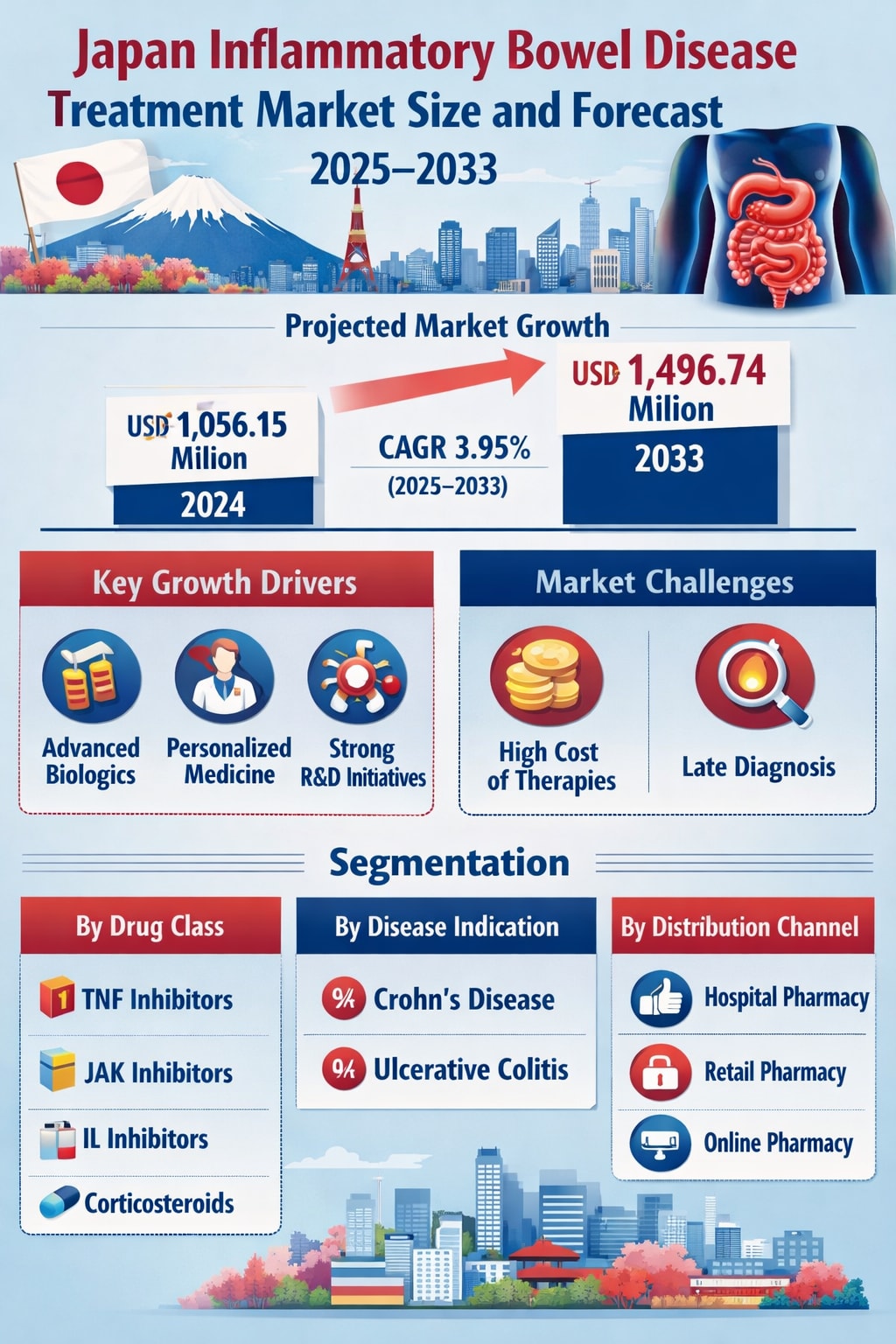
Japan’s healthcare landscape is undergoing a significant transformation, and one of the areas witnessing notable evolution is the treatment of Inflammatory Bowel Disease (IBD). According to Renub Research, the Japan Inflammatory Bowel Disease Treatment Market is expected to reach US$ 1,496.74 million by 2033, up from US$ 1,056.15 million in 2024, growing at a CAGR of 3.95% from 2025 to 2033. This steady expansion reflects not only the rising disease burden but also the country’s strong push toward advanced, patient-centric, and innovation-driven healthcare solutions.
Inflammatory Bowel Disease, primarily comprising Crohn’s disease and ulcerative colitis, is a chronic condition that significantly affects patients’ quality of life. Over the past decade, Japan has seen an increase in diagnosed cases, driven by better awareness, improved diagnostic tools, lifestyle changes, and an aging population. At the same time, the treatment paradigm has shifted dramatically—from conventional therapies such as corticosteroids and aminosalicylates to advanced biologics, targeted therapies, and small-molecule drugs.
Japan’s reputation for having one of the world’s most sophisticated healthcare systems plays a crucial role in this transition. Strong insurance coverage, government-backed healthcare programs, and a robust pharmaceutical R&D ecosystem have enabled faster adoption of innovative therapies. However, challenges such as high treatment costs, uneven access between urban and rural regions, and delayed diagnosis continue to influence market dynamics. Despite these hurdles, the long-term outlook remains positive, supported by technological progress, strategic collaborations, and a growing focus on personalized medicine.
Japan Inflammatory Bowel Disease Treatment Industry Overview
The Japanese IBD treatment market has evolved rapidly over the past few years. Traditionally, treatment focused on symptom management using aminosalicylates, corticosteroids, and immunosuppressants. While these therapies remain relevant, they often come with limitations, especially in moderate to severe cases where long-term disease control is difficult to achieve.
The introduction of biologic therapies, including anti-TNF agents, anti-integrin drugs, IL inhibitors, and JAK inhibitors, has fundamentally changed the treatment landscape. These drugs work by targeting specific immune pathways responsible for inflammation, offering better disease control, longer remission periods, and improved quality of life for patients. In Japan, where clinical standards are high and regulatory oversight is strong, the adoption of such advanced therapies has been relatively swift.
Another defining feature of the Japanese market is the strong emphasis on research and development. Both domestic pharmaceutical companies and multinational players are heavily investing in clinical trials, next-generation biologics, and novel small-molecule drugs. The country’s regulatory environment, while rigorous, is also supportive of innovation, enabling relatively faster approvals for breakthrough therapies that demonstrate clear clinical benefits.
Government initiatives have further strengthened patient access to treatment. Japan’s universal healthcare system and reimbursement policies reduce financial barriers for many patients, encouraging the use of newer, more effective therapies. Additionally, public health campaigns and professional medical education are slowly improving early diagnosis rates, although awareness gaps still exist.
Overall, the market is characterized by a blend of innovation, policy support, and growing clinical demand, making Japan one of the most important IBD treatment markets in the Asia-Pacific region.
Market Size and Growth Outlook
As highlighted by Renub Research, the Japan Inflammatory Bowel Disease Treatment Market is projected to grow from US$ 1,056.15 million in 2024 to US$ 1,496.74 million by 2033, registering a CAGR of 3.95% during the forecast period. This growth trajectory reflects a mature but steadily expanding market, driven more by therapy upgrades and innovation rather than just volume growth.
Several factors contribute to this expansion. First, the rising prevalence of IBD in Japan continues to increase the patient pool. Second, treatment intensification, where patients move from conventional therapies to advanced biologics and targeted drugs, raises the overall market value. Third, long-term disease management means patients often remain on therapy for extended periods, further supporting sustained revenue growth.
At the same time, the market is also shaped by pricing pressures and cost-containment policies, which may limit explosive growth. Nevertheless, the shift toward higher-value therapies ensures a stable and predictable expansion over the coming years.
Key Factors Driving Market Growth
Advancements in Treatment Options
One of the most powerful drivers of the Japanese IBD treatment market is the rapid advancement in therapeutic options. The emergence of biologics such as TNF inhibitors, anti-integrin therapies, IL inhibitors, and JAK inhibitors has transformed how physicians manage Crohn’s disease and ulcerative colitis. Unlike traditional drugs that broadly suppress inflammation, these newer therapies target specific immune mechanisms, resulting in better efficacy and fewer systemic side effects.
For patients with moderate to severe IBD, these drugs have significantly improved outcomes, offering longer remission periods and reducing hospitalization and surgery rates. In Japan, favorable reimbursement policies and strong clinical adoption have accelerated the uptake of these therapies, making them a central pillar of modern IBD care.
Rise of Personalized Medicine
Personalized medicine is increasingly shaping treatment strategies in Japan. Instead of following a one-size-fits-all approach, clinicians now consider genetic factors, disease severity, prior treatment response, and patient lifestyle when selecting therapy. Advances in biomarkers, diagnostic imaging, and genetic testing have made this precision-based approach more practical and effective.
For a chronic and heterogeneous condition like IBD, where patient responses to treatment can vary widely, personalized medicine offers a clear advantage. It improves treatment success rates, minimizes unnecessary side effects, and enhances overall patient satisfaction. As Japan’s healthcare system continues to integrate precision medicine into routine practice, demand for targeted and innovative therapies is expected to grow further.
Strong Research and Development Ecosystem
Japan’s commitment to medical innovation is another major growth driver. Pharmaceutical companies, research institutes, and academic centers are actively engaged in developing next-generation biologics, small-molecule drugs, and microbiome-based therapies. Ongoing clinical trials and real-world studies are expanding the evidence base for new and existing treatments, helping physicians make more informed decisions.
Collaborations between domestic and international companies also play a crucial role in speeding up innovation. These partnerships allow for knowledge sharing, faster development timelines, and broader access to global research expertise. Over the long term, this strong R&D focus ensures a steady pipeline of new therapies, supporting both market growth and improved patient care.
Challenges Facing the Market
High Cost of Biologic Therapies
Despite their clinical benefits, biologic therapies are expensive, and cost remains a significant barrier to widespread adoption. Although Japan’s healthcare system provides substantial coverage, out-of-pocket expenses can still be considerable for some patients. This financial burden not only affects patients but also puts pressure on national healthcare budgets and insurance systems.
In some cases, high costs may lead patients to delay treatment escalation or continue on less effective therapies, potentially compromising long-term outcomes. While the introduction of biosimilars and pricing negotiations may help ease this issue over time, cost remains a critical challenge for the market.
Limited Awareness and Late Diagnosis
Another important challenge is limited public awareness and delayed diagnosis. Early symptoms of IBD—such as abdominal pain, diarrhea, and fatigue—are often mistaken for less serious digestive issues. As a result, many patients are diagnosed only after the disease has progressed, reducing the effectiveness of early intervention strategies.
Delayed diagnosis increases the risk of complications, hospitalizations, and even surgery, while also raising overall treatment costs. Strengthening public education, improving primary care screening, and enhancing physician training are essential steps to address this issue and improve long-term patient outcomes.
Market Segmentation
By Drug Class
The Japan IBD treatment market is segmented into:
TNF Inhibitors
Anti-Integrin Therapies
IL Inhibitors
JAK Inhibitors
Corticosteroids
Aminosalicylates
Others
Among these, biologics and targeted therapies are gaining increasing share due to their superior efficacy in moderate to severe cases, while conventional therapies continue to play a role in mild disease and maintenance treatment.
By Disease Indication
Ulcerative Colitis
Crohn’s Disease
Both segments contribute significantly to market revenue, with treatment approaches becoming increasingly specialized based on disease type and severity.
By Distribution Channel
Hospital Pharmacy
Retail Pharmacy
Online Pharmacy
Hospital pharmacies remain the dominant channel due to the specialized nature of many IBD treatments, although online pharmacies are gradually gaining traction for maintenance therapies and refills.
Competitive Landscape and Company Analysis
The Japanese IBD treatment market is highly competitive, with the presence of major global pharmaceutical players. Key companies operating in this space include:
Abbott Laboratories
AbbVie Inc.
Allergan Therapeutics LLC
Bausch Health Companies Inc. (Salix Pharmaceuticals)
Bristol-Myers Squibb Company
Johnson & Johnson
Novartis AG
Pfizer Inc.
These companies compete on the basis of product innovation, clinical efficacy, safety profiles, and strategic partnerships. Continuous investment in R&D, lifecycle management of existing drugs, and expansion into new therapeutic areas are central to their growth strategies in Japan.
Future Outlook
Looking ahead, the Japan Inflammatory Bowel Disease Treatment Market is set to remain on a steady growth path. The continued rise in disease prevalence, increasing adoption of advanced therapies, and strong focus on personalized medicine will remain key growth drivers. At the same time, efforts to improve early diagnosis, expand patient awareness, and manage treatment costs will shape the market’s long-term sustainability.
Innovation will continue to be the cornerstone of progress, with next-generation biologics, small molecules, and potentially curative approaches offering new hope for patients. Supported by Japan’s robust healthcare infrastructure and research ecosystem, the market is well-positioned to deliver both clinical and economic value over the coming decade.
Final Thoughts
The Japan Inflammatory Bowel Disease Treatment Market, projected to grow from US$ 1,056.15 million in 2024 to US$ 1,496.74 million by 2033 at a CAGR of 3.95%, reflects a healthcare sector in transition—moving steadily toward more precise, effective, and patient-centered care. While challenges such as high treatment costs and delayed diagnosis remain, the overall trajectory is positive.
Driven by innovation, supportive healthcare policies, and a strong commitment to research, Japan is poised to remain a leading market for advanced IBD therapies in the Asia-Pacific region. For patients, physicians, and industry stakeholders alike, the coming years promise better treatments, improved outcomes, and a more hopeful future in the fight against inflammatory bowel disease.
About the Creator
Tom Shane
Tom Shane is a content writer specializing in SEO-driven blogs, product descriptions, and thought leadership. He crafts engaging, research-backed content that connects with audiences and drives results.
Dow Jones and U.S. Index Outlook: The Real Cost of Investor Hesitation
Introduction The performance of major U.S. stock indices often reflects more than just corporate earnings or economic data. They also reveal investor psychology—especially fear, caution, and hesitation. As markets evolve, many investors find themselves waiting on the sidelines, hoping for better entry points. However, when it comes to the Dow Jones and broader U.S. indices, hesitation itself can carry a significant cost.
By Hammad Nawaza day ago in Trader
Day Trading Strategies for Beginners: How to Trade Stocks Like a Pro
Introduction Day trading is one of the most exciting and challenging approaches to the stock market. Unlike long-term investing, day traders buy and sell stocks within the same trading day, aiming to profit from short-term price movements. While potentially profitable, day trading requires discipline, knowledge, and a well-planned strategy.
By Hammad Nawaz5 days ago in Trader




Comments
There are no comments for this story
Be the first to respond and start the conversation.