
India Snacks Market Size & Forecast 2026–2034
Urban Lifestyles, Rising Incomes, and Flavor Innovation Drive India’s Dynamic Snacking Boom

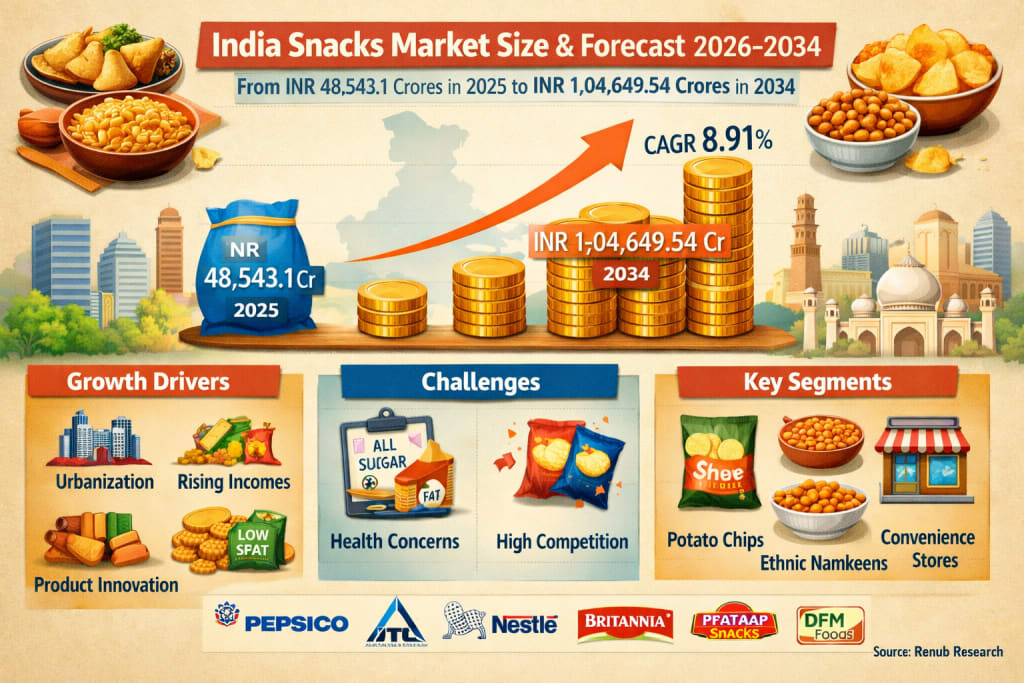
The India snacks market is entering a transformative growth phase, driven by rapid urbanization, lifestyle changes, and a rising appetite for convenience foods. According to Renub Research, the India Snacks Market is projected to grow from INR 48,543.1 Crores in 2025 to INR 104,649.54 Crores in 2034, registering a robust CAGR of 8.91% from 2026 to 2034.
The market’s upward trajectory reflects deeper structural changes in Indian society — from nuclear families and dual-income households to digital commerce expansion and evolving food preferences. Snacks, once limited to occasional indulgence or tea-time rituals, have now become an integral part of daily consumption patterns across demographics and regions.
India Snacks Market Outlook
Snacks are small, ready-to-consume food items eaten between meals to satisfy hunger, boost energy, or provide indulgence. The category spans savory namkeens, potato chips, cookies, chocolates, baked snacks, and increasingly, health-focused alternatives such as roasted nuts, millet-based snacks, and protein-enriched products.
In India, snacking is deeply embedded in cultural habits. From evening tea accompaniments to festive gatherings, snacks occupy an emotional and functional role in households. Traditional items like samosa, bhujia, chivda, and regional namkeens coexist with Western-style packaged chips, biscuits, and extruded snacks.
Urbanization, growing purchasing power, and exposure to global cuisines have expanded consumer expectations. Today’s Indian consumer seeks:
Convenience and portability
Long shelf life
Hygienic packaging
Flavor innovation
Health-oriented alternatives
The convergence of these factors is reshaping the organized snack segment while gradually formalizing the historically dominant unorganized sector.
Growth Drivers of the India Snacks Market
1. Changing Lifestyles, Urbanization, and Convenience Demand
India’s urban population continues to expand, bringing lifestyle transformations that directly influence food consumption patterns. With rising participation of women in the workforce, increasing numbers of nuclear families, and growing student populations in cities, time constraints are reshaping meal structures.
Snacks now function as:
Quick meal replacements
Office desk food
Travel companions
Evening indulgence options
Additionally, according to a 2023 article in The Times of India, nearly 38% of Indians identify as purely vegetarian. This demographic reality encourages manufacturers to innovate plant-based and vegetarian snack offerings that align with consumer preferences while maintaining indulgent flavors.
Long working hours and extended commute times have further accelerated the demand for ready-to-eat, packaged snack products — a major catalyst for market expansion.
2. Rising Disposable Income and Expanding Middle Class
India’s middle class is one of the fastest-growing in the world. From 1995 to 2021, the middle class grew at approximately 6.3% annually, reaching 338 million people. Today, it accounts for about 31% of the population and is expected to rise to 38% by 2031 and 60% by 2047.
With higher disposable incomes, consumers are:
Trading up from loose snacks to branded products
Exploring premium and gourmet variants
Experimenting with global flavors
Seeking value-added packaging
Premiumization is particularly visible in metro cities like Mumbai, Bengaluru, Delhi, and Hyderabad. However, Tier II and Tier III cities are also witnessing growing per capita snack consumption as affordability improves and distribution networks strengthen.
3. Product Innovation and Distribution Expansion
Innovation remains central to market growth. Manufacturers are increasingly introducing:
Regionally inspired flavors
International fusion formats
Baked and low-fat variants
Millet-based snacks
Protein-enriched and health-positioned products
In September 2024, Parle Products introduced “Nakli Bhujiya” under its Chatkeens range, targeting adventurous flavor seekers — a sign of how brands are blending humor, local familiarity, and innovation.
Simultaneously, expansion of organized retail, e-commerce platforms, and quick-commerce delivery has enhanced product accessibility even in secondary cities. Digital marketing and influencer campaigns further amplify brand visibility.
Challenges in the India Snacks Market
Health Concerns and Regulatory Pressure
Rising awareness about excessive salt, sugar, and fat intake poses a challenge for traditional fried snack segments. Increasing consumer scrutiny of labels and nutritional values pressures manufacturers to reformulate products.
Government-led initiatives promoting healthier eating habits may also affect high-calorie snack categories.
Intense Competition and Price Sensitivity
The Indian snacks market is highly fragmented. Alongside major national brands, thousands of regional and local players compete aggressively on price.
Price sensitivity among Indian consumers leads to:
Frequent promotional campaigns
Smaller stock-keeping units (SKUs)
Thin margins
Price wars in mass segments
Brand differentiation through quality, hygiene, packaging, and innovation is essential for long-term profitability.
India Unorganized Snacks Market
The unorganized segment remains highly significant, particularly in rural and semi-urban areas. It includes:
Loose namkeens
Locally fried snacks
Traditional sweets
Street-side savories
Consumers prefer this segment due to:
Low prices
Familiar taste profiles
Local authenticity
Although organized brands are expanding rapidly, the unorganized sector continues to hold considerable volume share due to ingrained consumption habits and affordability.
India Potato Chips Market
Potato chips represent one of the most dynamic segments in India’s snacks industry. Their popularity stems from:
Affordable pricing
Strong brand marketing
Indianized flavors (masala, chili, mint, etc.)
Convenient single-serve packaging
Organized players dominate this segment with robust distribution and packaging systems. Additionally, baked and low-calorie chips cater to health-conscious urban consumers.
Impulse buying behavior and frequent repeat purchases keep this segment highly competitive and innovation-driven.
India Ethnic Namkeen & Snacks Market
Ethnic namkeens such as sev, mixtures, chivda, and regional specialties maintain strong emotional resonance among consumers.
These snacks are:
Tea-time staples
Hospitality essentials
Travel-friendly foods
Organized brands are increasingly repackaging traditional products into hygienic, branded formats without compromising authenticity. Urban consumers prefer reliable quality alongside traditional taste.
India Ethnic Bhujia Market
Bhujia, originally from Rajasthan, has evolved into a nationwide staple. Its long shelf life, versatile usage (standalone or mixed), and affordable pricing support consistent demand.
Organized manufacturers have standardized production and scaled nationwide distribution. Premium and flavored variants are gradually expanding within urban markets.
Distribution Channel Analysis
Convenience Stores
Kirana stores, kiosks, and neighborhood outlets remain the backbone of snack distribution. They account for high volumes due to:
Proximity
Frequent footfall
Impulse purchases
Small pack affordability
Manufacturers prioritize visibility, shelf placement, and price-point packaging in these stores.
Supermarkets and Hypermarkets
Modern retail outlets are growing rapidly in metropolitan cities. They offer:
Wider product assortment
Imported and premium brands
Bulk purchase opportunities
Health-focused options
These channels influence premiumization and brand loyalty, although they still trail kirana stores in overall reach.
Online Retail Channels
E-commerce and quick-commerce platforms are redefining accessibility. With doorstep delivery and digital promotions, online channels are expanding rapidly, especially in urban India.
State-Level Market Insights
Maharashtra
Maharashtra represents one of the largest and most sophisticated snack markets due to high urbanization and purchasing power. Cities like Mumbai and Pune drive demand for packaged, ready-to-eat, and premium snacks. Health-conscious urban consumers are accelerating the growth of baked and protein-enriched variants.
Gujarat
Gujarat’s snack culture is deeply rooted in traditional farsaan, dhokla, khakhra, and ganthiya. The state is also a major production hub for namkeens and packaged snacks. Organized brands are expanding steadily due to better hygiene and packaging.
West Bengal
West Bengal showcases strong demand for chanachur, muri mixes, and fried tea-time snacks. While the unorganized sector dominates, branded packaged snacks are gaining traction in Kolkata’s urban landscape.
Market Segmentation
By Sector:
Organized
Unorganized
By Type:
Cookies & Crackers
Potato Chips
Tortilla Chips, Flips & Pretzels
Ethnic Namkeen & Snacks
Ethnic Bhujia
Others
By Distribution Channel:
Supermarket/Hypermarket
Online Retail
Convenience Stores
Other Channels
Top States:
Maharashtra, Tamil Nadu, Karnataka, Gujarat, Uttar Pradesh, West Bengal, Rajasthan, Telangana, Andhra Pradesh, Madhya Pradesh
Competitive Landscape
Major companies operating in the India snacks market include:
Prataap Snacks
Nestlé
DFM Foods Ltd.
PepsiCo
ITC Limited
Britannia
Agro Tech Foods Ltd. (Conagra Brands)
Each company has been evaluated across five viewpoints:
Overview
Key Personnel
Product Portfolio
Recent Developments & Strategies
Revenue Analysis
These players are focusing on product diversification, distribution expansion, brand building, and health-oriented reformulations to maintain competitive advantage.
Final Thoughts
The India snacks market is transitioning from a traditional, fragmented structure toward a more organized, innovation-driven ecosystem. With projected growth from INR 48,543.1 Crores in 2025 to INR 104,649.54 Crores in 2034 at a CAGR of 8.91%, the sector presents strong opportunities for manufacturers, investors, and retailers alike.
Urbanization, income growth, product innovation, and expanding retail infrastructure will remain core growth pillars. However, companies must balance indulgence with health consciousness while navigating price sensitivity and regulatory pressures.
About the Creator
Keep reading
More stories from shibansh kumar and writers in Trader and other communities.
Aroma Chemicals Market Size and Forecast 2026–2034
The global Aroma Chemicals Market is poised for steady expansion over the next decade, supported by growing demand across personal care, food and beverage, healthcare, and household products. According to Renub Research, the Aroma Chemicals Market is expected to reach US$ 12.91 billion by 2034, up from US$ 8.03 billion in 2025, registering a CAGR of 5.42% during 2026–2034.
By shibansh kumara day ago in Trader
Philippines Passenger Vehicles Lubricants Market 2026: Rising Car Ownership, Synthetic Oil Shift and Maintenance Awareness
Philippines Passenger Vehicles Lubricants Market Overview The Philippines passenger vehicles lubricants market is steadily expanding as vehicle ownership increases and consumers place greater emphasis on regular maintenance and engine efficiency. Passenger vehicle lubricants — including engine oils, transmission fluids, greases and hydraulic oils — play a critical role in reducing friction, enhancing fuel efficiency and extending vehicle lifespan. As the Philippines automotive sector grows and mobility demand rises, lubricant consumption continues to strengthen across private vehicle fleets nationwide.
By Manisha Dixit3 days ago in Trader
A Planetary Alignment will coincide with Mercury Retrograde
Double phenomena in the heavens Some people say in jest that the planets have aligned in their favor when life works the way they desire. Were you aware that there are seasons when things do line up in the heavens? There will be a planetary alignment AKA a planet parade, on February 28, 2026.
By Cheryl E Preston3 days ago in FYI


Comments
There are no comments for this story
Be the first to respond and start the conversation.