
India Perfume Market Size & Forecast 2026–2034: Fragrance Finds Its Place in Everyday Indian Life
Rising incomes, youth influence, and cultural reinvention drive a steady fragrance boom across India

India Perfume Market Overview
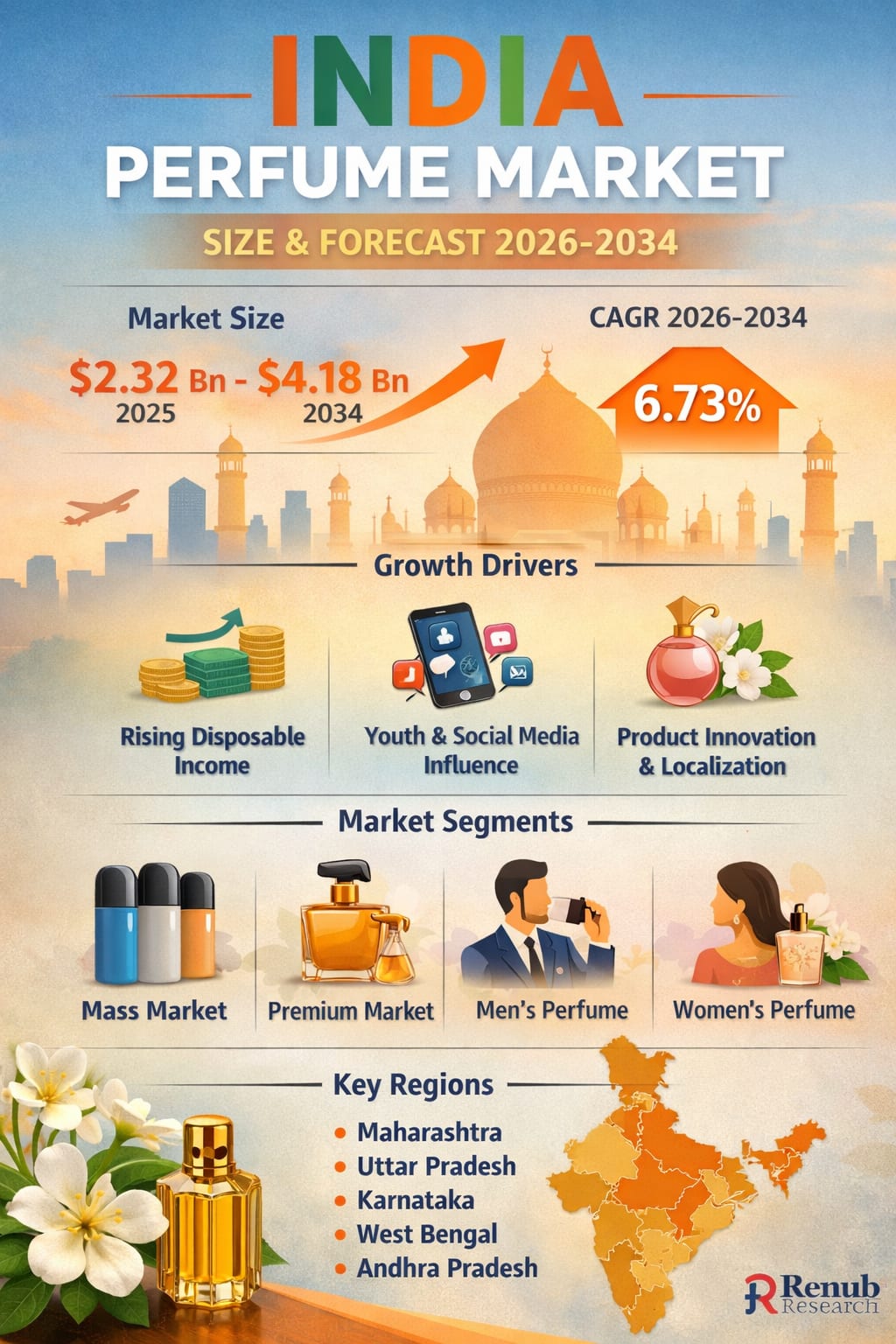
The India perfume market is undergoing a notable transformation, evolving from a niche luxury category into a mainstream personal grooming essential. According to Renub Research, the market is projected to grow from US$ 2.32 billion in 2025 to US$ 4.18 billion by 2034, registering a compound annual growth rate (CAGR) of 6.73% during 2026–2034.
This growth trajectory reflects broader socio-economic shifts taking place across the country. Rising disposable incomes, a rapidly expanding middle class, increasing urbanization, and a strong youth demographic are reshaping consumption patterns. Perfumes are no longer reserved for special occasions; instead, they are becoming part of daily self-expression, professional identity, and lifestyle aspirations.
The market’s expansion is further supported by the growth of organized retail, the surge in e-commerce platforms, influencer-driven marketing, and the blending of India’s traditional fragrance heritage with modern global perfumery trends.
India Perfume Market Outlook
Perfume is a fragrant blend of essential oils, aroma compounds, fixatives, and solvents, designed to enhance personal appeal, mood, and self-confidence. Based on concentration levels, perfumes are categorized into eau de parfum, eau de toilette, eau de cologne, and other variants that define longevity and intensity. Fragrance families range from floral, woody, and oriental to fresh, citrus, and spicy profiles.
In India, perfumes serve multiple purposes—personal hygiene, social confidence, emotional expression, and gifting. The country’s long-standing tradition of attars and natural fragrances, combined with rising exposure to international grooming trends, has created a uniquely diverse fragrance ecosystem. Modern perfumes infused with Indian ingredients such as sandalwood, jasmine, rose, and vetiver resonate strongly with both domestic and global consumers.
Growth Drivers of the India Perfume Market
Rising Disposable Income and Aspirational Consumption
India’s expanding middle class remains the single most powerful driver of perfume market growth. The middle-income segment has grown rapidly in both absolute numbers and purchasing power, shifting spending priorities from necessities to lifestyle and grooming products. Perfumes are increasingly viewed as affordable indulgences and daily-use essentials rather than luxury-only items.
India’s per capita disposable income rose from US$ 2.11 thousand in 2019 to US$ 2.54 thousand in 2023, and is projected to reach US$ 4.34 thousand by 2029. This steady rise in income is enabling greater experimentation with branded fragrances, particularly in urban and semi-urban regions. Aspirational buying, influenced by global fashion trends and celebrity endorsements, further accelerates market penetration.
Influence of Youth Population and Digital Media
India’s young population plays a pivotal role in shaping fragrance trends. Consumers under 35 years of age are heavily influenced by social media platforms, digital advertising, influencer reviews, and celebrity-backed launches. Concepts such as signature scents, fragrance layering, and seasonal perfume use have gained traction through digital storytelling.
A notable example of celebrity-led branding is the July 2025 launch of Dear Diary by Indian actress Rashmika Mandanna, developed in collaboration with The PCA Companies. Such launches reinforce emotional storytelling and deepen consumer engagement, especially among first-time buyers and younger audiences.
Product Innovation and Cultural Customization
Innovation remains a cornerstone of competitive differentiation in the Indian perfume market. Brands are increasingly designing fragrances that suit India’s climatic conditions, preference for long-lasting scents, and cultural sensibilities. Alcohol-free attars, hybrid oriental-western blends, gender-neutral fragrances, and wellness-infused formulations are gaining momentum.
Innovative packaging formats such as roll-ons, pocket sprays, and travel-size bottles have improved accessibility and affordability. Festival-themed launches and gifting-oriented collections further stimulate seasonal demand. In September 2024, SKINN—part of Titan Company Limited—introduced its affordable fragrance line 24 Seven, aiming to reach 2.5 million customers by FY2025, reflecting the growing focus on mass-premium segments.
Challenges in the India Perfume Market
Price Sensitivity and Counterfeit Products
Despite rising demand, India remains a highly price-sensitive market. A significant portion of consumers opts for low-cost alternatives, which limits premium brand penetration and encourages the proliferation of counterfeit products. Fake perfumes erode consumer trust, dilute brand equity, and disrupt pricing structures.
The prevalence of unorganized retail channels and grey-market imports further complicates enforcement. Low switching costs among mass consumers also result in weak brand loyalty, forcing genuine brands to constantly balance quality, pricing, and volume growth.
Distribution Gaps and Regulatory Complexities
While urban centers enjoy robust access to organized retail, rural and semi-urban markets still face distribution challenges. Logistics inefficiencies, fragmented supply chains, and high transportation costs restrict deeper penetration. Additionally, regulatory compliance related to chemical usage, labeling standards, and import duties increases operational complexity, particularly for international brands and small domestic players.
India Mass Perfume Market
The mass perfume segment accounts for the largest share of total fragrance volumes in India. Driven by affordability and widespread availability, this segment caters to students, first-time users, and price-conscious consumers. Local and regional brands dominate, offering deodorant sprays, body mists, and simple fragrance blends with moderate longevity.
High sales volumes during festivals, weddings, and promotional seasons make the mass segment commercially significant despite thinner margins. Semi-urban and rural demand ensures steady volume-driven growth across the country.
India Premium Perfume Market
The premium perfume segment is witnessing strong value-driven growth, supported by urban affluence, global exposure, and evolving gifting culture. Premium fragrances are increasingly perceived as lifestyle symbols, with consumers seeking uniqueness, superior performance, and exotic ingredients.
Luxury malls, airports, and online premium platforms are expanding access to international and niche brands. While premium perfumes contribute a smaller share of total volume, they command a disproportionately higher share of market value and profitability.
India Women Perfume Market
Women’s perfumes in India continue to gain traction, driven by rising workforce participation, fashion awareness, and self-care consciousness. Floral, fruity, and oriental fragrances dominate preferences, while experimentation with bold and unisex scents is increasing.
Festival gifting, bridal purchases, influencer marketing, and premium packaging strengthen brand positioning. As personal branding becomes a lifestyle priority, women’s perfumes are expected to remain one of the fastest-growing categories.
India Men Perfume Market
Men’s perfumes represent the largest gender-based segment in India. Fragrance usage among men has evolved from occasional deodorant application to regular perfume use, particularly in professional and social settings. Woody, musky, aquatic, and spicy notes dominate male preferences.
Celebrity endorsements, workplace grooming culture, and youth-centric branding drive strong repeat purchases, making men’s perfumes a stable revenue pillar across mass and premium segments.
India Offline Perfume Market
Offline channels continue to dominate perfume sales due to the sensory nature of fragrance selection. Department stores, cosmetic outlets, malls, supermarkets, and duty-free shops play a crucial role in consumer trials, brand storytelling, and premium sales.
Tier II and Tier III cities still rely heavily on physical retail, especially during festivals and wedding seasons. Despite rapid e-commerce growth, offline retail remains essential for high-value transactions and brand experience.
State-Level Market Insights
Maharashtra: Leads national demand, driven by Mumbai and Pune’s cosmopolitan culture and high retail density.
Uttar Pradesh: Volume-driven market dominated by mass and mid-range perfumes with strong seasonal demand.
Karnataka: Bengaluru’s tech-driven workforce fuels premium and niche fragrance growth.
West Bengal: Balanced mix of traditional attars and modern perfumes, with strong festival-driven sales.
Andhra Pradesh: Steady growth supported by urbanization, youth population, and rising lifestyle spending.
Market Segmentation
By Product:
Mass
Premium
By End User:
Men
Women
Unisex
By Distribution Channel:
Offline
Online
Top States Covered:
Maharashtra, Tamil Nadu, Karnataka, Gujarat, Uttar Pradesh, West Bengal, Rajasthan, Telangana, Andhra Pradesh, Madhya Pradesh
Competitive Landscape
Key companies analyzed with five viewpoints (overview, key person, recent developments, SWOT, revenue analysis) include:
The Avon Company
CHANEL
Coty Inc.
LVMH Moet Hennessy - Louis Vuitton
Estée Lauder Companies
Revlon
Puig
L'Oréal Groupe
Shiseido Company, Limited
Givaudan
Final Thoughts
The India perfume market is on a sustained growth path, shaped by rising incomes, youth-driven demand, cultural reinvention, and expanding retail infrastructure. As perfumes transition from luxury indulgences to everyday lifestyle essentials, both mass and premium segments stand to benefit.
With continued innovation, digital engagement, and deeper penetration into semi-urban markets, India is poised to become one of the most dynamic fragrance markets globally over the next decade.
About the Creator
Australia Recycled Plastics Market: Circular Economy, Sustainability Push & Industrial Innovation
Australia Recycled Plastics Market Overview The Australia recycled plastics market trends is gaining strong momentum as businesses, governments and consumers increasingly prioritise sustainability, circularity and resource efficiency. Recycled plastics — processed from post-consumer and post-industrial plastic waste — are used across packaging, construction, automotive components, consumer goods and industrial applications. The Australia recycled plastics market size reached USD 1.2 Billion in 2024. Looking forward, the market is expected to reach USD 2.0 Billion by 2033, exhibiting a growth rate (CAGR) of 5.20% during 2025-2033. This trajectory reflects escalating regulatory mandates on plastic waste management, rising adoption of recycled content in manufacturing, and growing consumer preference for environmentally responsible products. (Market data based on IMARC Group analysis.)
By Amyra Singh4 days ago in Trader
One Unchecked Box
"Republished" because it was the only way to add the embed for the newly recorded audio version of this story due to the Top Story badge. Plus it serves as a nice, informal announcement of the podcast's revival for another season (go subscribe!):
By Stephen A. Roddewig5 days ago in Fiction


Comments
There are no comments for this story
Be the first to respond and start the conversation.