
India Organic Food Market Size and Forecast 2025–2033
Health, Sustainability, and Exports Drive India’s Organic Food Revolution

India Organic Food Market Outlook
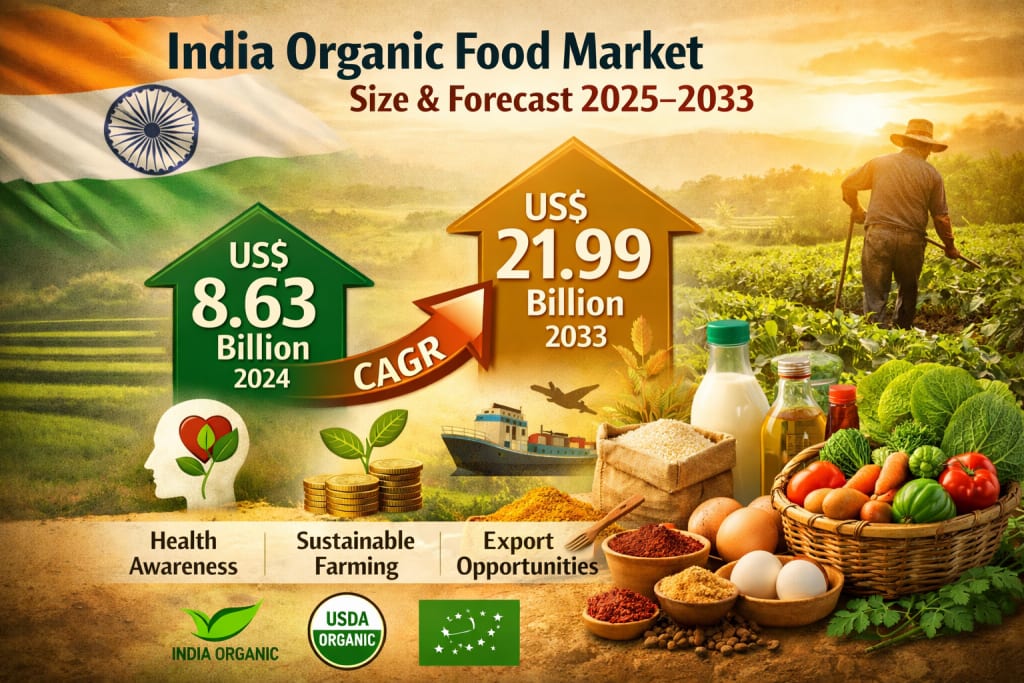
The India Organic Food Market is undergoing a strong transformation as consumer preferences shift toward healthier, safer, and more sustainable food choices. According to Renub Research, the India Organic Food Market is expected to reach US$ 21.99 billion by 2033, growing from US$ 8.63 billion in 2024, at a robust CAGR of 10.94% during 2025–2033.
This growth is being driven by increasing awareness of the health risks associated with chemical pesticides and fertilizers, rising demand for clean-label and natural products, and growing investments by Indian corporate firms in agribusiness, agritech, and organic farming. The combination of policy support, changing lifestyles, and export opportunities is steadily positioning India as both a major consumer and a significant global supplier of organic food products.
Organic food in India now spans a wide range of categories, including fruits and vegetables, cereals and grains, dairy, beverages, processed foods, bakery products, and packaged health foods. With urbanization, rising disposable incomes, and the rapid growth of e-commerce and modern retail, organic products are no longer limited to niche consumers—they are becoming part of mainstream consumption patterns.
India Organic Food Industry Overview
India’s organic food industry has expanded rapidly over the past decade, supported by rising health consciousness, environmental awareness, and government initiatives promoting sustainable agriculture. Consumers are increasingly concerned about the long-term impact of chemical residues in food, soil degradation, and environmental pollution caused by conventional farming methods. This has led to a steady shift toward organic alternatives that promise safer, cleaner, and more sustainable nutrition.
The Indian government has played a critical role in supporting this transition through programs such as the National Programme for Organic Production (NPOP) and Paramparagat Krishi Vikas Yojana (PKVY). Additional incentives are provided under the National Horticulture Mission (NHM), including subsidies of Rs. 10,000 per hectare (up to four hectares per beneficiary) and financial support for organic certification for farmer groups. These initiatives have encouraged more farmers to adopt organic practices and enter certified supply chains.
India is also a major exporter of organic products, including tea, spices, oilseeds, cereals, pulses, and processed organic foods. Strict certification systems and compliance with international standards such as India Organic, USDA Organic, and EU Organic have strengthened India’s position in global markets. Despite challenges such as higher production costs and certification complexities, the long-term outlook for India’s organic food industry remains highly positive.
Key Growth Drivers for the India Organic Food Market
1. Rural-to-Urban Transition
India’s rapid urbanization is significantly boosting demand for premium and health-focused food products, including organic foods. As more people migrate from rural to urban areas, lifestyle changes and greater exposure to health trends are reshaping food consumption patterns. Urban consumers are generally more aware of nutrition, sustainability, and food safety, and they are also more willing to pay a premium for certified organic products.
The expansion of supermarkets, specialty organic stores, and online grocery platforms has made organic food more accessible than ever. E-commerce, in particular, has played a major role in bridging the gap between producers and urban consumers, allowing even niche organic brands to reach a nationwide audience. This urban-driven demand is one of the strongest structural drivers of long-term market growth.
2. Global Export Opportunities
India’s organic products are gaining increasing recognition in international markets, especially in categories such as tea, spices, oilseeds, cereals, and herbs. Indian organic tea is widely appreciated for its quality, while spices like turmeric, cumin, and ginger are in high demand due to their health benefits and purity standards.
Government support, international certifications, and participation in global trade fairs have further strengthened India’s export potential. As global consumers continue to shift toward natural, chemical-free, and sustainably sourced food products, India’s diverse agricultural base gives it a strong competitive advantage in the global organic food trade. Export growth not only boosts revenue but also encourages higher quality standards across the domestic market.
3. Better Certification and Standards
Certification plays a crucial role in building consumer trust in organic products. Labels such as India Organic, USDA Organic, and EU Organic assure buyers that products meet strict standards related to farming practices, processing, and handling. These certifications confirm that products are free from harmful chemicals, synthetic pesticides, and genetically modified organisms (GMOs).
As awareness of food safety and quality increases, consumers are showing a clear preference for certified organic products. This trend is supporting both domestic consumption and export growth. Improved certification systems are also helping Indian producers gain access to premium markets and command better prices for their products.
Challenges in the India Organic Food Market
1. Pest and Disease Management
One of the biggest challenges in organic farming is managing pests and diseases without using synthetic pesticides. Organic farmers rely on natural methods such as crop rotation, biological control agents, companion planting, and organic inputs. While these methods are environmentally friendly, they are not always as immediately effective as chemical solutions, especially during severe pest outbreaks.
As a result, organic farmers may face lower yields, higher crop losses, and increased costs related to alternative pest management techniques. This can affect profitability and discourage some farmers from switching to organic practices, thereby slowing the pace of market expansion.
2. Inconsistent Quality and Standards
Although India has established certification frameworks such as NPOP, implementation and enforcement can vary across regions. In some areas, limited access to certification infrastructure and technical knowledge leads to inconsistencies in product quality and standards.
This unevenness can create confusion in the marketplace and weaken consumer confidence in the authenticity of organic products. Strengthening regulatory oversight, improving farmer training, and expanding certification access will be essential to maintaining the credibility and long-term growth of the Indian organic food market.
Regional Market Insights
East India Organic Food Market
East India, including states such as West Bengal, Odisha, and Bihar, is witnessing gradual but steady growth in organic farming and organic food consumption. Government initiatives like PKVY are encouraging farmers to adopt organic practices, while urban consumers are becoming more health-conscious and interested in chemical-free food options.
Demand is rising for organic vegetables, grains, tea, and spices, but the region still faces challenges related to supply consistency, distribution infrastructure, and access to certification, particularly in rural areas. Despite these hurdles, the long-term outlook remains positive as awareness and adoption continue to improve.
West India Organic Food Market
West India, covering states such as Maharashtra, Gujarat, and Goa, represents one of the most dynamic markets for organic food in the country. Major urban centers like Mumbai, Pune, and Ahmedabad are key consumption hubs, driven by higher disposable incomes, lifestyle changes, and strong health awareness.
Organic fruits and vegetables, dairy products, beverages, and processed foods are in high demand. The presence of modern retail chains, specialty stores, and strong e-commerce penetration has significantly improved product availability. While challenges such as price sensitivity and supply chain complexity remain, West India continues to be a major growth engine for the overall Indian organic food market.
India Organic Food Market Segmentation
By Product Type
Organic Fruits and Vegetables
Organic Meat
Poultry and Dairy
Organic Processed Food
Organic Bread and Bakery
Organic Beverages
Organic Cereal and Food Grains
Others
By Distribution Channel
Supermarkets / Hypermarkets
Specialty Stores
Convenience Stores
Online Retail Stores
Others
By Application
Bakery and Confectionery
Ready-to-Eat Food Products
Breakfast Cereals
Others
By Region
East
West
North
South
Competitive Landscape and Company Analysis
The Indian organic food market features a mix of established players and fast-growing brands, all focusing on quality, certification, distribution expansion, and product innovation. The market analysis covers key players from four perspectives: Key Person, Overview, Recent Developments, and Revenue Analysis.
Major Companies Covered:
Suminter India Organics Private Limited
Nature Bio-Foods Limited
Organic India Private Limited
Sresta Natural Bioproducts Pvt. Ltd
Phalada Agro Research Foundations Pvt. Ltd
Mehrotra Consumer Products Pvt. Ltd
Morarka Organic Foods Pvt. Ltd
Nature Pearls Pvt Ltd
Conscious Food Private Limited
Nourish Organics Foods Pvt Ltd
These companies are investing in supply chain strengthening, brand building, export expansion, and new product launches to capture the growing demand for organic foods both in India and abroad.
Final Thoughts
The India Organic Food Market is on a strong growth trajectory, supported by rising health awareness, sustainability concerns, government support, and expanding export opportunities. With the market projected to grow from US$ 8.63 billion in 2024 to US$ 21.99 billion by 2033 at a CAGR of 10.94%, organic food is steadily moving from a niche segment to a mainstream category in India’s food and beverage industry.
While challenges such as pest management, certification gaps, and supply chain complexities remain, continued policy support, technological innovation, and increasing consumer trust in certified organic products are expected to drive long-term growth. As India strengthens its position both as a major consumer and a global supplier of organic foods, the sector is set to play a crucial role in shaping the future of sustainable agriculture and healthy nutrition in the country.
About the Creator
Supply Chain Security Market Set to Soar USD 6.2 Billion by 2033 | CAGR 9.64%
Overview – Supply Chain Security Market Supply chain security refers to technologies, policies, and practices implemented to safeguard supply networks from vulnerabilities such as cyberattacks, counterfeit products, data breaches, and logistical disruptions. The market encompasses various solutions including threat detection software, identity management systems, and real-time monitoring tools. Growing adoption of cloud computing, IoT-enabled logistics, and digital procurement platforms has transformed supply chain operations, but also increased security risks. As global trade networks become more interconnected, organizations are prioritizing supply chain resilience, transparency, and compliance to ensure smooth business continuity and protect sensitive data.
By James Smith8 days ago in Trader
PayPal Stock Analysis: Can PayPal Sustain Growth in the Digital Payments Industry?
Introduction PayPal stock is one of the leading names in the digital payments sector. PayPal provides a global platform for online payments, money transfers, and merchant services. As e-commerce continues to expand and digital transactions become mainstream, PayPal remains central to the evolution of financial technology. Investors closely monitor whether PayPal stock can maintain growth amid competition, regulatory challenges, and technological innovation.
By Hammad Nawaz2 days ago in Trader
Goodbye, Mr. Duvall
It is turning out to be an interesting year. I was in the middle of teaching a class when a pop-up appeared on the screen announcing the death of Mr. Robert Seldon Duvall (yes, that was his full name). I was in the middle of a discussion on the obsession we have with winning when it comes to sports (the Winter Olympics was a theme), and I felt as though things were coming full circle. We had already lost Gene Hackman last year, and along with that titan, it feels though one particular golden age has closed off to be replaced by...?
By Kendall Defoe 3 days ago in Geeks




Comments
There are no comments for this story
Be the first to respond and start the conversation.