
Human Papilloma Virus (HPV) Testing Market Size and Forecast 2025–2033
How Global Screening Programs, Technology, and Awareness Are Reshaping Cervical Cancer Prevention

Human Papilloma Virus (HPV) Testing Market Overview
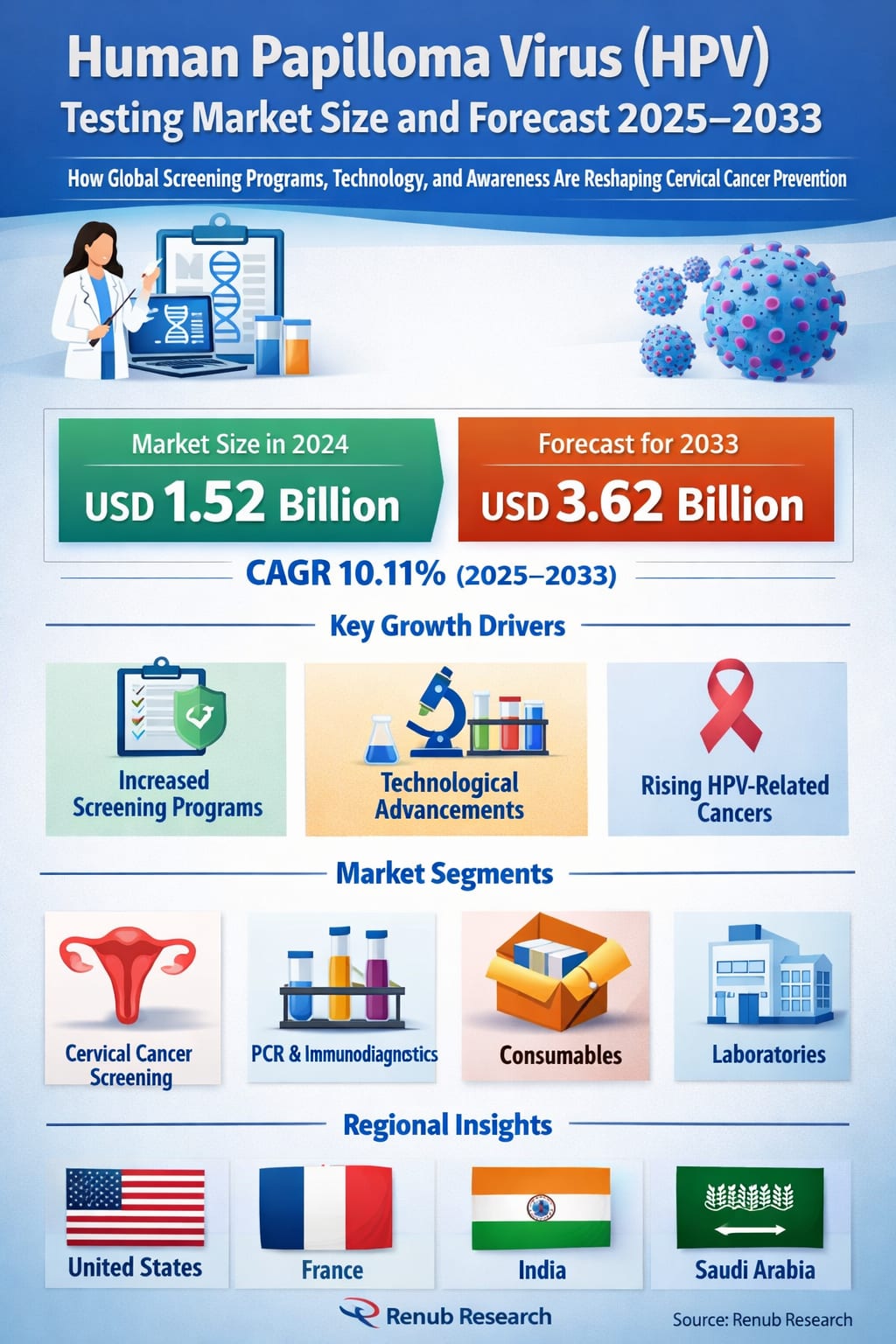
The Human Papilloma Virus (HPV) Testing Market is emerging as one of the most critical segments within preventive healthcare diagnostics. In 2024, the market was valued at USD 1.52 billion and is projected to reach USD 3.62 billion by 2033, expanding at a CAGR of 10.11% from 2025 to 2033. This robust growth trajectory reflects the rising global focus on early cancer detection, particularly cervical cancer, along with expanding screening programs and rapid technological progress in diagnostic testing.
HPV testing is a clinical diagnostic procedure used to detect the presence of HPV DNA or RNA in patient samples, most commonly cervical cells. Human papillomavirus is one of the most widespread sexually transmitted infections worldwide, and certain high-risk strains are directly responsible for cervical cancer as well as other anogenital and oropharyngeal cancers. Because persistent infection with high-risk HPV types is the primary cause of cervical cancer, HPV testing has become a cornerstone of modern preventive healthcare strategies.
Traditionally, cervical cancer screening relied heavily on Pap smear cytology. However, HPV testing offers higher sensitivity and better long-term risk prediction, making it increasingly preferred either as a primary screening tool or in combination with cytology. This shift in clinical practice is transforming how healthcare systems approach women’s health screening, especially in countries with organized national programs.
On a global scale, the adoption of HPV testing is being accelerated by rising awareness, strong backing from public health authorities, and international initiatives such as the World Health Organization’s campaign to eliminate cervical cancer as a public health problem. While developed countries have already integrated HPV-based screening into routine care, many developing nations are now following suit with support from global health organizations. Together, these trends are creating a strong and sustainable demand for HPV testing solutions across diverse healthcare settings.
Growth Drivers in the Human Papilloma Virus (HPV) Testing Market
Increasing Awareness and Government Screening Programs
One of the most powerful drivers of market growth is the expanding network of awareness campaigns and government-led screening initiatives. Across both developed and emerging economies, health authorities are promoting routine cervical cancer screening, particularly for women aged 30 and above. HPV testing is increasingly being recommended as a primary screening method due to its superior sensitivity compared to traditional cytology.
International organizations, including the WHO, strongly advocate HPV testing as a key tool in reducing cervical cancer incidence and mortality. Public education campaigns focusing on HPV, vaccination, and early detection are changing public perception and encouraging more women to participate in regular screening programs.
In September 2024, the United States, Australia, India, and Japan announced a major joint initiative to combat cervical cancer across the Indo-Pacific region, recognizing the disease as a preventable yet significant public health challenge. Such multinational efforts highlight the growing political and institutional commitment to HPV screening and early diagnosis, further strengthening long-term market demand.
Technological Breakthroughs in HPV Testing
Technological innovation has dramatically reshaped the HPV testing landscape. Advanced diagnostic methods such as polymerase chain reaction (PCR), next-generation sequencing, automated platforms, multiplex assays, and liquid-based cytology have significantly improved test accuracy, speed, and scalability.
The development of self-sampling kits is another major breakthrough, helping overcome barriers related to accessibility, privacy concerns, and limited healthcare infrastructure. These solutions are especially valuable in resource-limited settings, where traditional clinic-based screening may not be easily accessible.
Automation and digital integration in laboratories are also reducing turnaround times and operational costs while improving consistency and throughput. Continuous research and development investments by diagnostic companies are further enhancing sensitivity, specificity, and affordability of HPV tests, making large-scale population screening more feasible than ever before.
In June 2023, the WHO prequalified a fourth HPV test, reinforcing the importance of reliable and standardized diagnostics in global cervical cancer screening programs. Such regulatory and institutional endorsements play a crucial role in accelerating market adoption.
Rising Prevalence of HPV-Associated Cancers
The increasing global burden of HPV-related cancers, particularly cervical cancer, remains a central driver of the HPV testing market. According to global health estimates, cervical cancer is among the leading causes of cancer-related deaths in women, and the vast majority of these cases are linked to persistent high-risk HPV infections.
In the United States alone, an estimated 47,984 new cancer cases each year occur in areas of the body commonly associated with HPV infection. This growing disease burden is intensifying the demand for early detection, risk stratification, and long-term monitoring, placing HPV testing at the core of preventive oncology strategies.
As healthcare systems shift toward proactive and preventive care models, HPV testing is increasingly seen not just as a diagnostic tool, but as a long-term investment in public health outcomes and healthcare cost reduction.
Challenges in the Human Papilloma Virus (HPV) Testing Market
Limited Access in Low-Income Countries
Despite global awareness and strong medical consensus on the importance of HPV testing, access remains uneven, particularly in low- and middle-income countries. Many regions still lack adequate laboratory infrastructure, trained personnel, and organized screening programs. Cultural stigma and limited health literacy also continue to discourage participation in HPV testing in certain communities.
These gaps in access often lead to late-stage cancer diagnoses, when treatment options are more limited and outcomes are poorer. Addressing this challenge will require a combination of cost-effective point-of-care diagnostics, mobile screening units, public education campaigns, and stronger healthcare infrastructure investment.
High Cost of Advanced HPV Testing Technologies
While advanced molecular diagnostics such as PCR-based platforms offer superior accuracy, their high cost can be a significant barrier to widespread adoption, especially in resource-constrained healthcare systems. Beyond the initial investment, ongoing expenses related to maintenance, quality control, consumables, and specialized staffing further increase operational costs.
This affordability gap can limit the scale of mass screening programs, particularly in developing regions. Bridging this gap will depend on technological innovation, economies of scale, and supportive public health policies aimed at subsidizing or lowering the cost of essential diagnostic services.
Key Market Segments and Their Performance
Cervical Cancer Screening: The Dominant Application Segment
Cervical cancer screening represents the largest application segment within the HPV testing market. Since nearly all cervical cancers are caused by high-risk HPV types, early detection through HPV testing is critical for effective prevention and treatment.
Many countries are now integrating HPV DNA testing into primary screening protocols, either alongside or in place of traditional Pap smears. This shift has significantly improved detection rates and long-term risk assessment, driving strong demand for reliable, scalable, and sensitive testing solutions across public and private healthcare systems.
Consumables: A Recurring Revenue Engine
Consumables—including reagents, assay kits, swabs, and sample collection devices—form a vital part of the HPV testing ecosystem. With repeated testing cycles, expanding screening coverage, and growing adoption of self-sampling kits, demand for high-quality consumables continues to rise steadily.
Innovation in sample preservation, multiplex testing, and assay stability is further enhancing the value of this segment. Because consumables are used repeatedly, they provide a consistent and predictable revenue stream, making this segment a key contributor to overall market growth.
Immunodiagnostics: Expanding Access Through Simplicity
Immunodiagnostic HPV tests detect viral proteins or host immune responses using antibody-antigen interactions. These tests are generally simpler and more affordable than molecular methods, making them particularly useful in resource-limited settings and large-scale public health screening programs.
Although they are typically less sensitive than PCR-based tests, ongoing improvements in assay design and biomarker discovery are steadily enhancing their reliability. As a result, immunodiagnostics continue to play an important role in expanding access to HPV testing across diverse healthcare environments.
PCR-Based Testing: The Gold Standard
Polymerase chain reaction (PCR) remains the gold standard for HPV detection due to its exceptional sensitivity and specificity. These tests can identify multiple HPV genotypes in a single assay, enabling precise risk stratification and clinical decision-making.
The growing adoption of real-time PCR and multiplex platforms, combined with increasing automation and cost optimization, is strengthening the position of PCR-based testing in both centralized laboratories and large-scale screening programs. As precision medicine continues to gain importance, PCR will remain a cornerstone of the HPV testing market.
Laboratories: The Backbone of High-Volume Testing
Laboratories represent the leading end-use segment in the HPV testing market, offering high-throughput, standardized, and scalable diagnostic services. Centralized laboratories support hospitals, clinics, and public health programs by delivering consistent and high-quality testing results.
With rising screening volumes, laboratories are increasingly investing in automation, high-capacity platforms, and digital information management systems. The growth of reference laboratories and outsourcing models is further reinforcing the long-term expansion of this segment.
Regional Market Highlights
United States
The U.S. HPV testing market is well-established, supported by strong awareness, national screening guidelines, and widespread insurance coverage. The Centers for Disease Control and Prevention recommend routine HPV screening for women, and advanced diagnostic technologies are widely available. Growing interest in self-collection kits and home-based testing is also adding a new dimension to market growth.
France
France has made significant progress by adopting HPV testing as the primary screening method for women aged 30 and above, replacing traditional Pap smears. Government subsidies and a strong public healthcare system are driving higher participation rates and test volumes. The market is steadily moving toward automated molecular platforms and large-scale laboratory operations.
India
India’s HPV testing market is still in a developing phase but holds enormous long-term potential due to the country’s high cervical cancer burden. While adoption is currently concentrated in urban and private healthcare settings, government initiatives, NGOs, and low-cost testing solutions are gradually expanding access. As infrastructure improves and costs decline, India is expected to become a major growth engine for the market.
Saudi Arabia
Saudi Arabia is witnessing steady growth in HPV testing as part of broader healthcare reforms and a stronger focus on women’s health under Vision 2030. Government-backed vaccination and screening programs, combined with rising awareness, are gradually increasing test acceptance. Despite cultural sensitivities, the market shows strong potential for future expansion, especially in urban and private healthcare sectors.
Human Papilloma Virus (HPV) Testing Market Segmentation
By Application:
Cervical Cancer Screening
Vaginal Cancer Screening
By Product:
Consumables
Instruments
Services
By Technology:
Polymerase Chain Reaction (PCR)
Liquid-Based Cytology
Immunodiagnostics
Hybrid Capture
Others
By End Use:
Hospitals & Clinics
Laboratories
Others
By Countries:
North America: United States, Canada
Europe: France, Germany, Italy, Spain, United Kingdom, Belgium, Netherlands, Turkey
Asia Pacific: China, Japan, India, South Korea, Thailand, Malaysia, Indonesia, Australia, New Zealand
Latin America: Brazil, Mexico, Argentina
Middle East & Africa: Saudi Arabia, UAE, South Africa
Companies Covered:
Abbott Laboratories, bioMérieux SA, Bio-Rad Laboratories Inc., Epigenomics AG, Siemens Healthineers AG, Hologic Inc., Qiagen NV, F. Hoffmann-La Roche Ltd
(With coverage of company overview, key persons, recent developments & strategies, and financial insights)
Final Thoughts
The Human Papilloma Virus (HPV) Testing Market is on a strong and sustained growth path, driven by rising cancer awareness, expanding screening programs, and rapid technological progress. From USD 1.52 billion in 2024 to an expected USD 3.62 billion by 2033, the market’s evolution reflects a global shift toward preventive, data-driven, and patient-centric healthcare.
While challenges related to cost and access remain, ongoing innovation, supportive public policies, and international health initiatives are steadily closing these gaps. As countries continue to prioritize early detection and women’s health, HPV testing will remain a cornerstone of global cancer prevention strategies—and a critical growth area within the diagnostics industry for years to come.
About the Creator
As automakers compete for U.S. market share, Ford investigates Chinese EV partnerships. Electric Vehicle Market
As Chinese manufacturers of electric vehicles (EVs) increasingly target the United States, legacy automakers like Ford Motor Company look for ways to collaborate rather than compete alone, the automotive landscape in the United States is undergoing a potentially historic shift. The debate over national security, market competition, and the best way to maintain American manufacturing dominance has been sparked by discussions between Ford's leadership and the Donald Trump administration at the beginning of 2026 regarding potential joint ventures with Chinese partners.
By Raviha Imranabout 17 hours ago in Trader
Apple Stock Analysis: Is Apple Inc. Still a Strong Long-Term Investment?
Introduction Apple stock has long been considered a benchmark for stability, innovation, and long-term wealth creation in the stock market. As one of the most valuable companies in the world, Apple Inc. continues to attract both institutional and retail investors. From its iconic iPhone lineup to its expanding services ecosystem, Apple has built a business that goes far beyond hardware sales. The key question for investors today is whether Apple stock still offers attractive upside or if most of its growth is already priced in.
By Hammad Nawazabout 17 hours ago in Trader



Comments
There are no comments for this story
Be the first to respond and start the conversation.