
How to Take a Buy Entry (Long Position)
The arrows on your chart are from a trading indicator designed to give you signals for potential entries.

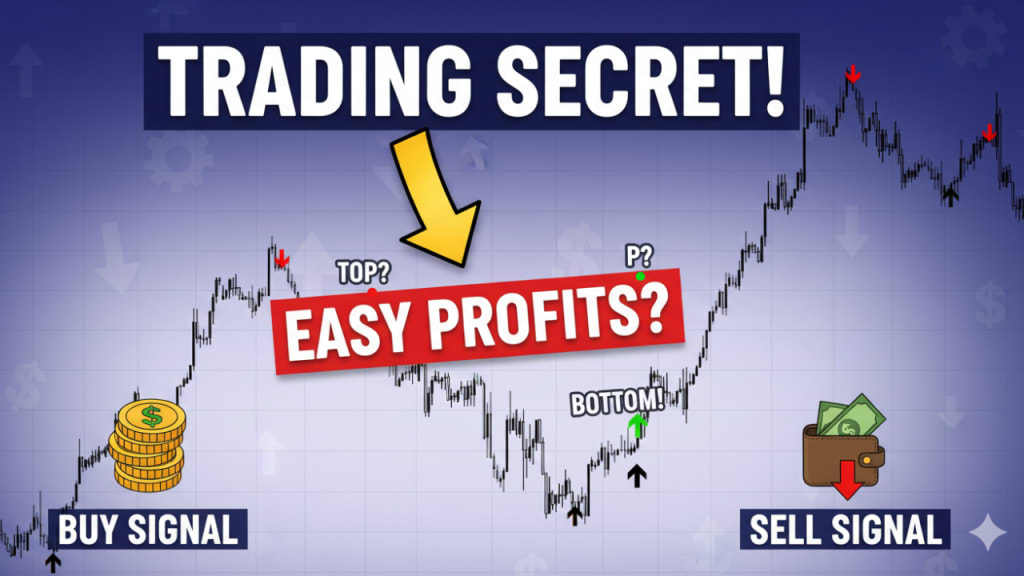
The arrows on your chart are from a trading indicator designed to give you signals for potential entries.
Green Arrow (pointing up) = Buy Signal
Red Arrow (pointing down) = Sell Signal
How to Take a Buy Entry (Long Position)
A "buy" or "long" position means you are betting that the price will go up.
Wait for the Signal: A green arrow appears below a price candle. This is your initial signal to look for a buying opportunity.Confirmation (Very Important): Do not enter the trade immediately when the arrow appears. The signal could be false. It's safer to wait for the candle with the arrow to close. Then, wait for the next candle to also show upward movement (e.g., it moves above the high of the signal candle). This is your confirmation.Entry: Place your buy order.Set a Stop-Loss: This is crucial for managing risk. Place your stop-loss order slightly below the recent low or below the low of the candle that has the green arrow. This will automatically sell your position if the price goes against you, limiting your potential loss.Set a Take-Profit: Decide on a target price where you will sell to take your profit. This could be at a previous resistance level or based on a risk-reward ratio (e.g., if your stop-loss is 10 points away, you might set your take-profit 20 points away for a 1:2 ratio).
Example:
A green arrow appears.You wait for that candle to close.The next candle starts moving up. You enter a buy trade.You place your stop-loss below the low of the green arrow candle.You set your take-profit target.
How to Take a Sell Entry (Short Position)
A "sell" or "short" position means you are betting that the price will go down.
Wait for the Signal: A red arrow appears above a price candle. This is your signal to look for a selling opportunity.Confirmation: Just like with a buy signal, wait for confirmation. Let the candle with the arrow close. Then, wait for the next candle to show downward movement (e.g., it moves below the low of the signal candle).Entry: Place your sell (or short) order.Set a Stop-Loss: Place your stop-loss order slightly above the recent high or above the high of the candle that has the red arrow. If the price moves up against your position, this order will close it to limit your loss.Set a Take-Profit: Decide on a target price where you will buy back to close your position and take profit. This is often set at a previous support level or using a risk-reward ratio.
Example:
A red arrow appears.You wait for that candle to close.The next candle starts moving down. You enter a sell trade.You place your stop-loss above the high of the red arrow candle.You set your take-profit target.
Very Important Rules to Remember
No Indicator is 100% Perfect: This indicator will give false signals. Sometimes you will buy and the price will go down, or you will sell and the price will go up. This is normal.Always Use a Stop-Loss: This is the most important rule in trading. It protects your money. Never trade without a stop-loss.Combine with Other Analysis: These arrow signals work best when you combine them with other forms of analysis, like:Support and Resistance: Is the buy signal happening near a strong support level? Is the sell signal happening near resistance? This makes the signal stronger.Trend: A buy signal is more reliable in an overall uptrend. A sell signal is more reliable in an overall downtrend. Avoid taking buy signals in a strong downtrend.Practice First: Before using real money, practice with these signals on a demo account to see how they perform.
Join Telegram Channel:- https://t.me/non_repaint_mt4
Disclaimer: This information is for educational purposes only and is not financial advice. Trading involves significant risk.
About the Creator
Pooja Verma
Forexwebstore.com Discover the Best Forex Indicators for a Simple Strateg. This page features key technical indicators for the most popular currency pairs in real time.
Keep reading
More stories from Pooja Verma and writers in Trader and other communities.
Forex Traders in South Africa.
10 Richest & Most Successful Forex Traders in South Africa Introduction South Africa is home to some of the most ambitious and resilient Forex traders in the world. With a fast-growing online trading culture, low barriers to entry, and a growing appetite for financial independence, South Africa has produced a wave of successful traders—some becoming millionaires by their mid-20s.
By Pooja Verma9 months ago in Trader
Berkshire Hathaway Inc.: A Deep Dive into the Value Investing Powerhouse
Berkshire Hathaway Inc. is not a typical stock. Led by Warren Buffett, it represents decades of disciplined investing, smart capital allocation, and a philosophy that prioritizes long-term growth over short-term gains. For investors, Berkshire Hathaway is more than a company—it’s a model of compounding wealth intelligently.
By Hammad Nawaz5 days ago in Trader
Clinical Trial Supplies Market Size & Forecast 2026–2034
The global Clinical Trial Supplies Market is entering a transformative decade. According to Renub Research, the market is projected to grow from US$ 2.94 billion in 2025 to US$ 5.37 billion by 2034, expanding at a CAGR of 6.93% during 2026–2034.
By shibansh kumarabout 20 hours ago in Trader




Comments
There are no comments for this story
Be the first to respond and start the conversation.