
How to Structure Ads Campaigns on Amazon for Maximum ROI
The secret to maximizing your Amazon ad profits without overspending is actually...

The secret to maximizing your Amazon ad profits without overspending is actually in how you structure your advertising campaigns. Proper campaign structure allows you to allocate your budget efficiently, target the right audience segments, and optimize bids to ensure every dollar spent drives meaningful returns. Without a clear and strategic framework, even the best ads can underperform, leading to wasted spend and missed opportunities for growth.
In this article, we’ll break down the key elements of campaign structuring, explain their importance, share best practices, common pitfalls, and how they collectively improve ad performance.
Understanding Different Types of Campaigns
Amazon offers several campaign types, each serving a distinct purpose:
a. Brand Campaigns (Branded Keywords)
Importance: Targets customers searching specifically for your brand or products.
Best Practice: Use exact and phrase match types to capture high-intent traffic.
Example: If your brand is “EcoFresh,” target keywords like “EcoFresh detergent” or “EcoFresh laundry soap.”
Common Mistakes: Mixing branded keywords with generic ones, leading to wasted budget on irrelevant traffic.
b. Generic Campaigns (Broad Keywords)
Importance: Targets broader search queries related to your product category.
Best Practice: Use a combination of broad, phrase, and exact matches to discover new converting keywords.
Example: For a detergent, target keywords like “laundry detergent” or “eco-friendly detergent.”
Common Mistakes: Not using negative keywords to exclude irrelevant search terms, resulting in wasted spend.
c. Competitor Campaigns
Importance: Targets shoppers searching for competing brands or products.
Best Practice: Bid on competitor brand names or product keywords to steal market share.
Example: Bidding on “Tide detergent” if you sell a competing product.
Common Mistakes: Overbidding on competitor keywords without analyzing profitability, which can quickly drain budget.

Keyword Segmentation and Match Types
Proper keyword segmentation is critical to control ad spend and optimize targeting.
Segmentation Approach:
Exact Match: Highly targeted, ensures ads show for precise queries.
Phrase Match: Targets queries containing your keyword phrase, allowing slight variations.
Broad Match: Captures a wide range of related queries, useful for discovery but can be less precise.
Best Practices:
Separate campaigns or ad groups based on match type for better bid control.
Regularly add high-performing broad or phrase match keywords to exact match campaigns.
Use negative keywords aggressively to exclude irrelevant traffic.
Common Mistakes:
Mixing match types within the same campaign or ad group.
Failing to review and update negative keyword lists regularly.
Budget and Bid Optimization
Importance:
Efficient budget allocation ensures you invest more where returns are higher and cut spend where performance lags.
Best Practices:
Allocate higher budgets to campaigns/products with proven ROI.
Use automated bid strategies (e.g., dynamic bids — up/down) for flexibility.
Regularly analyze campaign performance and adjust budgets and bids accordingly.
Examples:
Increase bids on exact match branded keywords due to higher conversion rates.
Lower bids or pause broad match keywords with low conversion.
Common Mistakes:
Setting the same budget across all campaigns regardless of performance.
Ignoring bid adjustments for placements or time-of-day.

Placement Control
Amazon allows advertisers to control bids by ad placement:
Top of Search (first page)
Product Pages
Rest of Search
Why It Matters:
Placement impacts visibility and cost. Top of Search typically drives higher sales but at a higher cost-per-click (CPC).
Best Practices:
Increase bids for Top of Search placements if profitable.
Lower bids for Product Pages or Rest of Search if they convert poorly.
Monitor placement performance data frequently.
Common Mistakes:
Ignoring placement bid modifiers and wasting budget on low-performing placements.
Treating all placements equally.
Continuous Monitoring and Optimization
Importance:
Amazon PPC is dynamic; performance changes based on competition, seasonality, and customer behavior.
Best Practices:
Schedule weekly or bi-weekly audits of keyword performance.
Refine negative keywords, pause underperforming ads, and expand successful keywords.
Use campaign reports to adjust bids and budgets.
Common Mistakes:
Setting campaigns on autopilot without ongoing optimization.
Failing to adapt to seasonal trends or competitive shifts.
How Proper Structure Improves ROI
Better Budget Control: Spend focuses on high-performing keywords and placements.
Higher Conversion Rates: Ads show to more relevant audiences.
Reduced Wasted Spend: Negative keywords and segmentation reduce irrelevant clicks.
Scalability: Clear structure makes it easier to expand campaigns systematically.
Data-Driven Decisions: Segmentation provides cleaner data for analysis and optimization.

Conclusion
Structuring your Amazon advertising campaigns is the foundation for success. By clearly separating brand, generic, and competitor campaigns; segmenting keywords; optimizing bids and budgets; and leveraging placement controls, you can maximize your ROI and scale your Amazon business efficiently.
Remember, PPC on Amazon isn’t “set and forget.” Continuous monitoring and adaptation are key to staying ahead in this competitive marketplace.
If you want to take your Amazon advertising to the next level, consider using advanced automation platforms like Sales Fortuna, which help streamline campaign structure and optimization for even better ROI.
About the Creator
Alina Bazhenova
I share insights Amazon sellers value—sometimes hinting at tools like Sales Fortuna that change the advertising game
https://www.salesfortuna.com/
Keep reading
More stories from writers in Trader and other communities.
Australia Consulting Services Market to Nearly Double to USD 10.1 Billion by 2033
The Australia consulting services market is undergoing a period of robust expansion as businesses and government entities increasingly rely on expert guidance to navigate digital disruption, regulatory complexities, sustainability initiatives, and economic transformation. Based on the latest IMARC Group data, the market reached USD 5.4 billion in 2024 and is forecast to grow to USD 10.1 billion by 2033, representing a strong compound annual growth rate (CAGR) of 6.7% during 2025–2033. This sustained growth reflects intensifying demand for high-value advisory services across industries and underscores the evolving role of consulting in shaping strategic decision-making across Australia’s economy.
By Rashi Sharma21 minutes ago in Trader
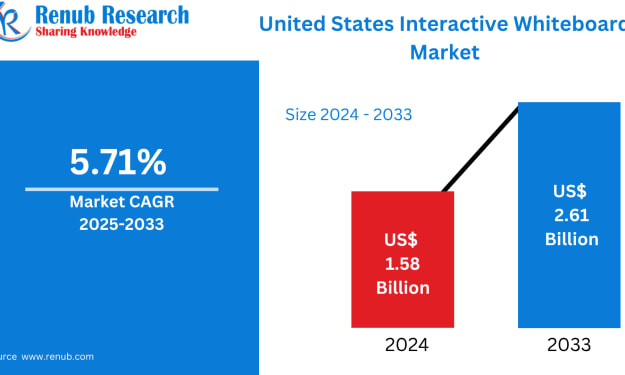
United States Interactive Whiteboard Market Size and Forecast 2025–2033
Introduction The United States is undergoing a significant transformation in how information is shared, taught, and collaboratively developed. From digital classrooms and university lecture halls to corporate boardrooms and remote work environments, interactive technologies are redefining traditional communication tools. Among these, interactive whiteboards (IWBs) have emerged as one of the most powerful and versatile platforms for enhancing engagement, productivity, and real-time collaboration.
By Marthan Sir6 days ago in Trader



Comments
There are no comments for this story
Be the first to respond and start the conversation.