
How to increase the probability of making money in stocks?
a potent tool

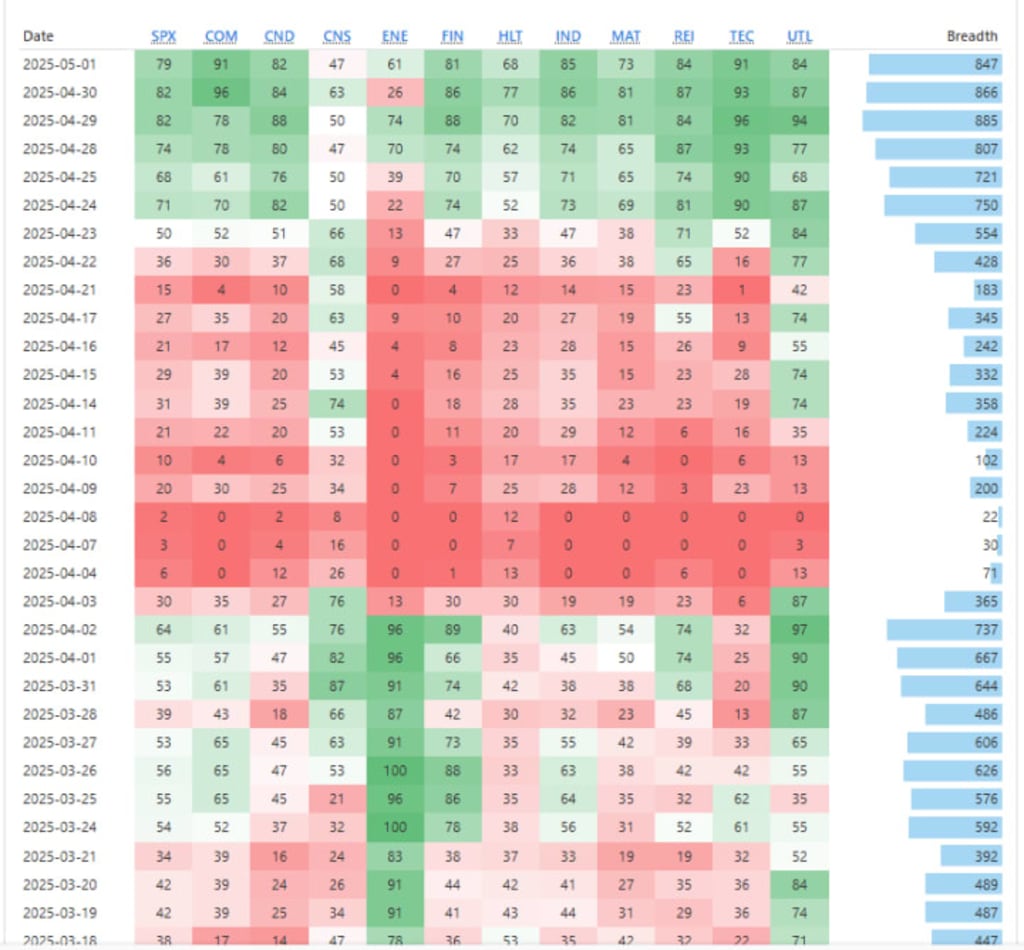
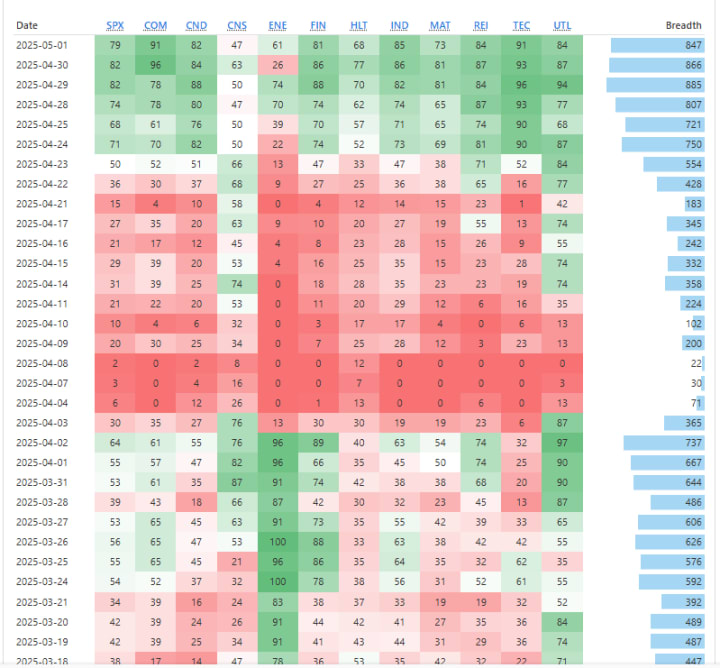
S&P 500 Index is composed of 11 sectors. The 11 sectors of the S&P 500 Index are: Information Technology、Health Care、Financials、Consumer Discretionary、Communication Services、Industrials、Consumer Staples、Energy、Utilities、Real Estate、Materials. On each market trading day, the performance of these sectors varies, with some rising and others falling, and ultimately, sectors’ movements are aggregated to determine the rise or fall of the S&P 500 Index.
Energy: This sector includes companies engaged in the exploration, production, refining, and marketing of oil, gas, and other energy - related products. Examples of major companies are Exxon Mobil and Chevron. It is highly sensitive to changes in global economic conditions and geopolitical events that affect energy prices.
Materials: Companies in the materials sector produce basic materials such as chemicals, metals, and building materials. They play a crucial role in the supply chain of various industries. Notable companies include Dow Inc. and DuPont de Nemours. The sector's performance is closely tied to the construction and manufacturing sectors.
Industrials: The industrials sector encompasses a wide range of companies involved in manufacturing, transportation, and industrial services. This includes aerospace and defense companies, machinery manufacturers, and logistics firms. General Electric and United Parcel Service (UPS) are well - known companies in this sector. It is influenced by economic growth, infrastructure spending, and trade policies.
Consumer Discretionary: Consumer discretionary companies offer products and services that are not essential for daily living but are purchased based on consumer preferences and disposable income. This sector includes retailers, automakers, and entertainment companies. Examples are Amazon, Tesla, and The Walt Disney Company. Its performance is highly correlated with consumer confidence and economic prosperity.
Consumer Staples: In contrast to the consumer discretionary sector, the consumer staples sector consists of companies that produce essential products such as food, beverages, household items, and personal care products. Procter & Gamble, Coca - Cola, and Walmart are major players in this sector. Demand for these products is relatively stable, even during economic downturns.
Health Care: The health care sector includes pharmaceutical companies, biotechnology firms, medical device manufacturers, and health care providers. Johnson & Johnson, Pfizer, and UnitedHealth Group are significant companies in this sector. It is driven by factors such as population growth, aging, and advancements in medical technology.
Financials: Financial institutions such as banks, insurance companies, investment firms, and real estate investment trusts (REITs) make up the financials sector. JPMorgan Chase, Berkshire Hathaway, and BlackRock are among the leading companies. This sector is sensitive to interest rates, regulatory policies, and the overall health of the economy.
Information Technology: The information technology sector is home to companies involved in software development, hardware manufacturing, semiconductors, and technology services. Apple, Microsoft, and Intel are well - known IT companies. It is one of the fastest - growing sectors, driven by continuous innovation and digital transformation.
Communication Services: This sector includes companies that provide communication services, such as telecommunications companies, media and entertainment firms, and internet - based communication platforms. AT&T, Verizon, and Meta (formerly Facebook) are key players. The sector is evolving rapidly with the growth of digital media and 5G technology.
Utilities: Utilities companies provide essential services such as electricity, gas, and water. They are typically regulated and offer stable, predictable cash flows. Examples include NextEra Energy and Dominion Energy. The sector is less affected by economic cycles compared to some others.
Real Estate: The real estate sector consists of REITs and companies involved in property development, management, and ownership. Simon Property Group and Prologis are major real estate companies. It is influenced by interest rates, population growth, and urbanization trends.
Mathematical model analysis
How can we measure the market sentiment of a stock in the short term? We define it that when the stock price is above its 20-day moving average, the market sentiment for that stock in the short term is considered to be positive. When all the stocks within a sector are above their respective 20-day moving averages, the trend of the sector will be extremely strong. Therefore, we can use a formula to calculate it.
In the book on Amazon, the author provides a detailed introduction to this indicator, including the data model, data sources, and the websites for data acquisition. If you want to know more, click on this book on Amazon to read.
https://www.amazon.com/dp/B0F6XKGNC3
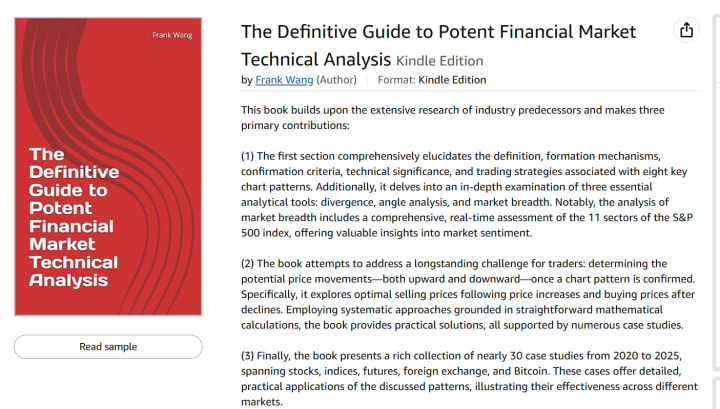
(1) The first section comprehensively elucidates the definition, formation mechanisms, confirmation criteria, technical significance, and trading strategies associated with eight key chart patterns. Additionally, it delves into an in-depth examination of three essential analytical tools: divergence, angle analysis, and market breadth. Notably, the analysis of market breadth includes a comprehensive, real-time assessment of the 11 sectors of the S&P 500 index, offering valuable insights into market sentiment.
(2) The book attempts to address a longstanding challenge for traders: determining the potential price movements—both upward and downward—once a chart pattern is confirmed. Specifically, it explores optimal selling prices following price increases and buying prices after declines. Employing systematic approaches grounded in straightforward mathematical calculations, the book provides practical solutions, all supported by numerous case studies.
(3) Finally, the book presents a rich collection of nearly 30 case studies from 2020 to 2025, spanning stocks, indices, futures, foreign exchange, and Bitcoin. These cases offer detailed, practical applications of the discussed patterns, illustrating their effectiveness across different markets.
About the Creator
China Ice Cream Market Size and Forecast 2026–2034
China Ice Cream Market Outlook The China ice cream market is experiencing remarkable growth as changing consumer lifestyles, rising disposable incomes, and evolving food preferences reshape the country’s dessert industry. According to Renub Research, the China Ice Cream Market is projected to grow from US$ 20.57 billion in 2025 to US$ 35.44 billion by 2034, expanding at a compound annual growth rate (CAGR) of 6.23% from 2026 to 2034. This growth reflects increasing consumer interest in indulgent desserts, premium frozen treats, and innovative flavors that combine local and global culinary influences.
By Sakshi Sharma4 days ago in Trader
Hottest in the Office
Dear Rafi, You’re very distracting to work around. For the first second I saw you the other day, I thought you were some type of executive. It took a moment to realize no, you were just the new guy, dressed up for the job he wants. Be still, my heart.
By Gabriel Shames5 days ago in Pride




Comments
There are no comments for this story
Be the first to respond and start the conversation.