
How to Identify Forex Trading Scams in 2025?
Around 32% of forex trading scam happen through social media platforms like Facebook, TikTok, Twitter, Instagram, and Telegram, according to Finance Magnets. So, keeping yourself safe from forex scammers is no longer a dream but compulsory.


Forex trading can be thrilling, but scams are everywhere. If you’re new or even moderately experienced in forex, learning how to spot a forex scam could save your hard-earned capital.
Here’s your ultimate guide to detecting and avoiding forex trading scams, along with warning signs and strategies to stay safe.
First, Why Are Forex Scams So Common?
Unlike traditional stock trading, forex markets operate globally and often beyond centralized regulation. This makes them a ripe playground for fraudsters using promises of fast profits, trading automation, or exclusive insider signals.
Platforms like Telegram, Instagram, and YouTube are packed with misleading ads and hype-filled promotions.
Top 6 Red Flags: How to Spot a Forex Scammer in 2025
1. Beware of “Guaranteed Profits.”
Any broker or trader promising guaranteed returns, "daily 5% profits," or risk-free trading is lying. Legitimate forex trading is volatile by nature. No system, strategy, or signal can promise fixed profits every day or week.
If you hear “get rich overnight,” it’s a scam. In real forex, nothing is guaranteed.
2. Social Media Pressure
Roughly 32% of scam offers pop up on platforms like Facebook, TikTok, Telegram, etc. Be cautious when ads or messages push you to join “exclusive” trading groups.
Warning: If someone slides into your DMs or comments with “DM me for daily profits,” ignore and report.
3. Fake Platforms & Mirror Trading
One of the most deceptive scams is mirror trading. Some scammers show fake trading dashboards (mirror MT4/5) that look real, but your money vanishes once you deposit.
It shows you "live trades" or “high profits.” But it’s not actually connected to any market. It’s a mirror interface meant to make you trust the system and deposit money.
4. No Regulation = Big Risk
Legit brokers are regulated by authorities like the CFTC, NFA, FCA, ASIC, or CySEC. Lack of this oversight? 🚫Big danger!!!
If your broker cannot prove their regulatory license, or their registration is with obscure offshore zones like St. Vincent or Seychelles, be cautious. Unregulated platforms have zero accountability and can disappear overnight.
5. FOMO Tactics: “Act Now or Miss Out”
Scammers love urgency: “Limited time only,” “spots filling fast”. They create FOMO (Fear of Missing Out). In genuine trading, there’s no rush—take your time.
Genuine brokers or educators never pressure clients with countdowns or scarcity claims.
6. Withdrawal Hurdles & Surprise Fees
Once you try to withdraw your funds, scam brokers may impose unexpected “taxes” or block you altogether. If you can’t get your money out easily, run away.
If you can’t get your own money out, you’re not in control—it’s a scam.
List of Forex Scams & How They Work:
Ponzi or Pyramid Schemes
Promise steady profits from group investing—new investors' funds pay old ones until it collapses.
Fake Brokers (Unregulated)
Offer flashy platforms, but operate without licenses—your money is never actually invested.
Signal Seller Scams
Sell “winning” trade signals with no proof of performance, often using fake screenshots or edited MT4 statements.
Fake Fund Managers
Claim to manage your capital and earn profits on your behalf, but usually steal deposits and vanish.
AI & Copy Trading Bots Scams
Marketed as fully automated “money-making” bots—often they’re rigged, don’t trade live, or are just front-end fakes.
Telegram Signal Scams
Impersonate successful traders, lure users with demo account screenshots and pressure them into private “VIP” groups.
Clone Websites
Scammers duplicate the look of real broker websites to trick users into depositing into fake platforms.
Impersonation of Prop Firms
Scam groups mimic trusted proprietary firms and promise funded accounts if you pay for "evaluation"—then disappear.
Withdrawal Block Scams
You can deposit and “see profits,” but once you request a withdrawal, the platform demands hidden taxes or denies access.
Cold Calling Scams
Aggressive agents call offering investments or account help—real brokers never cold-call out of the blue.
Fake Testimonials & Influencer Endorsements
Deepfakes or paid reviews on YouTube, Trustpilot, and TikTok trick you into trusting fake brokers or apps.
✅ How to Protect Yourself: Tips to Avoid a Scammer!
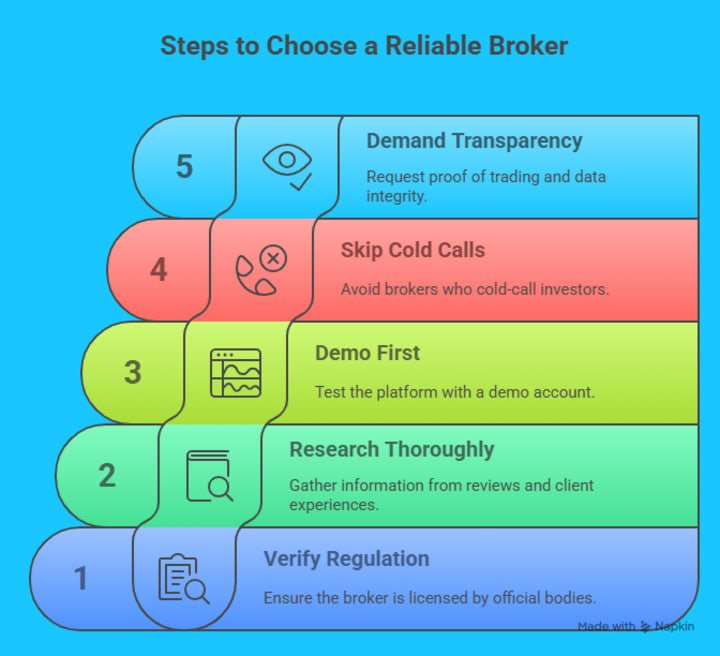
Here’s a step-by-step table to help you verify before you invest:
1. Verify Regulation
Check licensing via official websites (e.g., CFTC, FCA, ASIC)
2. Research Thoroughly
Read reviews, forums, and verify real client experiences
3. Demo First
Test with a demo account before risking real funds
4. Skip the Cold Calls
Legit brokers don’t cold-call investors.
5. Demand Transparency
Ask for proof of trading, and check the platform data integrity
What to Do If You’ve Been Scammed in Forex Trading?
If you’ve already fallen victim to a forex scam, don’t panic. There may still be a way to recover your funds or at least report the fraud to prevent others from being targeted.
Your first step should be to report the incident to your country’s financial regulatory authority. These organizations monitor broker activities, issue public warnings, and in some cases, can help freeze scam operations.
Report Forex Fraud to These Official Agencies:
For USA :
- FTC (Federal Trade Commission)
- CFTC (Commodity Futures Trading Commission)
- NFA (National Futures Association)
- SEC (U.S. Securities and Exchange Commission)
For UK
FCA (Financial Conduct Authority)
For Australia
ASIC (Australian Securities & Investments Commission)
For Europe
ESMA (European Securities and Markets Authority)
For Cyprus
CySEC (Cyprus Securities and Exchange Commission)
For California (USA)
DFPI (Department of Financial Protection and Innovation)
Final Thoughts: If It Looks Too Good to Be True...
…It probably is.
Forex scammers prey on greed, fear, and desperation. They’ll promise luxury, wealth, and fast-track trading success—but their real goal is your money.
The best way to fight back? Education, verification, and skepticism.
🔐 Stay safe. Stay informed. Treat forex like a business, not a gamble.
About the Creator
Daniel Reid
Technical & Finance Writer| Casual Trader| Web Content Strategist
X: https://x.com/DReid43887 IG: https://www.instagram.com/danielreidtsc/
Keep reading
More stories from Daniel Reid and writers in Trader and other communities.
How to Find the Best Forex Signals in 2025?
How to Find the Best Forex Signals in 2025? Let’s be real — the Forex market can be a total rollercoaster. Even pro traders sometimes feel stuck. Prices shift every second, and without a solid plan, it’s easy to get burned.
By Daniel Reid8 months ago in Trader
Server Chassis Market Size & Forecast 2026–2034
The Server Chassis Market is projected to grow from US$ 372.43 billion in 2025 to US$ 488.92 billion in 2034, expanding at a CAGR of 3.07% from 2026 through 2034. The steady rise reflects sustained investments in hyperscale data centers, cloud computing infrastructure, artificial intelligence (AI) workloads, and edge computing networks.
By shibansh kumar6 days ago in Trader
Australia Smart Safety Helmets Market 2026: Workplace Safety Innovation, Connected Protection and Industry 4.0 Integration
Australia Smart Safety Helmets Market Overview Australia’s smart safety helmets market is rapidly emerging as workplaces adopt advanced safety solutions that integrate digital technology with traditional protective gear. Smart safety helmets — equipped with sensors, communication modules and IoT connectivity — provide enhanced protection, real-time monitoring and automation support across construction, mining, manufacturing and industrial environments. As businesses prioritise employee safety, operational efficiency and compliance with stringent occupational standards, smart safety helmets are increasingly recognised as crucial components of modern safety ecosystems.
By Amyra Singh4 days ago in Trader



Comments
There are no comments for this story
Be the first to respond and start the conversation.