
How I Lost $5,000 Doing Options on AT&T
5 Things You Need To Know Before You Start Trading Options

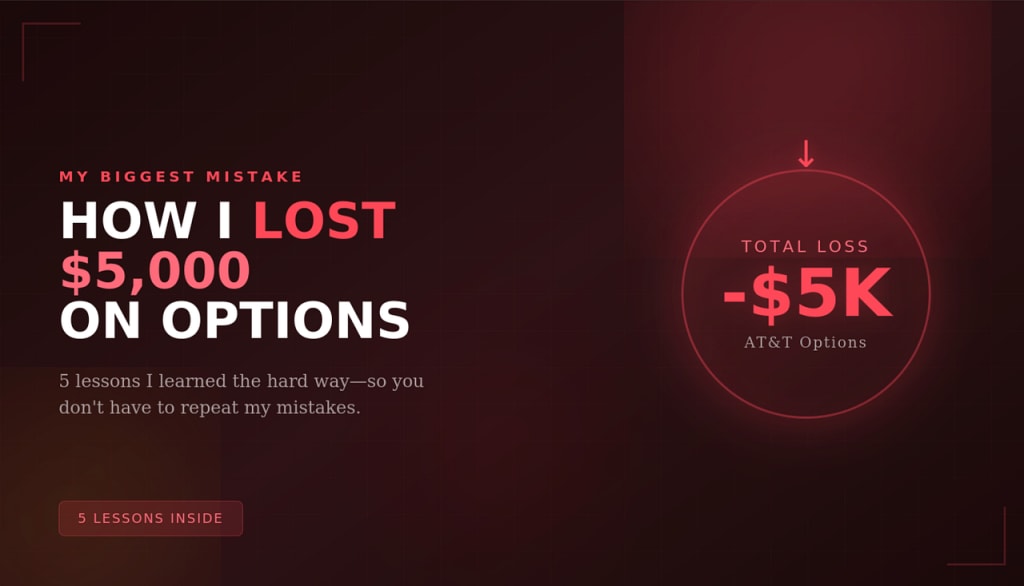
I lost five thousand dollars trading options on AT&T. And honestly? I deserved to lose it. Because I had no idea what I was doing.
Today I'm gonna break down what options actually are - in the simplest way possible - and then give you the five lessons I learned the hard way so you don't repeat my mistakes.
What are options?
Okay, before we get into the lessons, let me explain what options even are. Because when I started, I didn't really understand them. I just knew people were making a lot of money. And that was enough for me to jump in.
Spoiler: that was dumb.
So here's options explained like you're five years old:
Imagine you really want a toy that costs $100. But you don't have $100 right now. So you go to the store owner and say, 'Hey, can I pay you $5 today to LOCK IN the right to buy this toy for $100 anytime in the next 30 days?'
The store owner says sure.
Now you have an OPTION. You're not forced to buy the toy - you just have the RIGHT to buy it at that price if you want.
Why would you do this?
Because if that toy suddenly becomes super popular and the price jumps to $150… you can still buy it for $100. You saved $50, minus the $5 you paid for the option. That's a $45 profit.
But here's the catch:
If the toy price stays at $100 - or drops to $80 - your option is worthless. You don't need it. So you just lost that $5.
That's options in a nutshell.
A CALL option is betting the price goes UP. You're locking in the right to BUY at a certain price.
A PUT option is betting the price goes DOWN. You're locking in the right to SELL at a certain price.
And here's the part that got me: options expire. That 30-day window? When it's over, it's over. Your option either made money or it's worthless. There's a clock ticking against you the entire time.
With regular stocks, you can just wait. Price down? Hold for five years. It might come back.
With options? You don't have five years. You might have five days.
So when I bought calls AND puts on AT&T, thinking I'd win either way… I didn't account for the fact that AT&T just… sat there. Didn't move enough in either direction. Both options lost value as time ran out.
And just like that - five thousand dollars gone.
The 5 Lessons
So here's what I wish someone had told me before I ever placed that trade.
Lesson 1: Know What You're Doing Before You Go In
This sounds obvious. But I promise you, most people skip this step. I skipped this step.
I understood the basic concept of options - price go up, call make money. Price go down, put make money. Cool.
But I didn't understand the Greeks - delta, theta, gamma, vega. I didn't understand implied volatility. I didn't understand how time decay works. I didn't understand how options are priced.
I knew just enough to place a trade. I didn't know enough to manage it or understand why I was losing money even when I was kind of right about the direction.
If you can't explain your trade to someone else in detail - why you entered, what needs to happen for you to profit, and what your exit plan is - you're gambling. Not trading.
Don't be like me. Learn the mechanics deeply before you put real money on the line.
Lesson 2: Ask Yourself - Do You Even Need To Do Options?
Options are seductive because of the leverage. You can control 100 shares of a stock for a fraction of the cost. And the profit potential is huge.
But here's the thing nobody tells you: most people don't need options.
If your goal is to build wealth over time, buying and holding index funds or solid stocks will get you there. Exposed to the same upside, without the ticking clock, without the complexity, without the stress.
Options are a tool. They're useful in specific situations - hedging, income generation, leveraged bets when you have high conviction and understand the risks.
But for most people? They're unnecessary. And they add a layer of complexity and risk that works against you.
I thought I needed options to accelerate my returns. What I actually needed was patience and consistency. Don't add complexity just because it looks exciting.
Lesson 3: Confirm You're Built For The Trading Lifestyle
After my loss, I picked up a book called How To Day Trade For A Living by Andrew Aziz. Fantastic book. Genuinely one of the best resources on trading I've come across.
And you know what happened?
I read it and realized trading is not for me.
I actually dated a trader once. And let me tell you - that lifestyle is no joke. He had to wake up at the same time every single day. His sleep schedule was non-negotiable. He was disciplined about rest because he needed to hit the markets with full awareness and sharp decision-making. Groggy morning? Bad trade. Stayed up too late? Costly mistake.
That's the commitment. That's what real trading looks like.
It's not just watching charts when you feel like it. It's structuring your entire life around the market's schedule. Your sleep. Your mornings. Your mental energy. Everything revolves around being ready when that bell rings.
The lifestyle of a trader requires you to be glued to screens. You need to be decisive under pressure. You need to handle losses emotionally and move on immediately. You need to manage risk constantly. You need to study charts for hours.
And that's great - if you want it. Some people thrive in that environment. They love the game. They're wired for it.
But that's not what I want my life to look like.
I'm an investor, not a trader. I want to buy great assets, hold them for years, and let compounding do the heavy lifting. I don't want to wake up at 6 AM to watch pre-market. I don't want my income to depend on my screen time.
And that's okay. There's no shame in it.
But I had to learn that about myself - and it cost me five thousand dollars.
Before you start trading options, be honest with yourself: do you actually want the trading lifestyle? Or are you just attracted to the money? Because the money comes FROM the lifestyle. You can't skip the work and just collect the profits.
Lesson 4: Understand That Time Is Working Against You
This one burned me directly.
With stocks, time is your friend. Buy a good company, wait ten years, let it grow.
With options, time is your enemy.
Every single day that passes, your option loses a little bit of value. This is called theta decay, or time decay. It's like an ice cube melting. Even if nothing else changes, your option is worth less tomorrow than it is today.
And the decay accelerates as expiration gets closer. The last two weeks are brutal.
So when I bought those AT&T options, I didn't just need to be right about the direction. I needed to be right FAST. Before time ate away all my premium.
AT&T moved slowly. Too slowly. Even if it eventually went the direction I thought, it didn't happen in my timeframe. And the clock doesn't care about your thesis.
If you trade options, you're not just betting on direction. You're betting on direction AND timing. That's a much harder game.
Lesson 5: Paper Trade or Start Tiny Before Going Big
The absolute dumbest thing I did was size my position like I knew what I was doing.
Five thousand dollars. On my first real options play. On a stock I hadn't deeply analyzed. Using a strategy I didn't fully understand.
That's not confidence. That's arrogance.
If I had started with $500 - or even better, paper traded with fake money first - I would have learned the same lessons without the financial damage.
Paper trading is free. Most brokerages offer it. You get to see how options actually behave in real time without losing a dime.
And if paper trading feels boring, if you feel like you need real money on the line to pay attention… that's a red flag about your discipline, not a reason to skip the learning phase.
Start small. Treat your first trades as tuition. Learn with money you can afford to lose. And only scale up once you have a proven track record.
I skipped this step entirely. Don't be me.
Summmmmmmmmmmary
So yeah. Five thousand dollars on AT&T options. Gone.
But honestly? The lessons were worth more than that.
I learned that I didn't actually understand what I was trading. I learned that I don't even need options for my financial goals. I learned that trading isn't the lifestyle I want. I learned that time decay is a killer. And I learned to start small before going big.
If you're curious about options, I'm not saying don't do it. I'm saying go in with your eyes open. Learn the mechanics. Question whether it fits your goals. Be honest about the lifestyle. Respect the clock. And start small.
Do that, and you'll be way ahead of where I was.
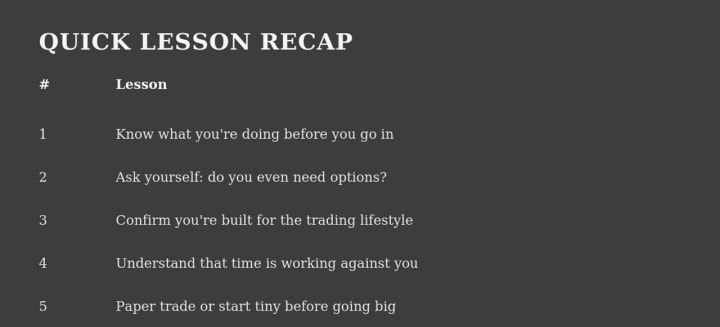
Quick Lesson Recap
Start investing in 20 minutes or less.
-
Disclaimer: This article reflects my personal experience and is for educational purposes only. It does not constitute financial advice. Past performance does not guarantee future results. Consult a financial advisor before making investment decisions.
About the Creator
Destiny S. Harris
Writing since 11. Investing and Lifting since 14.
destinyh.com
Keep reading
More stories from Destiny S. Harris and writers in Trader and other communities.
Australia Fisheries and Aquaculture Market Set for Steady Growth Through 2033
The Australia fisheries and aquaculture market reached 328.0 Thousand Tons in 2024 and is forecast to expand to 451.0 Thousand Tons by 2033, growing at a compound annual growth rate (CAGR) of 3.31% between 2025 and 2033. This projection reflects the sector’s transformation driven by sustainability mandates, technological adoption, consumer preferences, and supportive policy frameworks. As global seafood demand intensifies and environmentally responsible practices become imperative, Australia is positioning itself as a competitive and ethical producer in regional and international markets.
By Rashi Sharma7 days ago in Trader


Comments
There are no comments for this story
Be the first to respond and start the conversation.