
How Gold and Macroeconomic Data Confirm Market Patterns for Christmas Season Trading
Market liquidity is important to know the market pattern for profitable entries in holiday X-Mas season

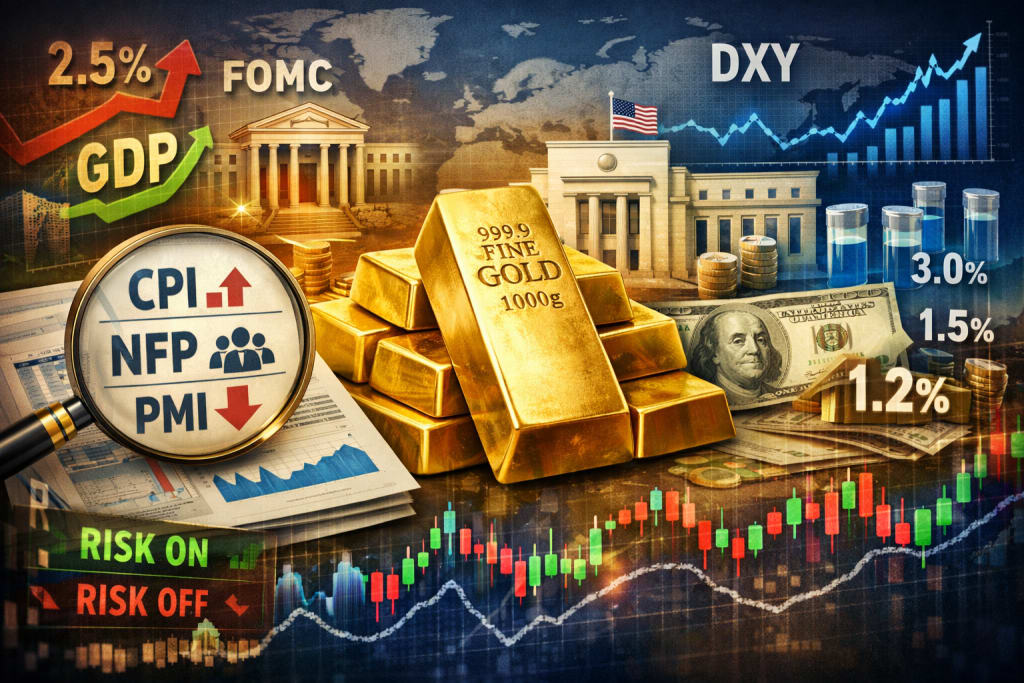
Gold has long occupied a unique position in global markets. Unlike equities, bonds, or currencies, gold is not tied to a single economy, earnings stream, or policy mandate. Instead, it operates as a macro confirmation asset—one that reflects shifts in liquidity, confidence, and systemic risk earlier and more cleanly than many traditional risk assets.
This article explains how gold prices (XAUUSD) and key economic data releases—CPI, NFP, FOMC decisions, GDP, PMI, yields, DXY, and liquidity metrics—work together to confirm market regimes, liquidity cycles, trend persistence, and institutional capital rotation. The goal is not prediction, but confirmation: understanding what markets are already signaling beneath the surface.
The analysis is designed for intermediate traders, macro investors, and professional observers seeking a framework-based, evidence-driven view of gold’s role in macro interpretation.
Gold’s Role in the Global Macro System
Gold is best understood as a monetary asset without liability. It is not tied to corporate cash flows, government creditworthiness, or policy promises. This structural neutrality explains why gold tends to perform well during periods of:
- Declining confidence in fiat currencies
- Rising inflation uncertainty
- Liquidity stress or financial fragmentation
- Policy credibility concerns
According to the World Gold Council (WGC), gold has maintained a positive real return over multi-decade horizons, particularly during periods when real yields were suppressed or volatile.
Between 2000 and 2023, gold delivered an average annual return of approximately 8–9%, largely driven by declining real interest rates and rising institutional demand.
How Gold Confirms Market Regimes: Risk-On vs Risk-Off
Market regimes are commonly categorized as risk-on or risk-off, but gold’s behavior across these regimes is conditional rather than binary.
- In risk-on environments with abundant liquidity, gold often consolidates as capital favors equities and credit.
- In risk-off regimes driven by systemic or monetary stress, gold tends to outperform both equities and bonds.
- In late-cycle risk-on phases, gold may quietly appreciate as institutional investors increase hedging exposure.
Gold’s value lies in its relative performance—particularly versus equities, real yields, and the US dollar—rather than its absolute price direction.
Why Liquidity Is Central to Gold Analysis
Liquidity conditions—defined by central bank balance sheets, funding markets, and credit availability—are among the most powerful drivers of gold prices.
Data from the Federal Reserve (FRED) shows that major expansions in central bank balance sheets (2008–2012, 2020–2021) coincided with strong gold bull markets. Conversely, periods of synchronized global tightening tend to introduce volatility rather than immediate downside.
Gold responds to liquidity because:
- It benefits when real yields are compressed
- It acts as a hedge against balance-sheet risk
- It reflects global, not domestic, monetary condition
- Gold as an Early Liquidity Stress Indicator
Gold often begins to trend before equities weaken, particularly during early tightening cycles when liquidity drains gradually. This characteristic makes gold a valuable confirmation tool for identifying hidden stress in the financial system.
Gold and Inflation Expectations
Gold does not respond mechanically to inflation data. Instead, it reacts to inflation expectations relative to interest rates.
When CPI rises faster than nominal yields, real yields fall—historically a supportive environment for gold.
According to research from the Bank for International Settlements (BIS), gold exhibits a strong inverse relationship with real yields over long horizons, particularly during periods of policy uncertainty.
Key Confirmation Patterns
- Rising gold ahead of CPI surprises often reflects embedded inflation expectations.
- Weak gold despite high CPI suggests markets expect aggressive policy tightening to restore price stability.
Gold and the US Dollar (XAUUSD): Understanding the Inverse Relationship
Gold is globally priced in USD, making the Dollar (XAU) a critical confirmation tool.
- Strong XAU often pressures gold
- Weak XAU often supports gold
But context matters.
When Gold and XAU Rise Together, this typically occurs during:
- Global stress events
- Short-term funding shortages
- Repatriation flows into USD liquidity
In such cases, gold confirms systemic risk, even when the dollar strengthens.
Institutional Behavior and Capital Rotation
Some institutional decisions and economic data releases impacts and shifts the market.
Central Bank Gold Demand
Central banks are structural participants in the gold market. According to data from the World Gold Council:
Central bank gold purchases have accelerated during periods of geopolitical fragmentation and reserve diversification
Emerging market central banks increasingly view gold as a neutral reserve asset
This institutional demand provides a non-speculative floor under gold prices.
Portfolio Hedging and Allocation Shifts
Gold often rises during:
- Late equity-cycle phases
- Rising volatility regimes
- Increasing correlations across risk assets
These moves reflect portfolio-level decisions, not retail speculation.
Pattern-Based Interpretations : Why Gold Rises Before Bad Data
Gold often anticipates deterioration because:
- Bond markets adjust earlier than equity markets
- Liquidity conditions tighten before growth slows
- Institutional hedging precedes public confirmation
This makes gold a leading confirmation signal, not a forecasting tool.
Gold Trading Tips for Christmas Season
Learn how to trade gold with more profits, no matter what the market seasonality is.
Trade smaller positions: Thin liquidity amplifies risk.
Focus on confirmations: Combine gold price, XAU, and real cues before entering trades.
Plan exits in advance: Holiday rallies can reverse quickly when liquidity returns.
Leverage macro calendar: Key data releases are limited but impactful; focus on CPI, NFP, and any Fed commentary.
How Does Gold Reflect Market Conditions?
Gold reflects shifts in real yields, inflation expectations, liquidity availability, and confidence in monetary policy.
Why Does Gold Move Before Economic Data?
Gold responds to expectations embedded in bond and funding markets, which often adjust before official data releases.
Financial markets are probabilistic, not predictive. Gold and macroeconomic indicators provide valuable confirmation of underlying conditions, but no single asset or data point offers certainty.
Effective analysis requires contextual interpretation, risk management, and an understanding of evolving market dynamics.
About the Creator
Daniel Reid
Technical & Finance Writer| Casual Trader| Web Content Strategist
X: https://x.com/DReid43887 IG: https://www.instagram.com/danielreidtsc/
Keep reading
More stories from Daniel Reid and writers in Trader and other communities.
Hormone Replacement Therapy Market Size & Forecast 2026–2033
The global Hormone Replacement Therapy (HRT) market is witnessing steady expansion as healthcare systems increasingly focus on improving quality of life for aging populations. According to Renub Research, the Hormone Replacement Therapy market is projected to grow from US$ 23.72 Billion in 2025 to US$ 40.52 Billion by 2034, expanding at a compound annual growth rate (CAGR) of 6.12% between 2026 and 2034.
By shibansh kumar3 days ago in Trader
A Transparent Look at Vocal Challenges and Top Stories
Almost three years ago, we shared a resource article that served as a place for people to suggest new challenge prompts. We thought it would be a good idea to refresh that thread, and take the opportunity to answer a few common questions about top stories, how challenges are judged and how submissions are reviewed.
By Vocal Curation Team4 days ago in Resources




Comments
There are no comments for this story
Be the first to respond and start the conversation.