
GMI Markets: Is It Time for Investors to Exit as GMI Shuts Down Globally?
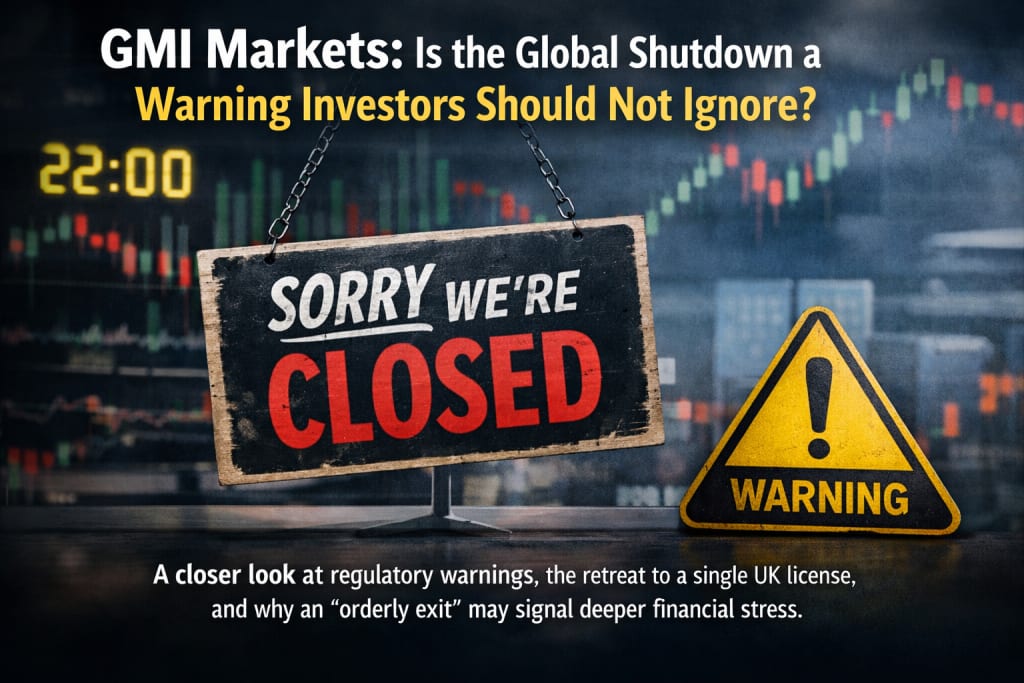
A closer look at regulatory warnings, the retreat to a single UK license, and why an “orderly exit” may signal deeper financial stress.
In the retail forex industry, platforms rarely announce a global shutdown without deeper reasons. When they do, the explanation given to the public often tells only part of the story.
In late 2025, GMI Markets (Global Market Index) informed clients that it would cease global retail trading operations, setting a clear timetable for trade suspension, forced position closures, and final withdrawals. On the surface, the process appeared orderly and transparent. But beneath that structure lies a series of regulatory signals, operational shifts, and market rumors that raise important questions about the true drivers behind the decision.
This article examines what is confirmed, what is strongly implied, and what remains market speculation—and, most importantly, what investors should do next.
1. What GMI Officially Announced (Confirmed Facts)
According to multiple industry sources and client notices, GMI announced the following timeline:
Trading halted after 24 December 2025 (GMT)
Close-only mode beginning 26 December 2025, with deposits disabled
Forced liquidation of remaining positions by 31 December 2025
Final withdrawal deadline set for 31 January 2026
The affected entities are offshore retail-facing companies, including registrations in St. Vincent and the Grenadines and St. Lucia, which historically serviced GMI’s global retail clients.
Importantly, GMI has not announced a full group-wide shutdown. Instead, the firm has effectively exited global retail forex, while retaining a UK-regulated entity that appears focused on professional or institutional services.
2. The Structural Shift: What Was Closed — and What Was Left Standing
One detail stands out immediately:
Only the UK-regulated entity remains operational.
All other offshore or lightly regulated entities have either:
been warned by regulators,
restricted from certain jurisdictions,
or quietly withdrawn from active retail expansion.
This pattern is not random.
In the forex industry, retail trading is the most capital-intensive and risk-exposed business line:
Client profits must be paid promptly
Volatile markets can create sudden liquidity gaps
Regulatory scrutiny on marketing and payments has increased sharply since 2023
By contrast, UK-regulated professional or B2B services:
Operate with smaller, professional client bases
Carry lower reputational and complaint risk
Are easier to wind down or scale without public friction
The selective retreat strongly suggests strategic triage, not retirement.
3. Regulatory History: A Pattern, Not a Single Event
Over recent years, GMI-branded entities and domains have appeared in multiple regulatory warning notices across jurisdictions, including Europe and the Asia-Pacific region.
These warnings generally do not allege criminal behavior, but they do state that certain GMI-related entities were:
not authorized to offer investment services locally, or
being confused with cloned or impersonated firms
While regulators often emphasize that “impersonators” are separate from legitimate companies, the practical damage is the same:
Payment providers become cautious
Advertising channels restrict access
Customer complaints increase
Legal and compliance costs rise
A firm can survive one warning. Multiple warnings across regions usually trigger internal reassessment.
4. Market Rumors: What Is Being Said — and What Cannot Be Proven
Within trading communities and social media, several rumors have circulated:
Claims that ownership is aging or exiting
Speculation about failed acquisition talks
Assertions that capital buffers became insufficient
None of these claims can be independently verified.
However, one point deserves attention:
If leadership retirement were the primary reason, a full business sale or transfer would be more logical than a global retail shutdown.
The decision to close first, withdraw gradually, and retain only one tightly regulated entity aligns far more closely with risk containment than with succession planning.
5. The Apparent Contradiction:
“If There Is a Capital Problem, Why Allow Withdrawals?”
This is where many observers misunderstand how platforms actually fail.
A firm facing early or mid-stage capital stress still has incentives to:
Encourage withdrawals
Reduce open exposure
Freeze new deposits
Close positions in an orderly way
Why?
Because:
Continuing operations increases unpredictable liabilities
Market volatility can instantly worsen capital ratios
An orderly exit preserves legal and reputational survivability
In contrast, platforms that block withdrawals abruptly are usually those that have already lost control of their balance sheet.
From this perspective, GMI’s actions are not contradictory. They are consistent with a firm choosing to exit before conditions deteriorate further.
6. The Most Plausible Explanation (Based on Evidence, Not Accusation)
There is no public proof that GMI is insolvent.
However, the convergence of facts suggests the following scenario:
Rising regulatory pressure across jurisdictions
Increased operational and compliance costs
Shrinking tolerance for offshore retail models
Heightened liquidity and capital risk in volatile markets
Together, these factors likely made global retail trading no longer sustainable under acceptable risk thresholds.
Closing the business while withdrawals are still possible is not weakness. It is damage control.
7. What Investors Should Do Now
For clients or partners still involved, caution—not panic—is the correct response.
Recommended actions:
Withdraw funds as early as possible, not near the final deadline
Avoid any “assistance services” or private contacts claiming to help with withdrawals
Document everything: statements, confirmations, emails
Ignore rumors of extensions or special arrangements
Treat the timeline as non-negotiable
History shows that final deadlines in platform closures are rarely extended.
Final Thoughts
GMI Markets’ global exit is not a sudden collapse, but it is also not a casual business decision.
It is a controlled retreat from a business model that has become increasingly fragile under regulatory, financial, and reputational pressure.
For investors, the lesson is simple and timeless:
The best exit is the one taken early, calmly, and with documentation.
Orderly closures are still closures—and time, not trust, is the most valuable asset left.




Comments (1)
There's an option for tagging AI generated articles on the site. Just letting you know.