
Global Water Heater Market Forecast 2025–2033: Energy-Efficient Heating Solutions Drive Future Growth
Rising urbanization, smart appliance innovation, and demand for sustainable energy solutions are accelerating global water heater adoption.

Introduction
The global water heater market is witnessing steady growth as consumers, businesses, and industries increasingly prioritize reliable and energy-efficient hot water solutions. Water heaters are a vital component of modern infrastructure, supporting daily activities such as bathing, cleaning, cooking, and industrial processes. As urban populations expand and construction activities rise worldwide, the demand for advanced water heating systems continues to grow.
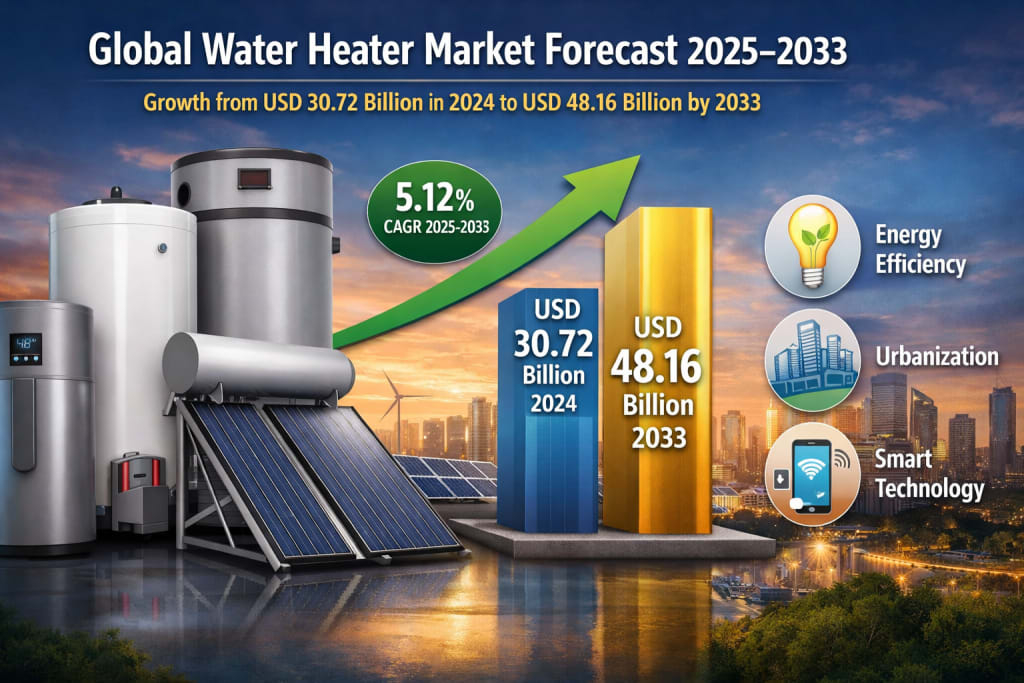
According to Renub Research, the global water heater market was valued at USD 30.72 billion in 2024 and is projected to reach USD 48.16 billion by 2033, expanding at a compound annual growth rate (CAGR) of 5.12% during 2025–2033. The growth of this market is largely driven by technological advancements, increasing energy efficiency standards, and the rising adoption of renewable energy-based water heating systems.
From residential homes to commercial establishments and large industrial facilities, water heaters have become an indispensable appliance worldwide. Innovations such as smart connectivity, heat pump technologies, and solar-powered systems are transforming the industry and redefining how consumers access hot water.
Water Heater Market Overview
A water heater is an appliance designed to heat and store water for various residential, commercial, and industrial applications. These systems raise the temperature of water using electricity, gas, or renewable energy sources to deliver hot water whenever needed.
There are several types of water heaters available in the market today, including:
Tankless (on-demand) water heaters
Storage tank water heaters
Heat pump water heaters
Solar-powered water heaters
Each type offers different benefits in terms of energy efficiency, heating capacity, installation requirements, and cost.
In residential environments, water heaters provide hot water for everyday tasks such as showering, washing dishes, and laundry. In commercial settings such as hotels, restaurants, hospitals, and spas, large-scale water heating systems ensure continuous supply for operations. Industrial sectors also rely heavily on high-capacity water heaters for manufacturing processes, cleaning operations, and chemical processing.
Another major transformation in the industry is the integration of smart technologies. Many modern water heaters now include features such as remote temperature control, smartphone connectivity, energy monitoring, and automated scheduling. These smart capabilities improve efficiency while offering greater convenience for users.
Key Growth Drivers of the Water Heater Market
Increasing Demand for Energy-Efficient Products
One of the strongest drivers of the water heater market is the global shift toward energy conservation and sustainability. Governments and consumers are increasingly focused on reducing energy consumption and carbon emissions.
Energy-efficient water heating technologies such as heat pump water heaters and solar-powered systems are gaining significant popularity because they consume less electricity and reduce operational costs. Heat pump technology, in particular, is becoming one of the most promising solutions for sustainable water heating.
Consumers are also becoming more aware of long-term cost savings associated with energy-efficient appliances. Although these systems may have a higher upfront cost, their lower energy consumption leads to reduced electricity bills over time.
As a result, manufacturers are continuously investing in innovative technologies that deliver both performance and sustainability.
Rapid Urbanization and Infrastructure Development
Urbanization is another major factor fueling the growth of the water heater market. Cities around the world are expanding rapidly, leading to increased construction of residential complexes, hotels, hospitals, and office buildings.
Currently, approximately 4.4 billion people—more than half of the global population—live in cities, and this number is expected to double by 2050. This rapid shift toward urban living is significantly increasing the demand for modern housing and infrastructure.
Large-scale infrastructure development also requires reliable hot water systems. High-rise buildings, commercial complexes, and hospitality establishments rely heavily on advanced water heating systems capable of handling large volumes of water efficiently.
According to the German Advisory Council on Global Change, the world must build as much infrastructure in the next three decades as it has since industrialization, requiring an estimated annual investment of EUR 3.6 trillion. Such developments will continue to create substantial demand for water heating systems.
Technological Advancements and Smart Features
Technological innovation is playing a crucial role in shaping the future of the water heater market. Modern water heaters are becoming smarter, more efficient, and easier to control.
Smart water heaters now include advanced features such as:
Remote temperature control through mobile apps
Energy usage monitoring
Automated heating schedules
Leak detection systems
Integration with smart home platforms
The integration of Internet of Things (IoT) technology allows homeowners and businesses to manage their water heating systems more efficiently.
For example, in September 2023, Midea Group introduced a Smart Wi-Fi Storage Water Heater designed to enhance convenience, safety, and energy efficiency. These innovations are attracting consumers who seek both comfort and advanced home automation capabilities.
Challenges in the Water Heater Market
High Installation and Maintenance Costs
Despite the increasing popularity of energy-efficient systems, high installation costs remain a challenge for many consumers.
Advanced technologies such as heat pump water heaters and solar-powered systems require a significant initial investment. This can discourage adoption, particularly in developing economies where consumers are highly price-sensitive.
In addition to installation costs, regular maintenance and potential repair expenses can increase the total cost of ownership. These financial factors may slow the adoption of modern water heating technologies, especially in lower-income markets.
Environmental and Regulatory Compliance
Environmental concerns and stricter government regulations also present challenges for manufacturers.
Traditional water heaters powered by gas or electricity contribute to carbon emissions and energy consumption. As governments implement stricter regulations regarding emissions and energy efficiency, manufacturers must invest heavily in research and development to meet these requirements.
Compliance with environmental standards may increase production costs, which could impact product pricing. At the same time, the transition toward renewable energy solutions is pushing companies to redesign their products to remain competitive in an evolving market.
Market Insights by Product Type
Electric Water Heater Market
Electric water heaters represent one of the largest segments of the global market due to their convenience, reliability, and ease of installation.
These systems are widely used in residential, commercial, and industrial settings because they require minimal maintenance and operate efficiently in areas where gas infrastructure is limited.
Electric water heaters are available in two main types:
Storage electric water heaters
Tankless electric water heaters
Technological advancements, including smart temperature controls and improved insulation systems, are enhancing the performance of electric models. Additionally, rising awareness of energy-efficient appliances and government regulations promoting fuel efficiency are contributing to market growth.
The expanding construction sector worldwide is also opening new opportunities for electric water heater adoption.
Solar Water Heater Market
Solar water heaters are gaining significant traction due to their environmental benefits and long-term cost savings. These systems use solar energy to heat water, reducing electricity consumption and carbon emissions.
Countries with abundant sunlight, such as India, China, and several Middle Eastern nations, are increasingly adopting solar water heating systems as part of their renewable energy strategies.
Government subsidies, incentives, and environmental policies encouraging renewable energy adoption are further boosting the solar water heater market.
Gas Water Heater Market
Gas-powered water heaters continue to be widely used in regions where natural gas infrastructure is well established.
These systems offer rapid heating capabilities and are often preferred in commercial environments where large volumes of hot water are required quickly. However, environmental concerns and stricter emission regulations may gradually limit their growth in some regions.
Market Insights by Technology
Storage Tank Water Heater Market
Storage tank water heaters remain one of the most commonly used systems worldwide. These units store heated water in insulated tanks, ensuring a continuous supply of hot water.
They are widely preferred due to their affordability, reliability, and ability to serve multiple outlets simultaneously. Technological advancements in insulation materials and heating efficiency have further improved their performance.
The rising demand for residential housing and commercial infrastructure continues to drive this segment.
Tankless Water Heater Market
Tankless water heaters, also known as on-demand water heaters, heat water only when required. This eliminates the need for storing hot water and significantly improves energy efficiency.
These systems are compact, space-saving, and ideal for modern apartments and small homes. As energy efficiency becomes a priority for consumers, tankless systems are gaining popularity worldwide.
Hybrid Water Heater Market
Hybrid water heaters combine multiple technologies, such as heat pumps and traditional heating elements, to deliver optimal energy efficiency. These advanced systems reduce electricity consumption while maintaining consistent water heating performance.
Although they are more expensive than conventional models, their long-term energy savings make them an attractive option for environmentally conscious consumers.
Industrial Water Heater Market
Industrial water heaters are designed to handle large volumes of water and high-temperature requirements. Industries such as food processing, pharmaceuticals, manufacturing, and hospitality depend heavily on these systems.
The expansion of industrial activities in emerging economies is driving the demand for high-performance water heating solutions. In addition, safety standards and energy efficiency regulations are encouraging industries to upgrade to advanced water heating technologies.
Regional Market Analysis
United States
The United States remains one of the largest markets for water heaters due to strong residential and commercial demand.
Consumers are increasingly choosing smart water heaters and energy-efficient systems to reduce electricity costs and environmental impact. Government regulations promoting energy efficiency are also encouraging the adoption of advanced heating technologies.
United Kingdom
The United Kingdom is experiencing growing demand for low-carbon water heating solutions as part of its national strategy to reduce greenhouse gas emissions.
Heat pump and solar-powered water heaters are gaining popularity as environmentally friendly alternatives. Rising housing developments and growing consumer awareness about energy efficiency are further supporting market growth.
India
India’s water heater market is expanding rapidly due to rising urbanization, a growing middle-class population, and increasing housing construction.
Water heaters are widely used in residential homes, hotels, hospitals, and commercial buildings. Solar water heaters are particularly popular in India due to abundant sunlight and government incentives promoting renewable energy adoption.
Manufacturers are also launching stylish and technologically advanced models to attract urban consumers.
Saudi Arabia
Saudi Arabia is witnessing increasing demand for water heating systems in both residential and commercial sectors.
The hospitality industry, healthcare sector, and new urban development projects are major drivers of this market. Government initiatives promoting energy efficiency and sustainable infrastructure are also supporting the adoption of modern water heaters.
Competitive Landscape
The global water heater market is highly competitive, with several major companies focusing on innovation, product development, and strategic partnerships to strengthen their market presence.
Key players in the industry include:
A.O. Smith
Rinnai Corporation
Whirlpool Corporation
Bajaj Electricals Ltd
Haier Inc.
Havells India Ltd
Lennox International Inc.
Kenmore
Thermex Corporation
These companies are investing heavily in research and development to introduce energy-efficient and smart water heating technologies.
Final Thoughts
The global water heater market is entering a new era driven by sustainability, technological innovation, and rapid urban development. As consumers become more conscious of energy efficiency and environmental impact, demand for advanced water heating systems is expected to grow steadily.
With smart features, renewable energy integration, and improved heating technologies, water heaters are evolving from simple household appliances into intelligent energy solutions.
As infrastructure expansion continues worldwide and governments promote energy-efficient appliances, the water heater market is poised for significant growth through 2033. Businesses that prioritize innovation, sustainability, and consumer convenience will be best positioned to lead the future of this rapidly evolving industry.
About the Creator
India Fertilizer Market Size and Forecast 2026–2034
The India fertilizer market is poised for steady and sustainable growth over the next decade, driven by the country’s rising population, increasing food consumption, and the urgent need to enhance agricultural productivity. According to Renub Research, the market is projected to grow from US$ 44.62 Billion in 2025 to US$ 75.96 Billion by 2034, expanding at a Compound Annual Growth Rate (CAGR) of 6.09% during 2026–2034.
By Sakshi Sharma7 days ago in Trader
Why Didn't Anyone Tell Us
Men, move along. This is not for you. This is for the women. I was forty-five when I began menopause. It is pretty young for that to be going on in a woman’s life, but I had undiagnosed PCOS, my entire life. Thank you to all the gynecologists I had seen my entire life. That in itself should encourage women to keep seeking second opinions, especially when you are not getting correct answers or any at all.
By Alexandra Grant5 days ago in Humans



Comments
There are no comments for this story
Be the first to respond and start the conversation.