
Global Powersports Market Size, Growth & Forecast 2025–2033
How Adventure, Technology, and Electrification Are Reshaping the Future of Powersports Worldwide

Introduction: The World Is Getting Faster, Wilder, and More Adventurous
The global powersports industry is riding a powerful wave of transformation. Once seen primarily as a niche segment for motorsport enthusiasts and outdoor adventurers, powersports vehicles have now become a mainstream symbol of lifestyle mobility, recreation, and utility. From rugged all-terrain vehicles (ATVs) and side-by-side UTVs to sleek motorcycles, snowmobiles, and personal watercraft, the sector is expanding both in purpose and popularity.
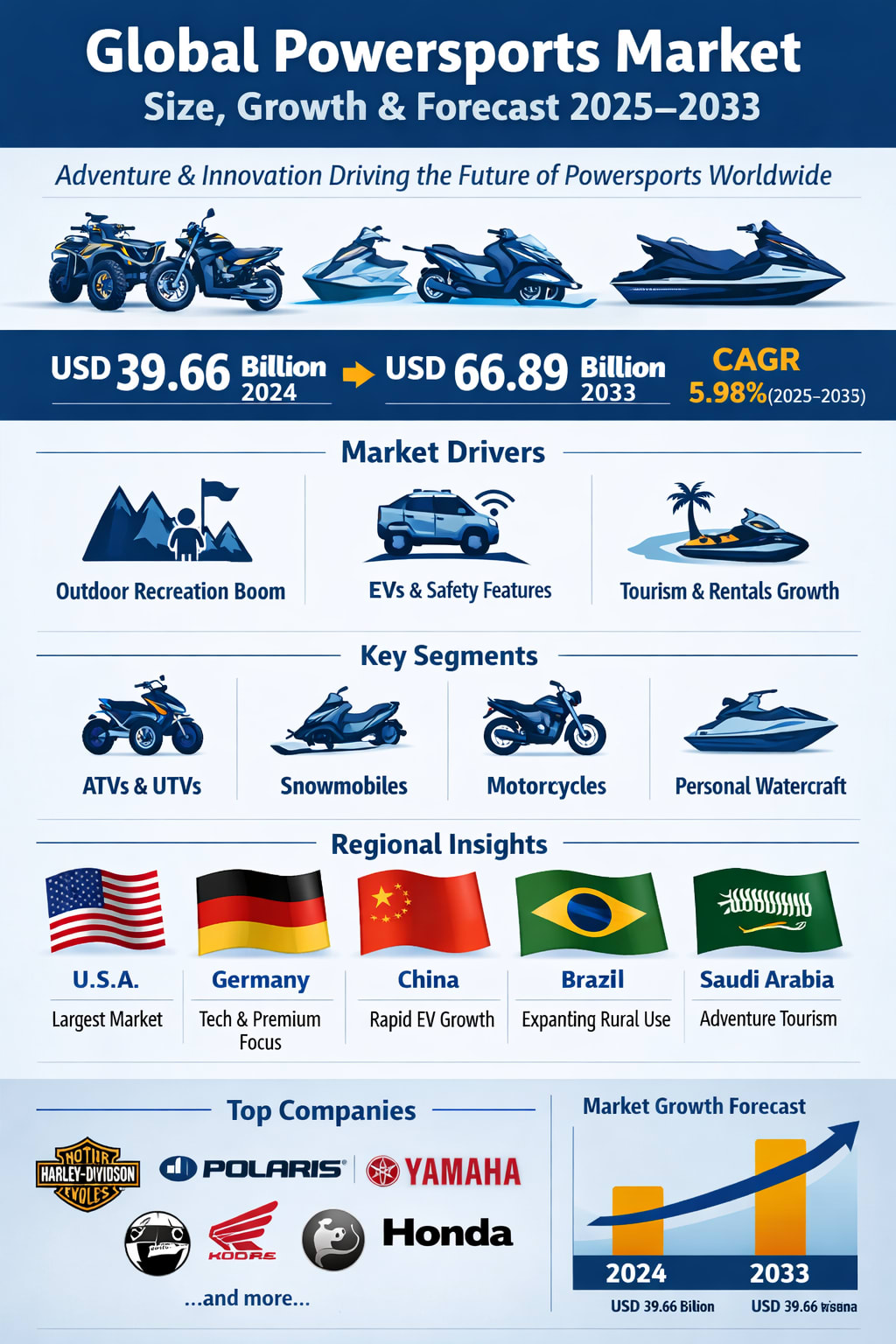
According to Renub Research, the global powersports market was valued at USD 39.66 billion in 2024 and is projected to reach USD 66.89 billion by 2033, growing at a CAGR of 5.98% during 2025–2033. This steady growth is being fueled by rising demand for recreational vehicles, increasing participation in off-road and adventure sports, and continuous technological advancements across motorcycles, ATVs, snowmobiles, and personal watercraft in North America, Europe, and Asia-Pacific.
In a world where consumers increasingly prioritize experiences over possessions, powersports vehicles are no longer just machines—they represent freedom, exploration, and a lifestyle built around the outdoors.
What Are Powersports Vehicles?
Powersports is a category of motorized equipment used for recreational, competitive, and utility purposes across land, water, and snow. This includes all-terrain vehicles (ATVs), side-by-side vehicles (UTVs), motorcycles, snowmobiles, and personal watercraft (PWCs) such as jet skis. These vehicles are engineered for speed, agility, and performance in challenging environments, making them ideal for adventure sports, trail riding, water recreation, and rural or off-grid work.
Beyond recreation, powersports vehicles play a crucial role in agriculture, forestry, search and rescue, law enforcement, and remote-area transportation. Their ability to operate in harsh and inaccessible terrains gives them a unique advantage over conventional vehicles. With better safety features, improved performance, and growing affordability, the customer base has expanded from hardcore enthusiasts to families, professionals, and tourism operators.
Key Growth Drivers in the Global Powersports Market
1. Rising Interest in Outdoor Recreation and Adventure Sports
One of the strongest growth engines for the powersports market is the global surge in outdoor recreational activities. Trail riding, off-road touring, water sports, and adventure travel have become increasingly popular, especially among younger consumers seeking experiences rather than traditional entertainment.
The pandemic era accelerated this trend as people looked for socially distanced outdoor activities. ATVs, UTVs, motorcycles, and PWCs offered the perfect mix of excitement, freedom, and versatility. Even today, this lifestyle shift continues to drive strong demand for both new and pre-owned powersports vehicles worldwide. For example, the United States-based National Ski Areas Association reported over 64.7 million skier visits in the 2022–2023 season, highlighting the sustained interest in outdoor and adventure-based activities.
2. Technological Innovation in Design and Safety
Modern powersports vehicles are far more advanced than their predecessors. Features such as electronic power steering, fuel injection, GPS integration, adaptive suspension systems, and advanced braking technologies have significantly improved comfort, safety, and performance.
Safety enhancements like anti-lock braking systems (ABS), traction control, and rider-assist features are making these vehicles more accessible to first-time buyers and older riders. At the same time, manufacturers are investing heavily in connected, smart, and electric models, appealing to tech-savvy and environmentally conscious consumers. In November 2024, for instance, Massimo Group introduced its 2025 UTV model, the Buck 550-6 Crew, designed for families, outdoor recreation, and light utility work—showing how the market is broadening its appeal.
3. Expansion of Rental and Tourism-Based Powersports Services
Another major catalyst is the rapid growth of adventure tourism and vehicle rental services. Many consumers prefer renting jet skis, snowmobiles, or ATVs at tourist destinations rather than owning them. This is especially common in beach resorts, ski destinations, and mountain regions.
Rental services lower the entry barrier for consumers while creating consistent demand for durable, easy-to-maintain vehicles. In April 2024, Royal Enfield expanded its “Rentals and Tours” service to more than 25 countries and 60 locations, highlighting how manufacturers are increasingly tapping into tourism-driven demand.
Challenges Facing the Powersports Industry
Stricter Environmental and Emissions Regulations
Governments worldwide are tightening emissions and noise regulations, particularly in environmentally sensitive regions. Since many powersports vehicles operate in forests, snowfields, and coastal areas, regulatory pressure is especially high in Europe and North America. Manufacturers are being forced to invest heavily in R&D to comply with evolving standards, accelerating the shift toward electric and low-emission models—but at a higher cost.
High Purchase and Maintenance Costs
Powersports vehicles are often considered discretionary or luxury purchases. Beyond the initial cost, owners must also consider expenses related to maintenance, fuel, insurance, licensing, and safety gear. In emerging markets and price-sensitive regions, these costs can limit adoption. While rental services help, long-term growth will depend on making ownership more affordable and service networks more accessible.
Segment Insights: How Different Categories Are Performing
All-Terrain Vehicles (ATVs)
ATVs remain one of the most versatile and widely used segments, serving both recreational and utility purposes. They are popular among outdoor enthusiasts, farmers, hunters, and emergency responders. Growth is being supported by electric ATV development and increasing demand in North America and Asia-Pacific, along with the introduction of youth and entry-level models.
Snowmobiles
The snowmobile market thrives in cold regions such as Canada, Scandinavia, and northern parts of the United States. While the market is seasonal and geographically limited, innovation in lightweight materials, fuel efficiency, and electric snowmobiles is opening up new niche opportunities and supporting winter tourism economies.
Electric Powersports
Electric powersports is one of the fastest-growing segments, driven by sustainability goals and regulatory pressure. Electric motorcycles, ATVs, UTVs, and PWCs offer quieter operation, zero emissions, and strong torque performance. Improvements in battery technology and charging infrastructure are gradually making electric models more practical and mainstream.
Diesel Powersports
Diesel-powered powersports vehicles occupy a smaller but important niche, particularly in heavy-duty utility, agricultural, and industrial applications. Their high torque and fuel efficiency make them suitable for towing and off-grid work, although stricter emissions regulations and the shift toward electrification are limiting long-term growth prospects.
On-Road Powersports
This segment includes motorcycles, scooters, and three-wheelers used primarily for street transportation. It is especially strong in densely populated urban areas where two-wheelers offer affordable and efficient mobility. Electric motorcycles are gaining traction in Europe and Asia, while rising fuel prices continue to support demand for two-wheeled transport solutions.
Regional Market Highlights
United States
The U.S. is one of the largest and most mature powersports markets, supported by a strong culture of outdoor recreation, motorsports, and rural utility use. A well-developed trail network, strong aftermarket, financing options, and tourism rentals further strengthen the ecosystem. In March 2022, Tucker Powersports launched the Tucker ePower Experience tour across more than 100 U.S. cities to promote electric powersports brands and products.
Germany
Germany serves as a premium hub for technologically advanced and high-performance powersports vehicles. Demand is driven by leisure riders, motorsport activities, and tourism. Electric and hybrid models are gaining popularity due to strict EU environmental regulations. In January 2025, ADVIK acquired Powersports MTG GmbH, strengthening its position in high-performance braking systems for motorcycles.
China
China’s powersports market is expanding rapidly due to rising disposable incomes, urbanization, and growing interest in lifestyle mobility among younger consumers. The country is also a major exporter of ATVs and UTVs. In May 2025, Honda introduced its first electric motorcycle, the E-VO, in China, underlining the market’s importance in the global electric transition.
Brazil
Brazil’s market is growing steadily, especially in rural and agricultural applications where ATVs and UTVs are widely used. Recreational off-road motorcycling is also gaining traction. In January 2025, BMW Motorrad announced plans to introduce seven new motorcycles in Brazil, with most produced locally at its Manaus plant.
Saudi Arabia
Saudi Arabia is emerging as a high-potential powersports market thanks to its desert terrain, tourism initiatives under Vision 2030, and strong youth interest in outdoor recreation. Activities such as dune bashing, quad biking, and jet skiing are particularly popular, supported by high disposable incomes and expanding tourism infrastructure.
Market Segmentation Overview
By Vehicle Type:
All-Terrain Vehicles (ATVs)
Side-by-Side Vehicles (UTVs)
Snowmobiles
Personal Watercraft
Heavyweight Motorcycles
By Propulsion Type:
Gasoline
Electric
Diesel
By Application:
On-Road
Off-Road
By Region:
North America (U.S., Canada)
Europe (France, Germany, Italy, Spain, UK, Belgium, Netherlands, Turkey)
Asia-Pacific (China, Japan, India, South Korea, Southeast Asia, Australia, New Zealand)
Latin America (Brazil, Mexico, Argentina)
Middle East & Africa (Saudi Arabia, UAE, South Africa)
Competitive Landscape: Key Players
Major companies shaping the global powersports market include Harley-Davidson, Polaris, Yamaha, Kawasaki, Suzuki, BRP, Honda, KTM, Arctic Cat, and Changjiang Motorcycle. These players are focusing on product innovation, electric mobility, global expansion, and strengthening their aftermarket and service ecosystems to maintain competitive advantage.
Final Thoughts: A Market Built on Experience, Innovation, and Freedom
The global powersports market is entering a dynamic new phase. With the market expected to grow from USD 39.66 billion in 2024 to USD 66.89 billion by 2033, the industry is clearly benefiting from a powerful mix of lifestyle shifts, technological progress, and expanding recreational and utility use cases.
While challenges such as regulatory pressure and high ownership costs remain, the long-term outlook is optimistic—especially with the rapid rise of electric powersports and tourism-driven demand. As consumers continue to seek adventure, mobility, and outdoor experiences, powersports vehicles will remain at the heart of this evolving global lifestyle economy.



Comments
There are no comments for this story
Be the first to respond and start the conversation.