
Global Photodynamic Therapy Market Size & Forecast 2025–2033: Light-Activated Innovation Transforming Cancer and Dermatology Treatment
Rising cancer cases, demand for minimally invasive therapies, and advancements in light-based medical technologies are propelling the global photodynamic therapy market toward nearly US$7.5 billion by 2033.

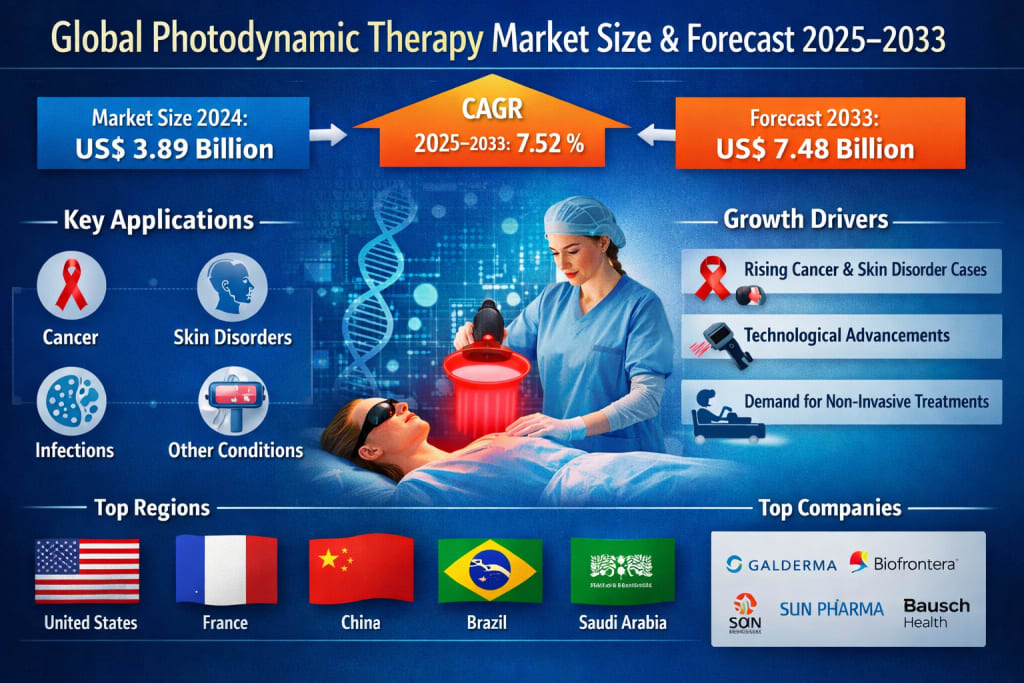
Global Photodynamic Therapy Market Size & Summary
The global photodynamic therapy (PDT) market is experiencing remarkable growth as healthcare providers increasingly adopt advanced, minimally invasive treatments for cancer and dermatological disorders. According to Renub Research analysis, the market is projected to expand from US$3.89 billion in 2024 to approximately US$7.48 billion by 2033, reflecting a compound annual growth rate (CAGR) of 7.52% between 2025 and 2033.
This growth is largely driven by the increasing prevalence of cancer and chronic skin conditions, combined with technological advancements in light-based medical devices and improved photosensitizing drugs. Photodynamic therapy is gaining attention because it offers a targeted treatment approach that selectively destroys abnormal cells while minimizing damage to surrounding healthy tissue.
As healthcare systems around the world move toward patient-friendly and precision-based treatment solutions, photodynamic therapy is emerging as a key therapeutic option in oncology, dermatology, and infection control. Continuous innovation in LED devices, lasers, and next-generation photosensitizers is further strengthening its global adoption.
Understanding Photodynamic Therapy
Photodynamic therapy is a medical treatment that uses a combination of light-sensitive compounds (photosensitizers) and specific wavelengths of light to produce reactive oxygen species that destroy targeted cells.
The procedure involves three key steps:
Administration of a photosensitizer drug.
Accumulation of the drug in abnormal or diseased cells.
Activation of the drug using a specialized light source.
Once activated, the photosensitizer produces oxygen radicals that selectively destroy abnormal cells. The therapy has proven highly effective for treating a variety of conditions including:
Early-stage cancers
Skin diseases
Pre-cancerous lesions
Certain bacterial infections
One of the major advantages of PDT is its precision and minimal invasiveness. Unlike conventional treatments such as chemotherapy or extensive surgery, PDT targets diseased tissue with limited systemic side effects and shorter recovery periods.
In oncology, photodynamic therapy is particularly effective in localized cancers, including esophageal, lung, and bladder cancers. Dermatology applications include treatment of actinic keratosis, psoriasis, acne, and other skin abnormalities.
Key Growth Drivers of the Photodynamic Therapy Market
Rising Prevalence of Cancer and Skin Disorders
The increasing global burden of cancer is one of the most significant drivers of photodynamic therapy adoption. With healthcare systems seeking safer and more targeted treatment approaches, PDT has become an attractive option for early-stage cancers.
According to global health projections, more than 35 million new cancer cases are expected by 2050, representing a 77% increase from approximately 20 million cases reported in 2022. Aging populations, lifestyle changes, and environmental factors are contributing to this dramatic rise.
Skin disorders are also becoming increasingly common worldwide. Conditions such as actinic keratosis, psoriasis, and acne affect millions of individuals and often require long-term treatment solutions.
Photodynamic therapy provides a highly effective option for managing these conditions because it:
Targets abnormal cells with precision
Preserves surrounding healthy tissue
Reduces treatment complications
Offers better cosmetic outcomes
Growing awareness among patients and healthcare providers about these benefits is fueling demand across hospitals and dermatology clinics.
Technological Advancements in Light-Based Therapies
Rapid technological innovation in light-based medical systems is significantly expanding the scope of photodynamic therapy.
Modern PDT devices now include advanced LED systems, lasers, and fiber-optic delivery mechanisms that allow deeper tissue penetration and improved treatment precision. These developments have made PDT more effective and accessible across a wider range of medical applications.
In addition, next-generation photosensitizers are being developed with improved:
Biocompatibility
Selectivity
Treatment efficiency
Reduced side effects
Such innovations are enabling healthcare providers to treat conditions that were previously difficult to manage with PDT.
A notable industry development occurred in June 2024, when Biofrontera Inc. introduced RhodoLED XL, an FDA-approved red-light LED lamp designed to enhance PDT treatment for dermatological conditions. The device features a modern design and user-friendly interface, making it easier for clinics to adopt the technology.
Research into combination therapies involving PDT and other treatments is also expanding its therapeutic potential.
Growing Demand for Non-Invasive Treatments
Modern healthcare increasingly prioritizes treatments that improve patient comfort while reducing risks and recovery times. As a result, minimally invasive procedures have become highly desirable for both patients and healthcare providers.
Photodynamic therapy aligns perfectly with this trend because it offers several advantages compared with traditional treatments:
Minimal damage to healthy tissues
Shorter hospital stays
Lower surgical risks
Faster patient recovery
For aging populations particularly vulnerable to cancer and chronic skin diseases, these benefits are especially valuable.
The global healthcare sector is also focusing more strongly on quality of life outcomes, further supporting the shift toward therapies like PDT.
Clinical research continues to validate these advantages. In November 2024, results from the Phase 3 ALA-BCC-CT013 study demonstrated significant positive outcomes for patients with superficial basal cell carcinoma treated with Ameluz photodynamic therapy combined with the BF-RhodoLED lamp.
Such clinical evidence is reinforcing the credibility of PDT as a reliable treatment option.
Challenges Facing the Photodynamic Therapy Market
High Treatment Costs and Limited Reimbursement
Despite its advantages, photodynamic therapy faces several financial barriers that can limit widespread adoption.
The therapy often requires:
Specialized medical devices
Photosensitizer drugs
Highly trained healthcare professionals
These factors can increase the overall treatment cost. In many healthcare systems, reimbursement policies for PDT remain inconsistent or limited, making it less accessible for patients.
In developing regions, the lack of comprehensive insurance coverage can further restrict market growth. Addressing these financial barriers through improved reimbursement policies and cost-effective device development will be critical for expanding PDT accessibility.
Limited Awareness Among Healthcare Professionals
Another major challenge for the PDT market is the lack of awareness and training among healthcare providers.
Although PDT has demonstrated strong clinical effectiveness, many physicians remain unfamiliar with:
Its mechanisms of action
Appropriate treatment indications
Advantages compared to conventional therapies
In addition, the number of training programs focused on photodynamic therapy remains limited. Without proper training, medical professionals may hesitate to adopt PDT technologies.
Expanding education initiatives, workshops, and medical training programs could significantly accelerate the adoption of photodynamic therapy worldwide.
Photodynamic Therapy Devices Market
Photodynamic therapy devices play a crucial role in activating photosensitizers during treatment. These devices include laser systems, LED lamps, and fiber-optic light delivery systems.
The device segment of the PDT market is experiencing steady growth due to increasing demand for minimally invasive treatments across several medical fields, including:
Oncology
Dermatology
Ophthalmology
These devices enable physicians to deliver highly controlled light doses to targeted areas, improving treatment precision and outcomes.
However, high equipment costs and limited technical expertise remain challenges for healthcare facilities considering adoption. Continued technological innovation and improved affordability are expected to drive future market expansion.
Cancer Photodynamic Therapy Devices Market
The use of photodynamic therapy devices in cancer treatment is gaining momentum worldwide.
PDT devices activate photosensitizers to selectively destroy cancer cells while minimizing damage to surrounding healthy tissues. This targeted approach is particularly beneficial for localized and early-stage cancers, including:
Lung cancer
Esophageal cancer
Bladder cancer
Technological improvements in device precision and treatment efficiency are supporting the growth of this segment. However, reimbursement limitations and equipment costs continue to present challenges.
Hospital Adoption of Photodynamic Therapy Devices
Hospitals represent one of the largest end-users of photodynamic therapy technology.
Healthcare institutions increasingly integrate PDT into treatment programs for cancer and dermatological conditions because the therapy offers several clinical and operational advantages:
Reduced patient recovery times
Lower hospitalization costs
Outpatient treatment possibilities
Improved treatment outcomes
However, the high cost of specialized equipment and the need for trained professionals can slow adoption in certain healthcare facilities.
Regional Market Insights
United States
The United States represents one of the most advanced markets for photodynamic therapy devices. The country benefits from strong healthcare infrastructure, active research initiatives, and the presence of leading industry players.
A notable clinical development occurred in early 2024, when researchers at UPMC Hillman Cancer Center initiated a clinical trial evaluating intraoperative photodynamic therapy for glioblastoma using the drug Pentalafen® and the Heliance® laser system developed by Hemerion Therapeutics.
France
France's PDT market is expanding steadily due to rising adoption of minimally invasive treatments in oncology and dermatology. Government support for advanced healthcare technologies and a well-established medical system contribute to market growth.
China
China is emerging as a significant market due to its large patient population and rapidly expanding healthcare infrastructure.
In May 2024, Photocure ASA announced that its partner Asieris Pharmaceuticals received acceptance from China’s National Medical Products Administration for a new drug application for Cevira®, a photodynamic therapy system designed for the treatment of high-grade squamous intraepithelial lesions.
Brazil
Brazil's market is growing due to increasing awareness of minimally invasive treatments and improvements in healthcare infrastructure. Rising rates of skin disorders and cancer are also contributing to demand.
Saudi Arabia
Saudi Arabia is witnessing increasing adoption of advanced medical technologies as part of its healthcare modernization initiatives. Government investment in healthcare infrastructure is expected to support the expansion of photodynamic therapy devices in the country.
Photodynamic Therapy Market Segmentation
Product Type
Photodynamic Therapy Devices
Photosensitizer Drugs
Application
Cancer
Actinic Keratosis
Psoriasis
Acne
Others
End Users
Hospitals
Cosmetics & Dermatology Clinics
Cancer Treatment Centers
Others
Key Players in the Photodynamic Therapy Market
Several companies are actively shaping the development of the global photodynamic therapy market through research, innovation, and product development.
Major industry participants include:
Galderma S.A.
Sun Pharmaceutical Industries Ltd.
Biofrontera Inc.
Lumibird S.A.
Bausch Health Companies Inc.
Soligenix Inc.
Modulight Corporation
Theralase Technologies Inc.
These companies focus on developing advanced photosensitizers, innovative light delivery systems, and new clinical applications for photodynamic therapy.
Final Thoughts
The global photodynamic therapy market is poised for strong growth over the next decade as healthcare systems increasingly prioritize precision medicine and minimally invasive treatments.
With its ability to selectively target diseased cells, reduce side effects, and improve patient outcomes, photodynamic therapy is emerging as a powerful alternative to traditional treatment approaches.
Although challenges such as high treatment costs and limited awareness remain, ongoing technological advancements and increasing clinical research are expected to drive broader adoption worldwide.
As innovation continues and healthcare infrastructure improves across emerging markets, photodynamic therapy could play a transformative role in the future of cancer treatment and dermatological care.
About the Creator
Female Infertility Market: Advancements, Trends, and Future Growth Opportunities
Female Infertility Market The female infertility market has experienced steady growth in recent years as infertility becomes a growing health concern across many regions of the world. Infertility affects millions of women globally and is defined as the inability to conceive after a year of regular unprotected intercourse. A combination of biological, lifestyle, and environmental factors contributes to this condition, creating a strong demand for advanced diagnostic methods and effective treatment solutions.
By James Smith3 days ago in Trader
The First Rainbow Baby
Pitter-patter, pitter-patter. The rain fell in rhythmic splatters, slowly slowing, but still constant. Mira rolled onto her side pulling the blanket tight against her ears, but still she could hear chitter-chatter and scurrying feet of the creatures that refused to sleep in the lower decks.
By A. J. Schoenfeld3 days ago in Fiction




Comments
There are no comments for this story
Be the first to respond and start the conversation.