
Global Convenience Store Market Size & Forecast 2025–2033: The Rise of Instant Retail in a Fast-Moving World
How urban lifestyles, ready-to-eat foods, and digital payments are reshaping the future of convenience retail worldwide

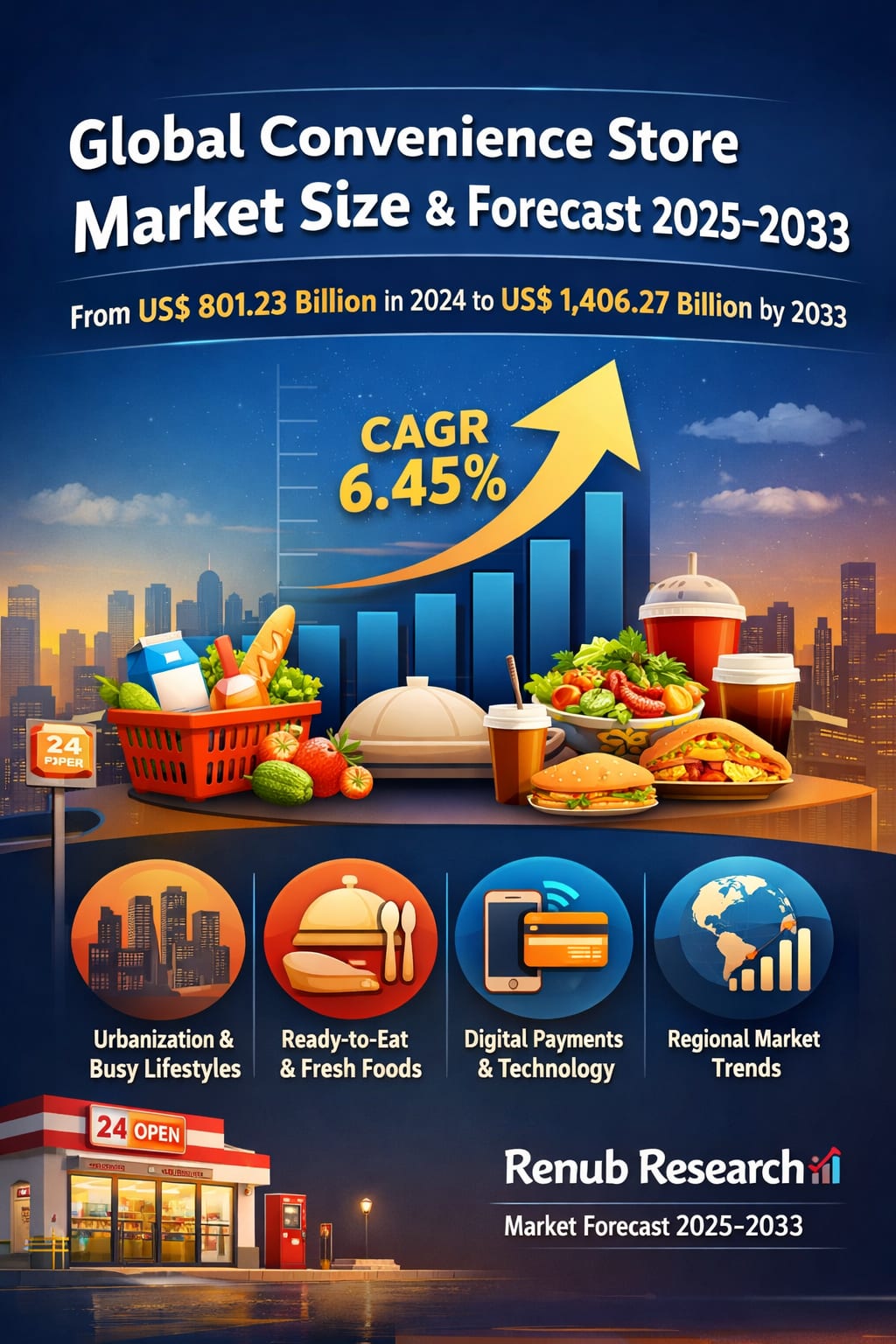
Global Convenience Store Market Outlook
The global convenience store market is entering a powerful phase of expansion as modern lifestyles continue to prioritize speed, accessibility, and flexibility in daily shopping. According to Renub Research, the convenience store market is expected to grow from US$ 801.23 billion in 2024 to US$ 1,406.27 billion by 2033, registering a compound annual growth rate (CAGR) of 6.45% from 2025 to 2033.
This rapid growth reflects a fundamental shift in consumer behavior. Shoppers today value quick access to essential items, ready-to-eat meals, beverages, and household products without the time investment required by large supermarkets. Convenience stores, often located near residential areas, transport hubs, and busy streets, are becoming the preferred choice for urban consumers managing hectic schedules.
Traditionally viewed as small neighborhood shops, convenience stores are now transforming into mini lifestyle hubs—offering fresh food, digital payment systems, and even delivery services. This evolution positions them as one of the most dynamic segments within the global retail ecosystem.
What Is a Convenience Store?
A convenience store is a small-format retail outlet designed for quick and easy shopping. These stores typically sell groceries, snacks, beverages, personal care items, and household essentials, often operating extended hours or 24/7.
Their compact size enables faster shopping experiences, while their strategic locations eliminate the need for long commutes. Many modern convenience stores now include fresh food counters, ready meals, coffee stations, and locally sourced products, strengthening their role as everyday shopping destinations.
As consumer lifestyles grow increasingly time-constrained, convenience stores have become essential in bridging the gap between supermarkets, restaurants, and online grocery platforms.
Key Growth Drivers in the Convenience Store Market
1. Rising Urbanization and Busy Consumer Lifestyles
Urbanization remains one of the strongest drivers of convenience store growth. According to the United Nations, 56.2% of the global population currently lives in urban areas, a figure expected to rise to 68% by 2050. This urban shift fuels demand for nearby, fast-access retail options.
Longer working hours, dual-income households, and time-poor consumers are pushing demand for stores that eliminate waiting time. Convenience stores, with their speed, accessibility, and extended operating hours, perfectly align with this need, making them indispensable to modern urban infrastructure.
2. Expansion of Ready-to-Eat and Fresh Food Offerings
One of the most transformative trends in the convenience store market is the rapid growth of ready-to-eat (RTE), ready-to-cook, and fresh food categories. Working professionals, students, and young consumers increasingly rely on these outlets for instant meals, snacks, and beverages.
Convenience retailers are responding by expanding their menus to include:
Fresh sandwiches and salads
Meal kits
Protein snacks
Premium beverages
Health-conscious food options
This shift positions convenience stores as competitors to quick-service restaurants.
In June 2025, Red Planet launched ready-to-eat foods with a 25-year shelf life, using freeze-drying technology to preserve taste and nutrition—highlighting innovation within the sector.
3. Technology Integration and Digital Payments
Technology is redefining how convenience stores operate. Digital payment systems, self-checkout kiosks, mobile apps, loyalty programs, and data-driven inventory management are now standard features across leading chains.
Post-pandemic, many stores added mobile ordering, curbside pickup, and home delivery, significantly improving customer convenience. Data analytics helps retailers personalize promotions, optimize pricing, and manage stock efficiently.
In August 2024, India’s NPCI announced UPI Circle and BBPS for Business, enabling faster and more secure B2B and consumer transactions—boosting digital payment adoption in convenience retail.
Challenges Facing the Convenience Store Market
Intense Competition from Modern Retail Formats
Convenience stores face heavy competition from supermarkets, hypermarkets, discount chains, and online grocery platforms, which offer lower prices and wider product selections.
To survive, convenience stores must differentiate through:
Location advantage
Speed and service
Curated product ranges
Local and fresh offerings
Without innovation, traditional convenience models risk losing relevance in highly competitive retail environments.
Rising Operational Costs and Supply Chain Disruptions
High rent, energy costs, and labor expenses—especially in urban areas—continue to pressure margins. Supply chain disruptions and fluctuating raw material costs further strain small store operators, who lack the bargaining power of large retail chains.
Efficient logistics, strategic partnerships, and technology-driven inventory management are becoming essential for sustainable growth.
Market Segmentation Analysis
Raw Food Convenience Store Market
Growing health awareness is driving demand for fresh fruits, vegetables, dairy, and unprocessed foods in convenience stores. Urban consumers increasingly prefer nearby stores for daily fresh items. Investment in cold storage and frequent restocking is helping retailers overcome shelf-life limitations.
Ready-to-Eat Convenience Store Market
The RTE segment is the fastest-growing category, driven by on-the-go consumption and changing food habits. Affordable, tasty, and quick meals are a major revenue driver, especially among younger demographics.
Meat and Poultry Convenience Store Market
Demand for ready-to-cook, pre-marinated, and packaged meat products continues to grow. Despite challenges in refrigeration and supply consistency, protein-rich diets and snack foods ensure sustained demand.
Vegetable-Based Convenience Store Market
Rising adoption of vegetarian, vegan, and flexitarian diets is boosting vegetable-based offerings. Salads, juices, plant-based meals, and sustainable packaging are attracting health-conscious consumers worldwide.
Distribution Channel Insights
Supermarkets & Hypermarkets Adopting Convenience Models
Large retail chains are launching small-format express stores that combine convenience with price competitiveness. These hybrid models intensify competition but also expand the overall market size by introducing new shopping habits.
Regional Market Insights
United States Convenience Store Market
The U.S. hosts over 150,000 convenience stores, many integrated with fuel stations. Leading chains are expanding fresh food, digital services, and loyalty programs to remain competitive.
Japan’s Seven & i Holdings plans to open 500 new stores in the U.S. and Canada by 2027, highlighting strong market confidence.
Germany Convenience Store Market
Germany’s market is driven by single households and urban lifestyles. Fresh bakery items, organic foods, and ready meals dominate. In November 2024, REWE’s Lekkerland launched its first unmanned Smart BOX store, signaling automation trends in Europe.
India Convenience Store Market
India’s market is expanding rapidly due to urbanization and rising incomes. While traditional kirana stores dominate, modern chains are growing fast.
In July 2025, South Korea’s Emart24 announced its entry into India, marking a major milestone in organized convenience retail.
Brazil Convenience Store Market
Brazil’s convenience store growth is supported by fuel-station kiosks and urban demand. FEMSA’s Oxxo chain reached 600 stores in December 2024, with a focus on organic expansion over the next five years.
Saudi Arabia Convenience Store Market
Driven by Vision 2030, Saudi Arabia is witnessing rapid expansion in modern retail.
In November 2024, Othaim opened its first Othaim Express convenience stores in Riyadh, reflecting rising demand for quick shopping in urban centers.
Market Segments Covered
By Type
Raw Food
Canned Food
Frozen Food
Ready-to-Eat
Ready-to-Cook
Others
By Product
Meat/Poultry Products
Cereal-Based Products
Vegetable-Based Products
Others
By Distribution Channel
Supermarkets & Hypermarkets
Convenience Stores
Specialty Stores
Others
By Country
North America, Europe, Asia Pacific, Latin America, Middle East & Africa
Key Players Covered
Nestlé S.A
Campbell Soup Company
Del Monte Foods Inc.
Thai Union Group PCL
Bonduelle
Danish Crown AmbA
Ayam Sarl
The Bolton Group
CHB Group
Each company is analyzed across overview, key persons, recent developments, SWOT, and revenue insights.
Final Thoughts
The global convenience store market is no longer just about proximity—it is about experience, speed, and smart retailing. With the market projected to surpass US$ 1.4 trillion by 2033, convenience stores are emerging as critical pillars of modern urban life.
By embracing technology, expanding fresh and ready-to-eat offerings, and adapting to local consumer preferences, convenience retailers are transforming from simple corner shops into highly efficient, lifestyle-driven retail ecosystems.
As urbanization accelerates and consumer expectations evolve, convenience stores are set to remain one of the most resilient and innovative segments of global retail in the decade ahead.
About the Creator
Sakshi Sharma
Content Writer with 7+ years of experience crafting SEO-driven blogs, web copy & research reports. Skilled in creating engaging, audience-focused content across diverse industries.
Keep reading
More stories from Sakshi Sharma and writers in Trader and other communities.
Global Combine Harvesters Market Size & Forecast 2025–2033
Introduction The global agriculture sector is undergoing a powerful transformation, driven by mechanization, technology adoption, and the urgent need to increase food production. At the center of this transformation stands the combine harvester—a machine that has revolutionized how crops are harvested worldwide.
By Sakshi Sharmaa day ago in Trader
Stanislav Kondrashov on the Quiet Power Shift: How Tesla, Meta, and Microsoft Are Shaping Global Markets
The focus of economic commentary often falls on interest rates, central bank policy, or the strength of national currencies. But beneath these surface-level fluctuations, a deeper shift is taking place—one led not by policymakers, but by technology companies. According to Stanislav Kondrashov, founder of TELF AG, firms like Tesla, Meta, and Microsoft are increasingly becoming the defining forces behind market behaviour.
By Stanislav Kondrashov3 days ago in Trader
alex honnold net worth: How Fearless Climbing Turned Passion into Lasting Wealth
alex honnold net worth is the result of a rare mindset and years of brave choices. Alex Honnold became famous for climbing huge rock walls without ropes. This risky path was not about money at first. It was about focus, control, and love for climbing. Over time, his bold actions brought global attention. That attention helped turn passion into income. Today, alex honnold net worth reflects both courage and smart decisions.
By John.doe7986 days ago in Trader




Comments
There are no comments for this story
Be the first to respond and start the conversation.