
Global Cardiac Holter Monitor Market Size and Forecast 2025
Rising Heart Disease Burden, Wearable Tech, and Preventive Healthcare Trends Power Market Growth Through 2033

Introduction
The global healthcare industry is undergoing a significant transformation, driven by technological innovation, rising chronic disease prevalence, and a growing focus on preventive care. Among the many diagnostic tools benefiting from this shift, cardiac Holter monitors have emerged as a critical solution for continuous heart rhythm monitoring. These devices, once bulky and limited to hospital settings, are now evolving into compact, patient-friendly, and digitally connected systems that support early diagnosis and long-term cardiac care.
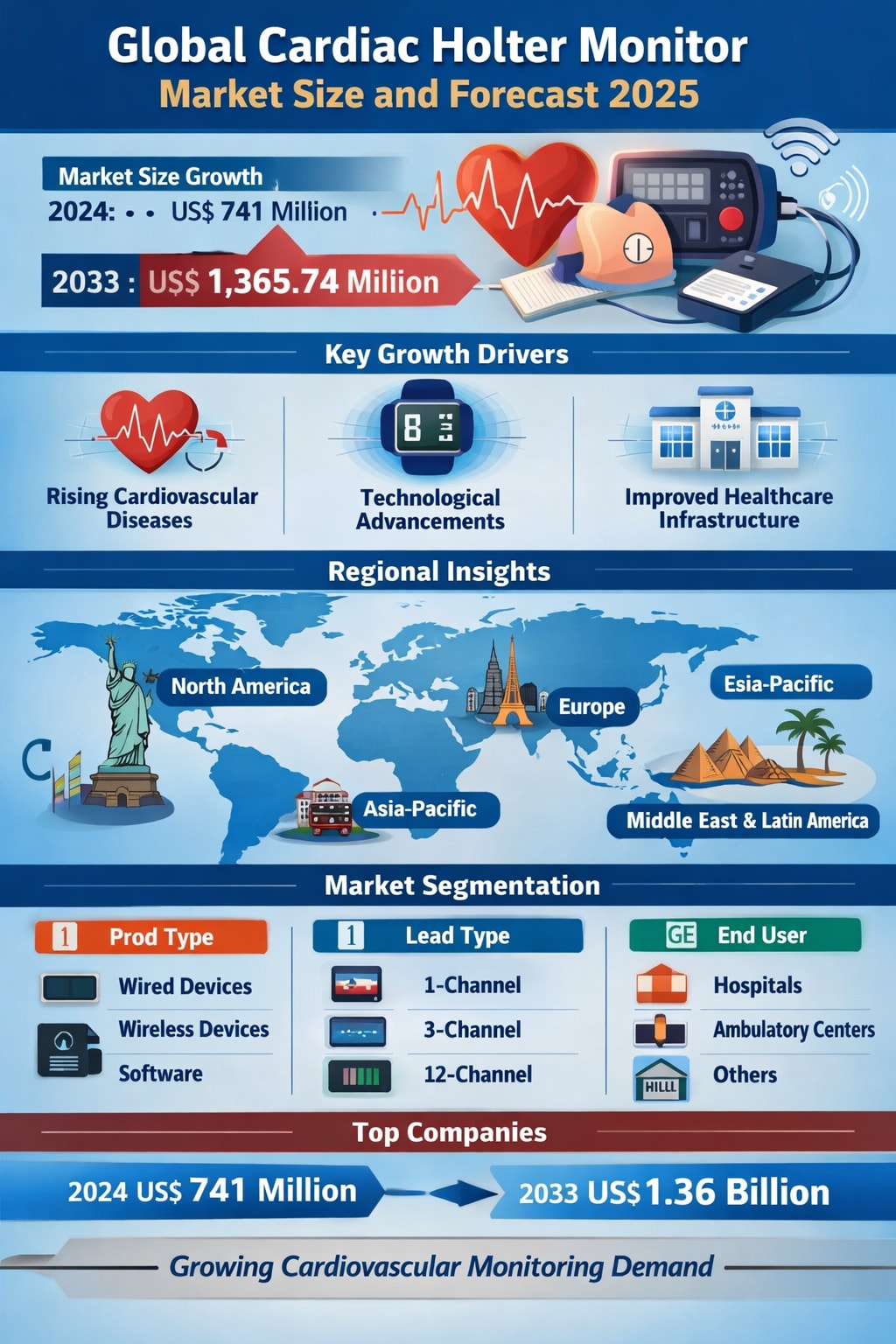
According to Renub Research, the Global Cardiac Holter Monitor Market is expected to grow from US$ 741.00 million in 2024 to US$ 1,365.74 million by 2033, registering a CAGR of 7.03% from 2025 to 2033. This steady expansion reflects the rising global burden of cardiovascular diseases, increasing adoption of wearable medical technologies, and expanding healthcare infrastructure across both developed and emerging economies.
Cardiac Holter monitors play a crucial role in detecting irregular heart rhythms such as arrhythmia, tachycardia, and atrial fibrillation—conditions that often go unnoticed during short, in-clinic ECG tests. By offering continuous monitoring over 24 to 48 hours or longer, these devices provide physicians with a clearer and more accurate picture of a patient’s cardiac health, enabling better treatment decisions and improved outcomes.
Understanding Cardiac Holter Monitors
A cardiac Holter monitor is a portable, battery-operated electrocardiography (ECG) device designed to record heart activity continuously over an extended period, typically 24 to 48 hours, and sometimes even longer. The device consists of electrodes attached to the patient’s chest, connected to a recording unit that stores heart rhythm data. This data is later analyzed using specialized software to detect abnormalities in heart function.
Unlike standard ECG tests, which capture only a few seconds of heart activity, Holter monitors are especially useful for identifying intermittent or irregular cardiac events that may not occur during a brief clinical examination. This makes them indispensable in diagnosing conditions such as arrhythmias, unexplained fainting episodes, palpitations, and other cardiac irregularities.
With advancements in technology, modern Holter monitors are becoming smaller, lighter, and more comfortable to wear. Some newer models, such as patch-based devices, eliminate the need for wires altogether, improving patient compliance and enabling more natural daily activity during monitoring.
Market Growth Drivers
Rising Incidence of Cardiovascular Diseases
One of the strongest forces driving the cardiac Holter monitor market is the growing prevalence of cardiovascular diseases (CVDs) worldwide. Heart-related conditions remain the leading cause of death globally, fueled by factors such as sedentary lifestyles, unhealthy diets, stress, smoking, and aging populations.
As the number of patients suffering from arrhythmias, coronary artery disease, and heart failure continues to rise, the demand for reliable and continuous cardiac monitoring solutions is increasing. Holter monitors offer a non-invasive and highly effective way to track heart activity over time, making them an essential tool for early diagnosis and long-term disease management.
The growing awareness among both patients and healthcare providers about the importance of early detection is further strengthening the adoption of these devices. Early diagnosis not only improves treatment outcomes but also helps reduce long-term healthcare costs associated with advanced cardiac complications.
Technological Advancements in Medical Devices
Technology is reshaping the cardiac Holter monitor market at a rapid pace. Traditional wired devices are gradually being complemented—and in some cases replaced—by wireless and wearable solutions that offer greater comfort and flexibility.
Modern Holter monitors now feature:
Wireless connectivity for real-time data transmission
Smaller and lighter designs for improved patient comfort
Longer battery life for extended monitoring periods
Advanced software and analytics for faster and more accurate diagnosis
These innovations are not only improving the quality of cardiac monitoring but also expanding the use of Holter devices beyond hospitals into home healthcare and remote patient monitoring environments. This shift aligns perfectly with the global trend toward digital health and telemedicine, further accelerating market growth.
Improvement in Healthcare Infrastructure
Healthcare infrastructure is improving across many parts of the world, particularly in emerging economies. Governments and private healthcare providers are investing heavily in modern diagnostic equipment, better hospital facilities, and expanded access to medical services.
As more hospitals, clinics, and diagnostic centers adopt advanced cardiac care technologies, the demand for Holter monitors continues to rise. The non-invasive nature and clinical reliability of these devices make them a preferred choice for routine cardiac evaluations as well as long-term patient monitoring.
In addition, growing health insurance coverage and supportive reimbursement policies in several countries are making advanced diagnostic tools more accessible to patients, further supporting market expansion.
Challenges Facing the Market
High Cost of Devices and Monitoring
Despite strong growth prospects, the cardiac Holter monitor market faces challenges related to cost. The initial investment required to purchase and maintain these devices can be significant, especially for smaller healthcare facilities and providers in low-income regions.
In addition to device costs, there are expenses associated with data analysis, software systems, and trained personnel needed to interpret the results. These factors can limit widespread adoption, particularly in resource-constrained healthcare systems.
Regulatory Hurdles
The medical device industry is highly regulated, and cardiac Holter monitors are no exception. Manufacturers must comply with strict regulatory standards related to safety, performance, and clinical effectiveness. These regulations vary from region to region, often resulting in lengthy approval processes and increased development costs.
While these regulations are essential to ensure patient safety, they can slow down product launches and limit the speed at which new innovations reach the market. For smaller companies and startups, regulatory compliance can be a significant barrier to entry.
Regional Market Overview
North America
North America holds a leading position in the global cardiac Holter monitor market, driven by advanced healthcare infrastructure, high awareness of cardiovascular health, and rapid adoption of new medical technologies. The region benefits from strong investment in digital health and a well-established reimbursement framework that supports the use of advanced diagnostic devices.
Europe
Europe represents another major market, supported by an aging population and a strong focus on preventive healthcare. Countries such as Germany, the United Kingdom, France, and Italy are seeing increasing adoption of Holter monitors in both hospital and outpatient settings.
Asia-Pacific
The Asia-Pacific region is expected to witness the fastest growth over the forecast period. Rising healthcare spending, increasing prevalence of heart diseases, and improving access to medical services are driving demand in countries like China, India, and Japan.
Latin America and Middle East & Africa
These regions are emerging markets with growing healthcare infrastructure and increasing awareness of cardiovascular health. While adoption is currently lower compared to North America and Europe, long-term growth potential remains strong.
Country-Level Insights
United States
The United States is a major contributor to the global cardiac Holter monitor market. The high prevalence of cardiovascular diseases, combined with strong technological adoption, is fueling demand for continuous cardiac monitoring solutions. Innovations in wearable and wireless Holter monitors are improving patient compliance and expanding use in both clinical and home care settings.
In March 2024, Wellysis and Artella Solutions jointly introduced Wellysis’s remote cardiac monitoring service in the U.S., highlighting the country’s continued leadership in digital cardiac care.
Germany
Germany’s strong healthcare system, aging population, and emphasis on early diagnosis make it a key European market. The country’s well-established reimbursement policies and commitment to medical innovation are supporting steady adoption of advanced cardiac monitoring technologies, including Holter devices.
India
India is witnessing rapid growth in the cardiac Holter monitor market due to rising cardiovascular disease prevalence and improving healthcare access. Government initiatives to strengthen healthcare infrastructure, combined with increasing awareness of preventive care, are driving demand. Affordability and technological innovation remain crucial factors shaping market growth in the country.
Saudi Arabia
In Saudi Arabia, changing lifestyles and an aging population are increasing the burden of cardiovascular diseases. The country’s strong investment in healthcare infrastructure and focus on advanced medical technologies are supporting the adoption of Holter monitors, particularly in well-equipped diagnostic centers and hospitals.
Market Segmentation
By Product Type
Wired Monitor Device
Wireless Monitor Device
Software
By Lead Type
1-Channel
2-Channel
3-Channel
12-Channel
Others
By End User
Hospitals
Ambulatory Surgical Centers
Others
By Region and Countries
North America: United States, Canada
Europe: France, Germany, Italy, Spain, United Kingdom, Belgium, Netherlands, Turkey
Asia-Pacific: China, Japan, India, South Korea, Thailand, Malaysia, Indonesia, Australia, New Zealand
Latin America: Brazil, Mexico, Argentina
Middle East & Africa: Saudi Arabia, UAE, South Africa
Competitive Landscape
The global cardiac Holter monitor market is moderately competitive, with several established players focusing on innovation, product expansion, and strategic partnerships. Key players are analyzed across four main viewpoints: company overview, product portfolio, recent developments and strategies, and sales analysis.
Key Players Include:
General Electric Company (GE)
Nihon Kohden Corporation
Hill-Rom Holdings, Inc.
OSI Systems, Inc.
Boston Scientific Corporation
Koninklijke Philips N.V.
Medtronic plc
iRhythm Technologies Inc.
These companies are investing heavily in R&D to develop more compact, accurate, and user-friendly monitoring solutions, strengthening their positions in the global market.
Future Outlook
Looking ahead, the cardiac Holter monitor market is set for sustained growth through 2033. The convergence of rising cardiovascular disease prevalence, rapid technological innovation, and expanding healthcare access will continue to drive demand for continuous cardiac monitoring solutions.
The shift toward wearable and remote monitoring devices is expected to redefine how cardiac care is delivered, moving it beyond traditional hospital settings and into patients’ daily lives. As digital health ecosystems mature, Holter monitors will play an increasingly central role in preventive care, early diagnosis, and long-term disease management.
Final Thoughts
The Global Cardiac Holter Monitor Market stands at a promising crossroads of medical necessity and technological innovation. With the market projected to grow from US$ 741.00 million in 2024 to US$ 1,365.74 million by 2033 at a CAGR of 7.03%, the future looks strong for this essential diagnostic segment.
As healthcare systems worldwide place greater emphasis on early detection, continuous monitoring, and patient-centric care, cardiac Holter monitors will remain a cornerstone of modern cardiology. For manufacturers, healthcare providers, and investors alike, this market represents not just growth—but a meaningful opportunity to improve heart health outcomes on a global scale.
About the Creator
Sakshi Sharma
Content Writer with 7+ years of experience crafting SEO-driven blogs, web copy & research reports. Skilled in creating engaging, audience-focused content across diverse industries.
Keep reading
More stories from Sakshi Sharma and writers in Trader and other communities.
Asia Pacific Data Centre Market Size and Forecast 2025
Introduction: The Digital Backbone of Asia-Pacific’s Future The Asia-Pacific data center market is entering a golden era of expansion as the region accelerates its digital transformation journey. Valued at US$ 26.95 billion in 2024, the market is projected to grow at a robust CAGR of 12.70% from 2025 to 2033, reaching an impressive US$ 79.05 billion by 2033. This growth reflects not just rising data consumption, but a fundamental shift in how businesses, governments, and consumers across the region operate in an increasingly digital-first world.
By Sakshi Sharmaabout 16 hours ago in Trader
US Stock Market Update: Dow, S&P 500, and Nasdaq Futures Continue Uptrend
The US stock market today showed renewed strength as major indices extended their upward momentum. Futures for the Dow Jones Industrial Average, S&P 500, and Nasdaq indicate continued optimism among investors. Following a series of positive economic data releases and corporate earnings reports, traders are increasingly confident that the market rally may sustain in the near term.
By Hammad Nawaza day ago in Trader
Feelings Never Die
It is Valentine's Day again, and it bought back memories that were over fifty years old. It bought me back to 1971, and I woke up and I knew my baby was due today. I was big and pregnant, and I felt like I was about to burst wide open. Imagine my surprise when the doctor told my I had a due date of February 14. I couldn't believe it, and since my baby was due today, I felt I could indulge myself a bit. I had gained a lot of weight, and chocolate was on the no-no list, but I had came to the end of this pregnancy, and I hoped it would be okay, after all I would deliver this baby today. So I walked across the street to the grocery story, and bought myself, a peppermint patty, covered in chocolate, my favorite. Me and my Valentine's baby would enjoy it together.
By Susan Payton6 days ago in Fiction



Comments
There are no comments for this story
Be the first to respond and start the conversation.