
Fundamental vs Technical Analysis in Forex
Which One is Better?


Forex trading is a world of fast decisions, deep research, and sharp instincts. But to consistently succeed, every trader needs one powerful advantage: analysis.
There are two primary methods traders use to make decisions: Fundamental Analysis and Technical Analysis. Each has its strengths, weaknesses, and dedicated followers — but which one is truly better for Forex in 2025?
Let’s break down both approaches so you can understand how they work, what they offer, and how to decide which one fits your trading style.
🔍 What Is Fundamental Analysis?
Fundamental analysis looks at the big picture. It focuses on economic, political, and financial factors that influence a country’s currency value.
In short: if a country’s economy is strong, its currency usually gains strength. If the economy is weak or unstable, the currency may drop.
🏦 Key Factors in Fundamental Analysis:
1. Interest Rates – Higher rates attract investors → stronger currency
2. Inflation – Moderate inflation is good, but high inflation weakens a currency
3. GDP Growth – A growing economy supports a stronger currency
4. Unemployment Rates – Lower unemployment = economic strength
5. Geopolitical Events – Elections, wars, or policy changes can shake currency values
6. Central Bank Policies – Decisions by the Fed, ECB, BOJ, etc., directly affect Forex markets
🧠 Example:
If the U.S. Federal Reserve raises interest rates, it often strengthens the USD. You might expect USD/JPY or EUR/USD to move in response.
---
✅ Pros of Fundamental Analysis:
Provides long-term direction
Helps you understand why the market moves
Works well for position traders or swing traders
❌ Cons:
Can be complex and requires daily news tracking
Market may react irrationally or delayed
Not always useful for short-term trades
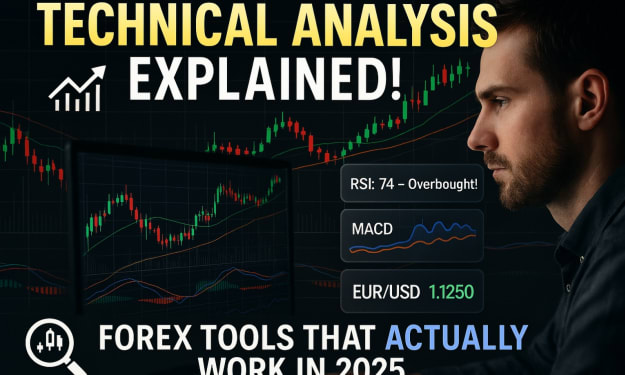
📊 What Is Technical Analysis?
Technical analysis focuses on price charts, patterns, and indicators. The idea is simple: history tends to repeat itself.
Technical analysts believe that all fundamental information is already priced into the market, so they rely solely on chart behavior to predict future moves.
🔧 Key Tools in Technical Analysis:
1. Candlestick Patterns – e.g. Doji, Engulfing, Hammer
2. Support & Resistance Levels
3. Indicators – RSI, MACD, Moving Averages, Bollinger Bands
4. Trend Lines & Chart Patterns – Head and Shoulders, Flags, Triangles
5. Volume & Volatility Tools
🧠 Example:
If EUR/USD forms a double bottom on a 1-hour chart with RSI below 30 (oversold), a trader might enter a long position expecting a bounce.
---
✅ Pros of Technical Analysis:
Ideal for short-term trading (scalping, day trading)
Fast, visual, and easy to automate
Works well even without deep economic knowledge
❌ Cons:
Can give false signals in low-volume or news-heavy markets
Doesn’t explain why price is moving — only shows that it is
Requires chart reading skill and practice
⚔️ Technical vs Fundamental: Which One Wins in 2025?
There’s no one-size-fits-all answer. It depends on your trading style, goals, and personality.
Here’s a quick comparison:
Factor Fundamental Analysis Technical Analysis
Focus Economic & political events Price charts & patterns
Best for Long-term traders Short-term traders
Complexity Higher – needs research Lower – more visual
Speed Slower reaction Fast signals
Strength Explains "why" the market moves Helps with timing and entry points
Weakness Can lag in fast-moving markets Can give false signals
🔄 Why the Best Traders Combine Both
The most successful traders in 2025 blend both methods.
They:
Use fundamentals to identify the big picture or bias (bullish/bearish)
Use technical analysis to fine-tune their entry and exit points
📌 Example:
If GBP/USD is in a strong uptrend due to positive UK interest rate news (fundamentals), a trader might wait for a pullback to support and enter on a bullish candlestick pattern (technicals).
---
✅ Final Verdict: Which Is Better?
If you enjoy following news, reading reports, and understanding global economics → Start with Fundamental Analysis
If you’re more visual, like charts, and prefer fast trades → Start with Technical Analysis
But for maximum power, combine both.
In Forex trading, knowledge is profit. The deeper your understanding, the more confident and accurate your decisions will become.
Like Comments and Subscribe For more .....
By: Junaid Ali
About the Creator
Junaid Ali (Official)
Start writing...forex Trader | Market Analyst | Risk Manager
5+ yrs of exp
Technical & Fundamental Analysis
Risk Management Strategies
Day & Swing Trading
Discipline. Patience. Consistency
💬 DM for collab
📊 “Trade with logic, not emotion
Keep reading
More stories from Junaid Ali (Official) and writers in Trader and other communities.
How to Use Technical Analysis in Forex Trading
In the fast-paced world of Forex trading, one of the most powerful tools in a trader’s toolbox is technical analysis. Unlike fundamental analysis, which focuses on news and economic data, technical analysis uses charts, indicators, and patterns to predict future price movements based on historical behavior.
By Junaid Ali (Official)8 months ago in Trader
Hang Seng Index Forecast: What Traders Need to Know Now
The hang seng index is a key measure of Hong Kong’s biggest companies. Every day, traders watch the hang seng index to see which sectors are strong and which may be weak. Movements in the hang seng index can show global trends, investor confidence, and economic shifts. By understanding the hang seng index, traders can make better decisions, whether they are buying, selling, or holding investments.
By hamza mirzaabout 3 hours ago in Trader
Review of 'Man on the Run'
My wife and I saw Man on the Run, a nearly 2-hour documentary on Amazon Prime, about Wings, Paul McCartney's group that flew around the world from shortly after The Beatles broke up in early 1970 to shortly after John Lennon was murdered at the end of 1980, making a Beatles reunion forever impossible.
By Paul Levinson3 days ago in Beat


Comments
There are no comments for this story
Be the first to respond and start the conversation.